Ultra pure water systems achieve a resistivity of 18.2 MΩ·cm to eliminate every trace of organic and inorganic interference from your source water.
Using ASTM Type I standards is the only way to ensure your analytical results are verifiable and legally defensible. Without this level of precision, you are essentially gambling with your research integrity.
One tiny oversight in your purification chain could be the invisible ghost haunting your failed experiments.
Understanding the 18.2 Megohm Standard
The term “pure” is subjective, but in the scientific community, it is defined by electrical resistance. Specifically, ultra pure water must reach a resistivity of 18.2 MΩ·cm at 25°C.
This means the water is so devoid of dissolved salts and minerals that it no longer conducts electricity effectively.
When you reach this threshold, you are working with a blank slate for your most sensitive liquid chromatography or mass spectrometry tasks.
To understand where your water stands, you must look at the official classifications provided by organizations like ASTM International. These standards separate water into tiers based on purity. Type I water is the gold standard for high-stakes applications.
Consequently, using anything less than Type I for critical tasks like cell culture or HPLC is a recipe for disaster.
| Parameter | Type I (Ultra Pure) | Type II (Pure) | Type III (RO Water) |
| Resistivity (MΩ·cm) | 18.2 | 1.0 | 0.05 |
| Total Organic Carbon (TOC) | < 50 ppb | < 50 ppb | < 200 ppb |
| Bacteria (CFU/ml) | < 10 | < 10 | < 1000 |
How Deionization and UV Oxidation Work
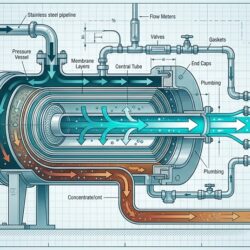
The heart of ultra pure water systems lies in the removal of every single contaminant. First, the system utilizes deionization to exchange mineral ions for hydrogen and hydroxyl ions.
This process effectively strips the water of its conductive potential. However, ion exchange alone cannot handle organic molecules.
Therefore, the system incorporates UV oxidation at a wavelength of 185nm.
This high-energy light breaks down organic compounds into carbon dioxide and ionic species. These are then polished off by a final ion exchange resin.
You must also consider the role of ultrafiltration if you are working with genomic data. This stage removes nucleases and endotoxins that could otherwise shred your DNA samples.
Critical Applications for Type I Water
Why do you need such extreme purity?
In medical diagnostics and pharmaceutical manufacturing, even a part-per-billion level of contamination can alter the results of an assay. Specifically, ultra pure water is essential for preparing mobile phases in High-Performance Liquid Chromatography (HPLC).
If your water contains trace organics, you will see “ghost peaks” on your chromatogram that make data interpretation impossible.In the world of molecular biology, the stakes are even higher.
Researchers rely on Type I water for Polymerase Chain Reaction (PCR) and gene sequencing. Any presence of nucleases in the water will degrade the very samples you are trying to study.
Furthermore, for those interested in the safety differences in medical environments, comparing distilled water vs sterile water is a vital step in facility management.
Maintenance and Monitoring for Reliability
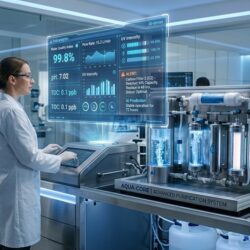
Owning laboratory water purification systems is not a “set it and forget it” task. You must monitor the Total Organic Carbon (TOC) levels and resistivity constantly.
Most modern systems include built-in sensors that provide real-time data. If the resistivity drops to 18.1 MΩ·cm, it is often a sign that your ion-exchange cartridges are exhausted.
Regularly replacing your UV lamps and filters is non-negotiable. Consequently, you should establish a strict maintenance schedule to avoid downtime.
For specialized medical standards, refer to the CDC guidelines to ensure your facility meets all safety protocols. Failure to maintain the system will lead to biofilm growth within the internal tubing.
But there is a hidden danger in how you actually use the water once it is dispensed.
Why You Cannot Store Ultra Pure Water
One of the biggest mistakes lab managers make is attempting to store Type I water in a plastic carboy. Specifically, ultra pure water is an aggressive solvent.
The moment it leaves the dispenser, it begins absorbing carbon dioxide from the air. This forms carbonic acid, which immediately lowers the resistivity and increases the conductivity.
Furthermore, the water will leach plasticizers and ions from the walls of any container you put it in. Therefore, you must use ultra pure water immediately after it is dispensed from the system.
If you need water for later use, you are better off using Type II water. Type I water is strictly a “point-of-use” resource.
Does your current lab setup account for this immediate degradation?