Total organic carbon water testing is the most precise method for detecting invisible organic contaminants in purified water systems used across pharmaceutical, biotech, and food-grade applications.
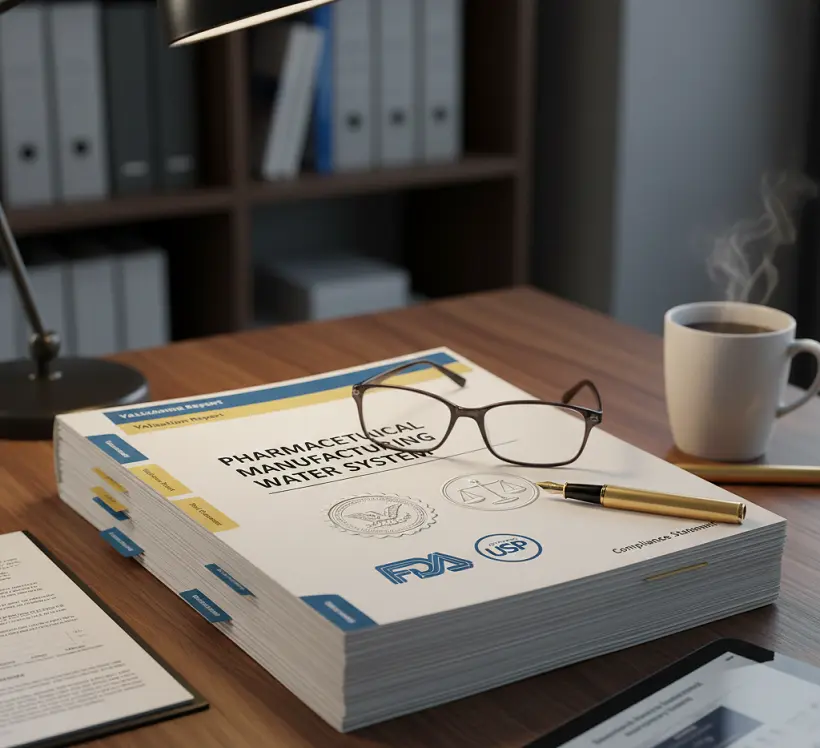
It is the definitive, scientifically validated standard trusted by regulatory bodies worldwide. Get it right, and you protect your process, your product, and your patients.
What Total Organic Carbon Actually Measures
TOC is not just a number on a report. It is a direct measurement of how much carbon-based contamination survives your purification process.
Specifically, TOC analysis works by oxidizing all organic compounds in a water sample and measuring the resulting carbon dioxide. The result tells you exactly how much organic matter is present, down to parts per billion.
Here is what TOC actually detects in your water:
According to USP <643>, the target TOC limit for Purified Water and Water for Injection is 500 parts per billion. Note that the actual enforceable limit is instrument-specific and is calculated against a USP-traceable sucrose standard. Exceed that threshold, and your water fails compendial requirements outright.
Consequently, TOC is not optional in regulated environments. It is the gatekeeper between compliant water and a failed batch. And that raises a critical question most labs never think to ask.
Where TOC Testing Is Legally Required
Not every industry requires TOC testing. But if you operate in any of the following sectors, it is mandated, not recommended.
The regulated industries that require TOC testing include:
- Pharmaceutical manufacturing under FDA 21 CFR Part 211 and USP standards.
- Biopharmaceutical production where water contacts active ingredients
- Medical device manufacturing using Water for Injection
- Food and beverage processing under FDA food safety modernization rules
- Semiconductor fabrication requiring ultrapure water grades
The FDA outlines its expectations for quality-critical water instrumentation in 21 CFR Part 11, and USP explicitly identifies TOC as a required quality attribute for Purified Water and Water for Injection systems. Therefore, if you are in any of these industries and skipping TOC testing, you are not just cutting corners. You are operating outside regulatory compliance.
Now that you know where it is required, here is how the actual testing process works.
How TOC Testing Works in Practice
There are two primary TOC measurement methods used in modern water quality labs.
1. Combustion TOC Analysis
This method injects the water sample into a high-temperature combustion tube (typically 680 to 950 degrees C), converting all organic carbon to CO2. A detector then measures the CO2 concentration. It is the most accurate method for complex matrices and high-organic-load samples.
2. UV Persulfate Oxidation
This is the most common method for pharmaceutical-grade water. It uses ultraviolet light combined with a chemical oxidant to break down organic compounds. It is faster, requires less maintenance, and is fully compliant with USP <643> requirements.
Both methods produce a TOC value in micrograms per liter (ug/L) or parts per billion (ppb). ASTM D5904 specifically covers the UV-persulfate oxidation method with membrane conductivity detection for water TOC analysis.
For a full comparison of how TOC stacks up against conductivity as a water quality parameter, read TOC vs. Conductivity: What Matters More?.
But knowing the method is only half the battle. The real risk lies in misinterpreting your TOC results.
How to Interpret Your TOC Results Correctly
A single TOC reading means very little on its own. What matters is the trend over time.
Here is a practical interpretation framework:
| TOC Level (ppb) | Interpretation | Action Required |
|---|---|---|
| Below 100 | Excellent purity | Continue routine monitoring |
| 100 to 300 | Acceptable, monitor closely | Increase sampling frequency |
| 300 to 500 | Approaching USP limit | Investigate contamination source |
| Above 500 | USP limit exceeded | Reject water, investigate system |
Health Canada’s guidance on Natural Organic Matter in Drinking Water notes that the World Health Organization recommends optimized organic matter removal to minimize biofilm growth in water distribution systems. Therefore, trending your TOC data over weeks and months reveals system degradation before it becomes a compliance failure.
Second, always compare TOC results against your established system baseline, not just the USP target limit. A sudden spike from 50 ppb to 300 ppb is a red flag even though it is still within specification.
The data does not lie. But only if you know how to read it.