
Imagine running your HPLC assay and getting a clean, flat baseline every single time. No ghost peaks. No failed cell cultures. No wasted weeks chasing a contamination source that turns out to be your water.
That is what working with the right water grade feels like.
But right now, you might be dealing with something very different:
- Ghost peaks ruining your chromatography data
- Cell cultures dying for no obvious reason
- Batch-to-batch inconsistency you cannot explain
- Expensive columns clogging ahead of schedule
The problem is not your samples. The problem is not your protocol. The problem is that nobody ever clearly explained where Type 2 water stops being good enough and Type 1 becomes non-negotiable.
This article fixes that. By the end, you will know exactly which water grade belongs in which application, what the numbers actually mean for your daily workflow, and how to stop losing data to a problem that is completely solvable.
2x Water Grades: What Do the ASTM and ISO Standards Actually Say?
The first thing to understand is that water purity is not a vague concept — it is a measurable, standardized thing.
In 2026, the scientific community relies on two primary frameworks: ASTM D1193 and ISO 3696. These are not loose guidelines. They are hard benchmarks that define exactly how many contaminants can exist per milliliter of water. The parameters that matter most are resistivity, total organic carbon (TOC), and bacterial count.
Think of them as the scoring rubric your water either passes or fails.
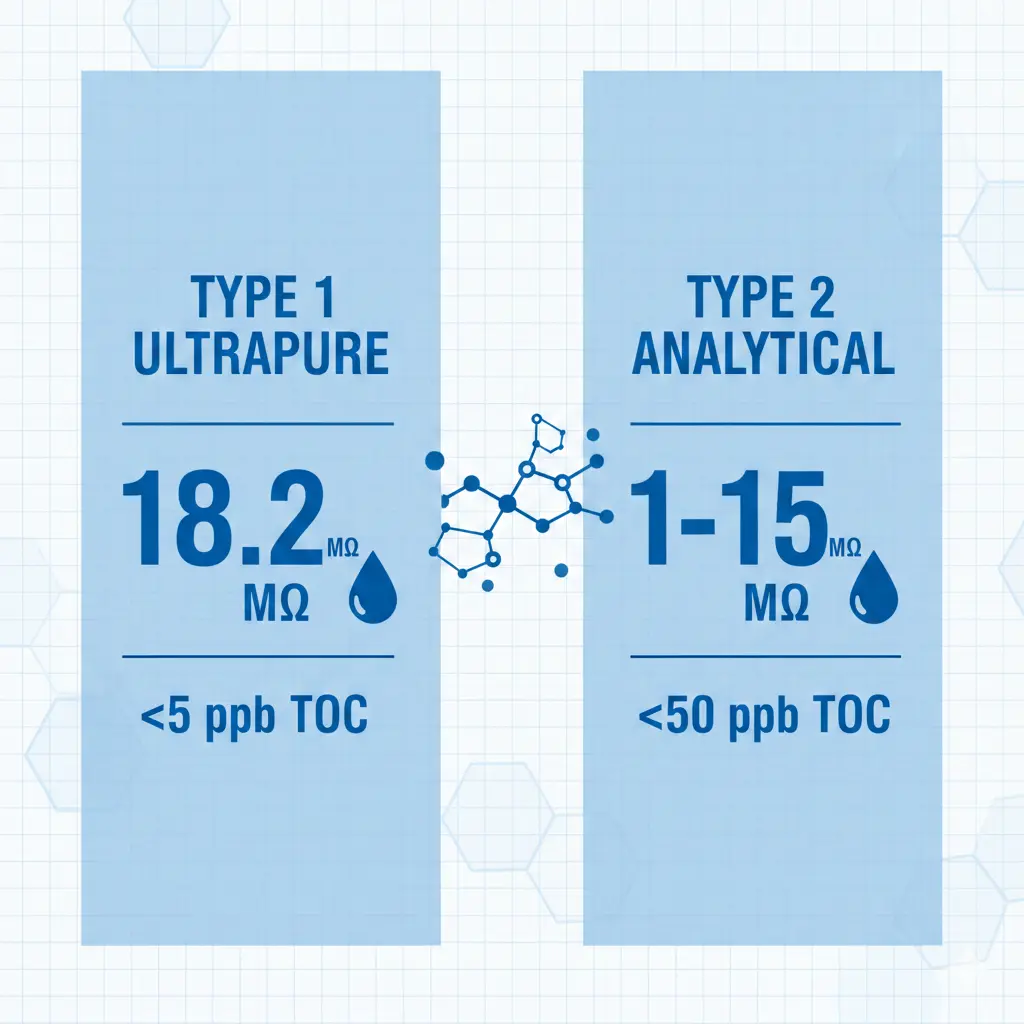
Type 2 Analytical Grade
Type 2 water is what most people mean when they say “general lab water.” You produce it through a combination of reverse osmosis and deionization. It is dramatically cleaner than tap water. But it still carries trace amounts of dissolved ions and organic carbon.
The key phrase is “good enough for most things.” For applications where a few parts-per-billion of residual salt will not affect your results, Type 2 delivers everything you need at a fraction of the cost of polishing to ultrapure levels.
The question is: where exactly does “good enough” run out?
The 1 to 15 MΩ-cm Resistivity Window
Here is what resistivity is actually measuring: how difficult it is for electricity to flow through the water. The harder it is, the fewer ions are dissolved in it. Type 2 water typically sits between 1 and 15 MΩ-cm.
That range tells you the vast majority of minerals are gone. But some dissolved ions remain. For routine chemistry tasks where a trace of salt is irrelevant, this is perfectly acceptable. The ASTM International standards set these global benchmarks precisely so you know what you are working with before you start.
Where Type 2 Earns Its Place in the Lab
Here is where Type 2 genuinely shines:
- Buffer and reagent preparation at scale
- Feeding clinical analyzers without mineral scale
- Lab dishwashers and glassware rinsing
- Standard pH adjustments and spectrophotometry
It is cost-effective to produce in large volumes. And for these applications, the extra cost of polishing to Type 1 would be pure waste.
Type 1 Ultrapure Water
Type 1 water is a different category entirely. The defining number is 18.2 MΩ-cm resistivity at 25°C. And here is what makes that number remarkable…
…at 18.2 MΩ-cm, the only ions present in the water are the hydrogen and hydroxide ions from the water molecules themselves. You have reached the theoretical limit of what pure water can be. Leave an open beaker of it on the bench and it will actually pull minerals out of the air around it.
That is how ion-hungry this stuff is.
Why 18.2 MΩ-cm Is the Number That Matters
The number is not arbitrary. It represents the absolute physical ceiling. Any drop below 18.2 means a contaminant has entered the system. For this reason, well-designed Type 1 systems monitor resistivity in real time and alert you the instant that number slips. Your data’s integrity depends on that vigilance.
The TOC Requirement: Getting Below 5 ppb
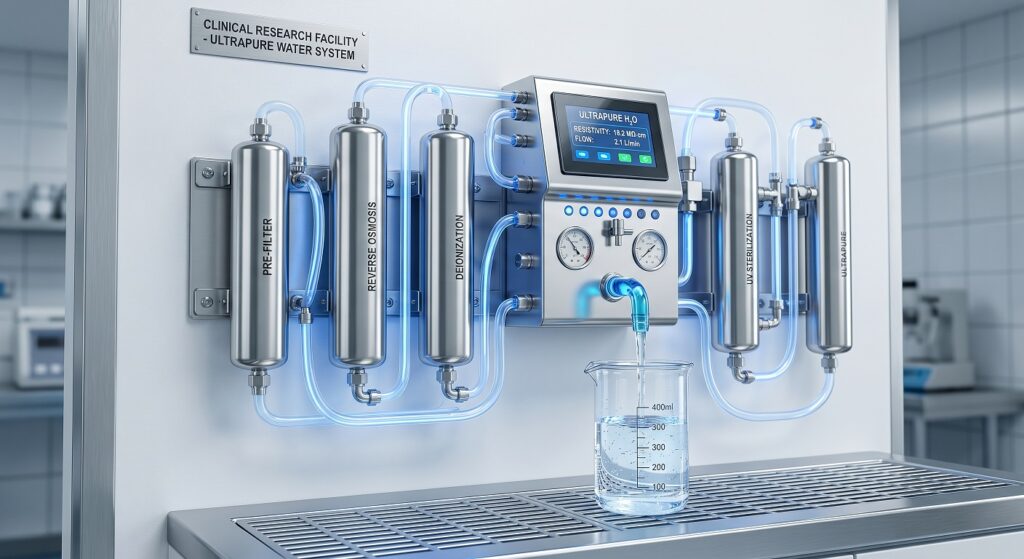
Resistivity handles ionic contamination. But there is a second war happening at the molecular level. Organic molecules can survive a deionization stage and still interfere with biological assays. Type 1 water must maintain a total organic carbon level below 5 parts per billion. The way you get there is with a dual-wavelength UV lamp running at both 185nm and 254nm. The UV light breaks organic chains apart so resin filters can capture them. Skip this step and your water can be ionically perfect while still containing organic interference that wrecks your readings.
4x Scenarios Where Type 1 Is Non-Negotiable
The most expensive mistake a lab manager can make is substituting Type 2 water into applications that genuinely require Type 1.
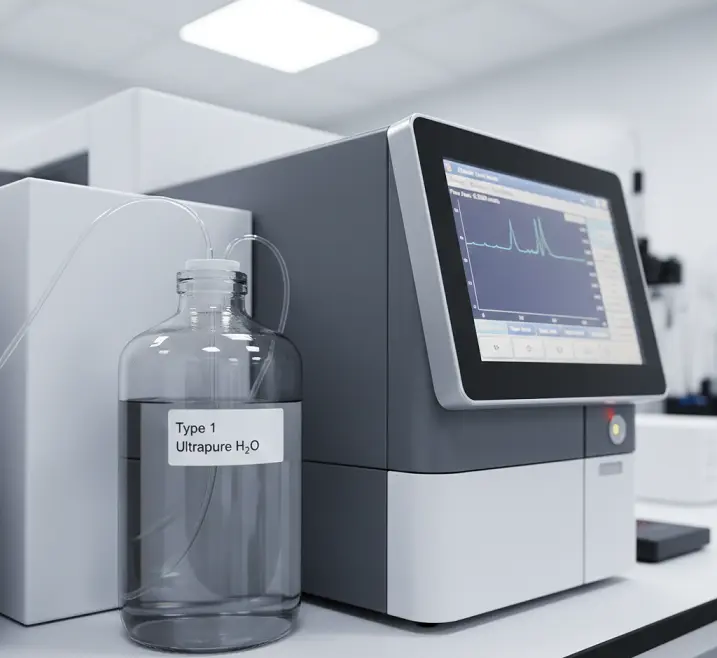
One failed HPLC run from contaminated water can cost more than an entire year of Type 1 system maintenance. That is not a hypothetical. That is a real calculation that gets ignored until it hits someone’s budget.
Scenario #1: HPLC — Where Ghost Peaks Kill Your Data
In high-performance liquid chromatography, the water is not background noise. It is the mobile phase. It is an active participant in every separation you run.
If your water carries organic contaminants, those compounds show up on your chromatogram. Now you cannot tell whether a peak belongs to your sample or to your water. You are no longer doing science. You are troubleshooting contamination.
The National Center for Biotechnology Information consistently flags reagent purity as one of the primary drivers of reproducibility failures in liquid chromatography. The fix is always the same: Type 1 water with TOC below 5 ppb.
Column Clogging and Pressure Spikes
Contaminated water does not just corrupt your chromatogram. It destroys your column. Micro-particles and bacteria in lower-grade water physically clog the silica packing inside expensive HPLC columns. That clogging creates pressure spikes. Pressure spikes blow seals. And a blown seal means a total system overhaul.
Type 1 water is column insurance.
The Gradient Elution Trap Most Researchers Walk Straight Into
During gradient elution, the ratio of water to solvent shifts continuously. Any organic contaminants in the water accumulate on the column during the water-heavy phase. Then, when the solvent concentration rises, those organics release all at once.
The result is a massive, uninterpretable spike. And here is the part that costs weeks of work: most researchers assume the problem is their sample. They adjust their extraction, clean their standards, re-prepare their controls. The actual culprit was Type 2 water used to save a few dollars on consumables.
Scenario #2: Mammalian Cell Culture and IVF — Living Cells Cannot Tolerate Trace Contaminants
Cells respond to their environment at the molecular level. Even trace heavy metals or endotoxin fragments in Type 2 water can inhibit growth, alter gene expression, or trigger unexpected cell death.
When you are working with expensive primary cells or sensitive embryos, the water in your media is not a detail. It is the foundation of every result you produce. This is why Type 1 water with an ultra-filtration stage is mandatory in these applications, a standard aligned with ISO guidelines for biological analysis water quality.
Endotoxins and Nucleases
Two specific threats matter most in cell work:
Endotoxins are fragments of bacterial cell walls. They are toxic to mammalian cells at concentrations far below what most instruments detect without specialized testing. Nucleases are enzymes that digest DNA and RNA. If they contaminate your media, the nucleic acids you are trying to study simply disappear.
A properly specified Type 1 system with a 5,000-Dalton ultra-filter physically blocks both. There is no chemical workaround that matches mechanical exclusion at that level.
Batch-to-Batch Consistency
THIS IS THE CONTAMINATION PROBLEM NOBODY TRACKS UNTIL IT IS TOO LATE. If you are using Type 2 water, the mineral content of your feedwater shifts every time your municipal supply changes. Different season, different rainfall, different distribution chemistry. Your media changes with it — invisibly. Cells behave differently from one week to the next with no apparent cause. Switch to Type 1 and you eliminate that variable entirely. Every batch starts from the same blank slate.
Scenario #3: Molecular Biology
PCR amplification and similar techniques operate at sensitivity levels where parts-per-trillion contamination can produce false positives or suppress amplification entirely. The same logic applies to mass spectrometry, where ionic background from residual minerals directly raises your noise floor and pushes your detection limits in the wrong direction.
For any technique that measures at the molecular level, Type 1 water is not a premium choice. It is a basic requirement.
Scenario #4: Protecting Analytical Instrumentation Long-Term
Beyond the immediate data quality argument, there is a total-cost-of-ownership argument. Residual minerals in Type 2 water form scale deposits on instrument flow paths, tubing, and detector cells over time. UV-Vis spectrophotometers, TOC analyzers, and ion chromatography systems all degrade measurably faster when fed lower-grade water. The consumable and service costs accumulate quietly. Type 1 water is preventive maintenance you pay for once instead of repair costs you pay for repeatedly.
How Storage and Maintenance Can Destroy Water You Already Paid to Purify
Here is the part of this conversation that most water system guides skip entirely.
You can produce perfect Type 1 water and then ruin it completely through poor storage and neglected maintenance. The purity does not hold itself.
The Biofilm Problem: What Grows in Pipes That Are Not Moving
Still water grows bacteria. Every time. Bacterial colonies attach to pipe walls and form biofilms — dense, structured communities that are nearly impossible to remove chemically once established. A properly designed recirculation loop keeps water moving continuously through UV lamps even during idle hours. Without that recirculation, you are producing high-purity water and storing it in a bioreactor.
Why Your UV Lamp’s Wavelength Determines What Gets Killed vs. What Gets Broken Down
254nm UV kills bacteria by disrupting their DNA. 185nm UV breaks the carbon bonds in organic molecules, reducing them to fragments that resin filters can capture. These are two different jobs. A single-wavelength lamp does one of them. A dual-wavelength lamp does both simultaneously. If your system only runs one wavelength, you are leaving one of those contamination pathways open.
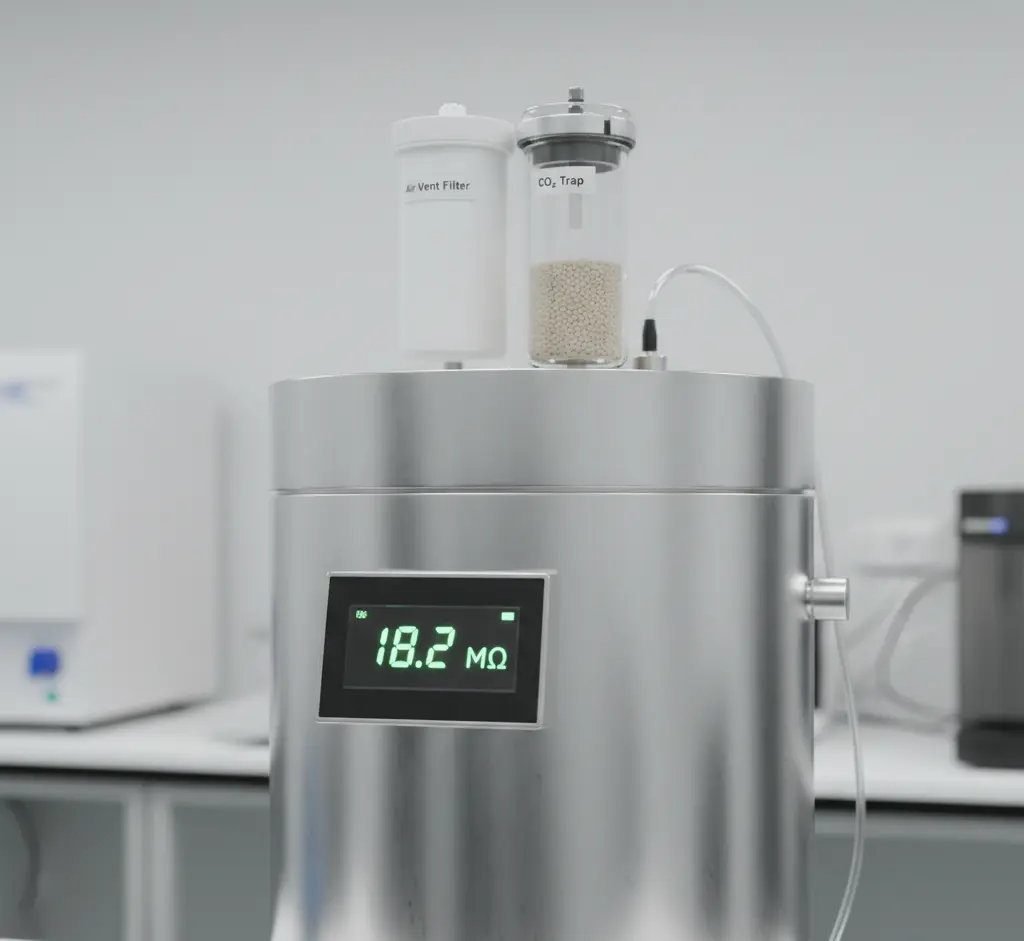
Air Vent Filters on Storage Tanks
As you draw water from a storage reservoir, air must enter to equalize pressure. Unfiltered air carries dust, airborne bacteria, and CO2. That incoming air immediately starts degrading the water you just produced. Every storage tank needs a 0.2-micron air vent filter and a CO2 trap. Without them, the tank itself becomes the contamination source, regardless of what your purification system produces upstream.
Also worth noting: filter cartridges have finite lifespans that degrade gradually, not suddenly. By the time a failed cartridge shows up in your data, it has often been compromised for weeks. For detailed guidance on identifying water quality issues affecting your specific research applications, the resources at the National Center for Biotechnology Information and Purific’s Complete Guide to Medical Grade Water are both worth bookmarking.
Wrapping It Up
Type 2 water is your lab’s reliable partner for the volume work — buffers, rinsing, general chemistry, instrument feed water. Type 1 is your specialist, deployed only when every molecule in the reaction matters and every error carries a real cost.
Match your water grade to your application correctly and you stop troubleshooting contamination and start producing reproducible science. And as analytical instruments get more sensitive every year, that purity gap is only going to become more critical.
So here is the question: which application in your current workflow is still running on the wrong water grade?

Purific Australia sells water purification systems, including some of the products and technologies discussed in this article. This content is written to inform, not to sell. Where a Purific product is a relevant solution, we say so plainly. Where it is not the right fit, we say that too.
All technical claims are based on published research, manufacturer data, or direct laboratory testing. If you have questions about a specific product recommendation or want independent verification of any data cited here, contact our technical team.