
Dissolved silica in HPLC systems often bypasses standard resistivity monitors and wreaks havoc on sensitive analytical results. By understanding how silica breakthrough occurs, you can implement preventative maintenance that saves your columns and ensures data integrity. This guide provides the technical roadmap to identifying and eliminating this invisible contaminant before it compromises your lab.
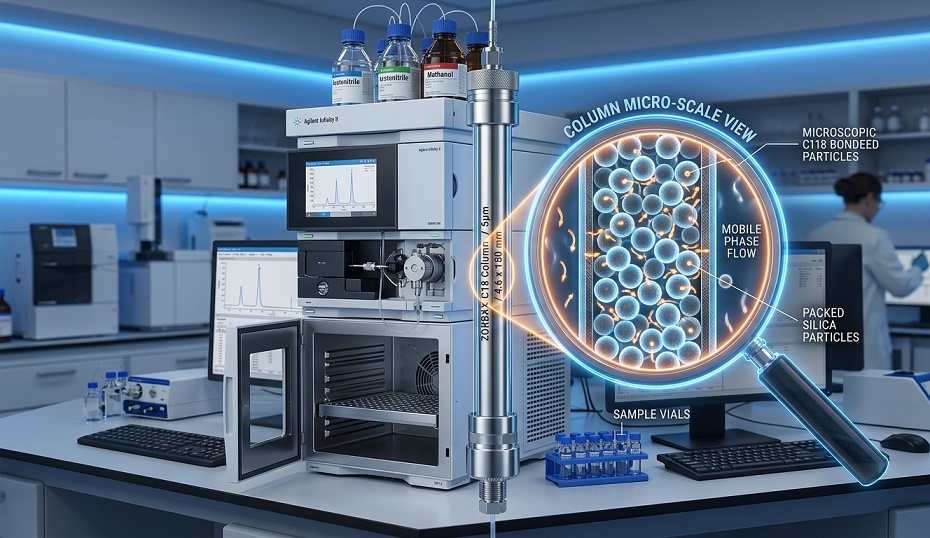
You might think your water is pure because the meter says so. But while you celebrate that perfect resistivity reading, a glass-like coating is quietly suffocating your $1,000 column.
Your Resistivity Meter Cannot See Silica
Most lab managers treat 18.2 MΩ.cm as the gold standard of purity. It is a vital metric; however, resistivity only measures ionized substances.
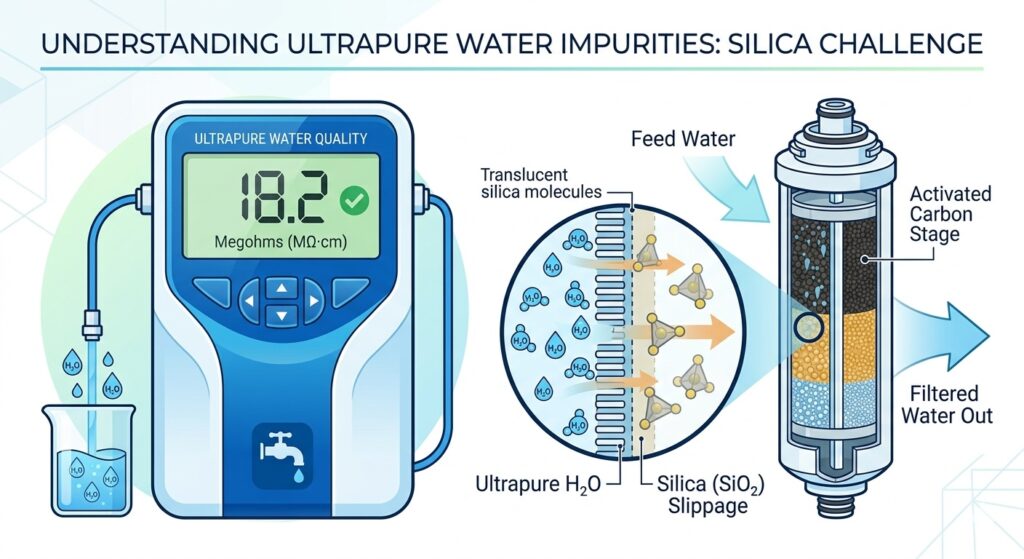
Dissolved silica is a weakly ionized compound that often exists in a non-charged state in your feed water.
Why Resistivity Monitors Fail to Detect Silica
Resistivity meters work by measuring the flow of electricity through ions. Because dissolved silica is such a weak acid, it contributes almost nothing to the conductivity of the water. You can have a significant concentration of silica present even when your meter shows a perfect 18.2 MΩ.cm.
The Chemistry of Weakly Ionized Contaminants
In most water sources, silica exists as silicic acid. Since this molecule does not dissociate well into ions at a neutral pH, it remains invisible to the sensors that guard your HPLC. This is why you must look beyond the digital display on your water system.
This disconnect between perceived purity and actual contamination is exactly how the trouble starts.
Silica Breakthrough Destroys Your HPLC Column
When dissolved silica enters your mobile phase, it does not just pass through the system. It behaves like a liquid glass that eventually hardens on your stationary phase.
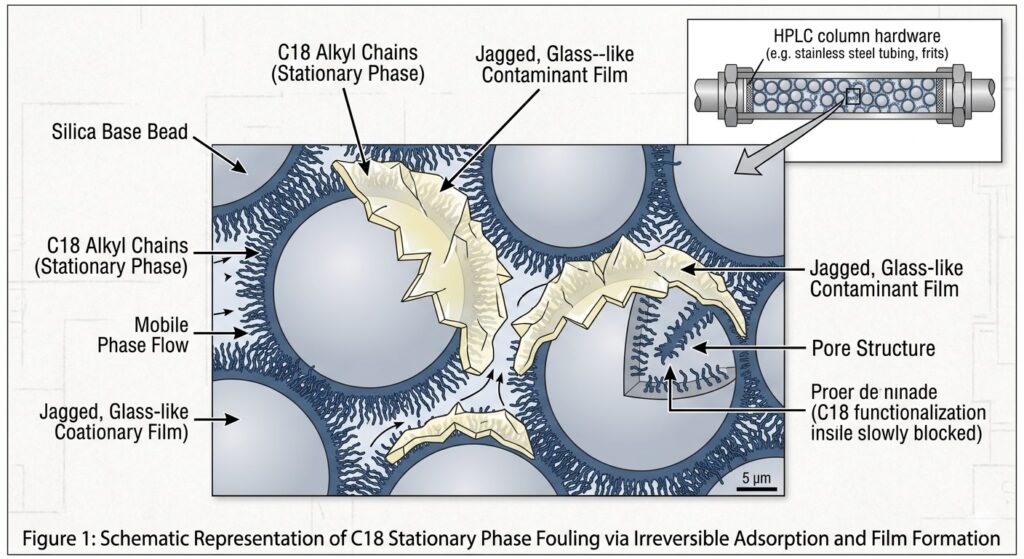
This coating changes the chemistry of your column and destroys your chromatography.
Mechanisms of Column Degradation
As silica deposits on the packing material, it creates a physical barrier between your analytes and the bonded phase. This leads to a series of escalating issues:
- Significant peak tailing due to non-specific interactions with the new silica layer.
- Increased backpressure as the frit and column bed become clogged.
- Loss of resolution between closely eluting peaks.
Silica Deposition on C18 Phases
Even if you use high-quality C18 columns, the ghost silica will eventually find a home. It effectively transforms your expensive, specialized column into a low-grade silica column. You are no longer performing the separation you designed; you are performing a separation on a contaminated mess.
You might assume your column is just old, but the true culprit is likely your water source.
Know When Your Polishing Cartridges Are Exhausted
To stop silica, you have to understand the limits of your water purification resin. Silica is typically the first substance to break through an ion exchange bed as it nears exhaustion. This is known as the silica breakthrough point.
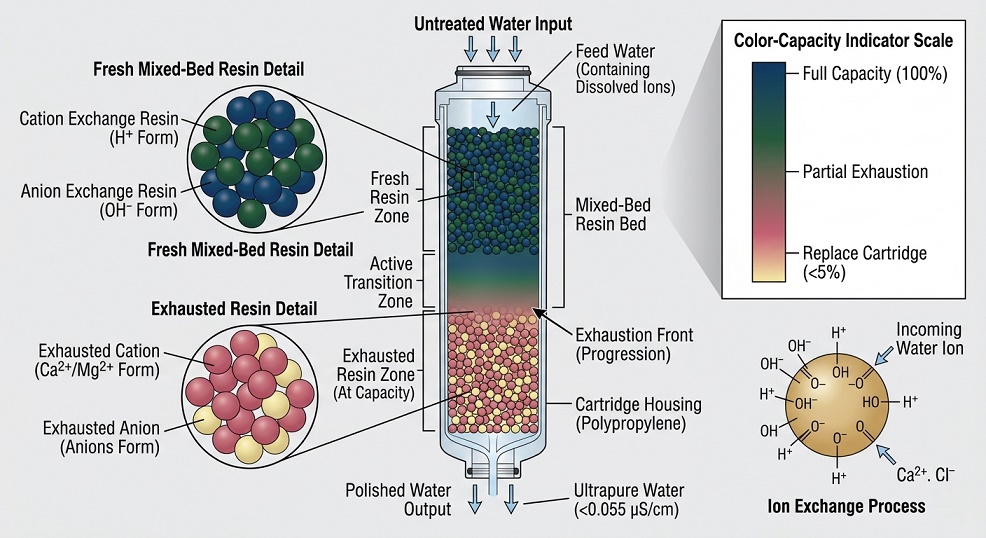
The Selective Nature of Anion Exchange
Your polishing cartridges use specialized resins to trap anions. Because silica is a weak anion, it has the lowest affinity for the resin. When the cartridge begins to fill up, the stronger ions like chlorides or sulfates will actually kick the silica off the resin and into your product water.
| Water Quality Parameter | Type I (Ultrapure) | Type II (Pure) | Type III (RO) |
|---|---|---|---|
| Resistivity (MΩ.cm) | 18.2 | 1.0 | 4.0 |
| Total Silica (ppb) | < 3 | < 10 | < 500 |
| TOC (ppb) | < 5 | < 50 | < 200 |
Predicting the Breakthrough Point
You cannot wait for the resistivity to drop to 15 or 10 MΩ.cm. By the time the resistivity changes, the silica has already been flooding your system for days or weeks. You must establish a validation protocol based on the volume of water processed or specific intervals.
For a deeper dive into these metrics, see Water Quality Monitoring Parameters Explained.
Understanding this timeline is the only way to stay ahead of the contamination curve.
Stop Silica Before It Reaches Your Machine
Protection is cheaper than replacement. If you are serious about HPLC column longevity, you need a proactive strategy that treats water quality as a core component of your method.
Implementing a Strict Maintenance Schedule
Don’t let your water system tell you when it is time to change filters. Use these steps to build a wall around your HPLC:
Always use fresh ultrapure water; do not store it in plastic carboys where silica can leach from the container.
- Replace polishing cartridges every six months, regardless of the resistivity reading.
- Install a 0.05-micron ultrafilter at the point of use to catch polymerized silica.
- Test your product water specifically for silica using a colorimetric kit once a month.
The Role of Feed Water Pre-treatment
Your ultrapure system is only as good as the water entering it. If your RO (Reverse Osmosis) membrane is failing, the silica load on your polishing resin will skyrocket. Ensuring your pre-treatment is functional is the best way to extend the life of your expensive polishing kits.
To ensure your lab meets these rigorous standards, you should learn How to Validate Your Lab Water Quality.
The cost of a new cartridge is a fraction of the cost of a ruined batch of samples and a dead column.
Frequently Asked Questions
Can I remove dissolved silica with a standard 0.22-micron filter?
No, dissolved silica is a molecular contaminant and is far too small to be trapped by a standard 0.22-micron sterile filter. You need a functioning ion exchange resin or a specialized ultrafilter with a much lower molecular weight cutoff to effectively remove it.
How does silica breakthrough affect baseline noise in HPLC?
Silica breakthrough can cause significant baseline instability and ghost peaks as the silica deposits and then leaches off the column. This creates a high background signal that can mask low-level analytes and ruin your limit of detection.
Is bottled HPLC-grade water safer than in-house ultrapure water?
Bottled water can be safe, but it is often stored in glass bottles which can actually leach silica back into the water over time. In-house ultrapure water, used immediately after dispensing from a well-maintained system, is generally the superior choice for sensitive applications.
Why does my column pressure increase when silica is present?
Silica can polymerize into larger particles when it hits the organic solvents used in HPLC mobile phases. These particles then lodge themselves in the column inlet frit, leading to a steady and irreversible increase in backpressure.
References:
- ASTM International. (2018). D1193-06(2018) Standard Specification for Reagent Water. (https://www.astm.org/d1193-06r18.html)
- IUPAC. Compendium of Chemical Terminology, 2nd ed. (the “Gold Book”). (https://goldbook.iupac.org/)
- National Center for Biotechnology Information. (2026). PubChem Compound Summary for Silicic Acid. (https://pubmed.ncbi.nlm.nih.gov/)
Leave a Reply
You must be logged in to post a comment.