Conductivity measurement water purity testing is the fastest, most cost-effective method for detecting dissolved ionic contaminants in industrial, utility, and laboratory water systems.
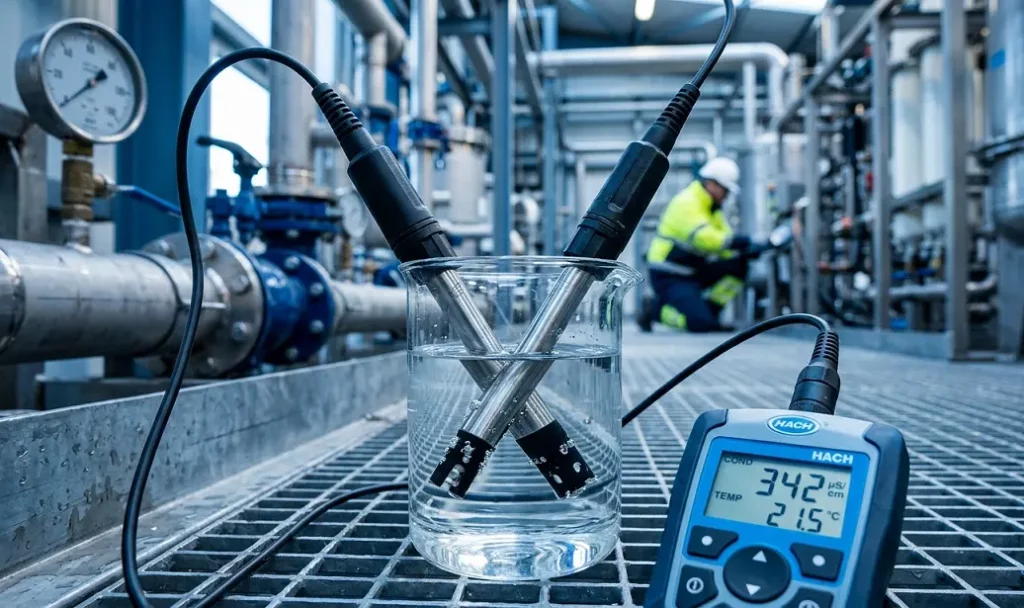
It is a battle-tested, globally recognized parameter endorsed by the EPA, USP, and ASTM. Master this metric, and you gain real-time visibility into your water system that no other single instrument can match.
What Conductivity Measurement Actually Detects
Conductivity measures how easily an electric current passes through water. Pure water conducts electricity very poorly. The moment dissolved ions enter the picture, conductivity rises.
Specifically, conductivity detects the presence of these ionic contaminants:
Ultrapure deionized water in ideal conditions has a conductivity of just 0.055 microsiemens per centimeter (µS/cm) at 25 degrees Celsius. Any significant deviation from your system baseline is a signal worth investigating.
Therefore, conductivity is your early warning system for ionic contamination. It is not a definitive pass or fail on its own. But it is the fastest trigger you have. And what it cannot see is just as important as what it can.
Where Conductivity Testing Is Used and Required
Conductivity testing is one of the most widely deployed water quality measurements in the world. Its speed and low cost make it the default first-pass metric across dozens of industries.
Here are the primary applications where conductivity testing is either required or standard practice:
USP <645> defines a three-stage conductivity test for pharmaceutical water. Stage 1 is an inline or offline non-temperature-compensated measurement compared against a temperature-conductivity table. First, if Stage 1 passes, no further conductivity testing is needed. Second, if it fails Stage 1, the water proceeds to Stage 2 and Stage 3 for more detailed ionic analysis.
This is where conductivity gets powerful in regulated settings. But the measurement is only as reliable as the equipment behind it.
How to Measure Conductivity Correctly
Accurate conductivity measurement depends on three things: calibration, temperature compensation, and electrode condition.
Temperature Compensation
Conductivity is highly temperature-dependent. For ionic salt solutions, conductivity increases by approximately 2 percent per degree Celsius. For ultrapure pharmaceutical-grade water, the increase can be as high as 5 percent per degree Celsius. Consequently, all pharmaceutical-grade conductivity measurements must be temperature-compensated or reported at a reference temperature of 25 degrees Celsius per USP <645> requirements.
Cell Calibration
Conductivity meters use a cell constant to convert raw electrical measurements into accurate conductivity values. The cell constant must be verified against a certified reference standard regularly.
According to ASTM D1125, conductivity measurement of water requires careful attention to cell constant verification and electrode cleanliness to ensure accuracy.
Electrode Maintenance
Fouled or damaged electrodes produce readings that drift over time. Inspect electrodes regularly for mineral deposits, biofilm buildup, or physical damage. A drifting baseline is almost always an electrode issue first.
For a complete picture of how conductivity compares to TOC as a water purity parameter, read TOC vs. Conductivity: What Matters More?.
But even a perfectly calibrated conductivity meter has one fundamental weakness that surprises most water quality professionals.
The Critical Limitation You Cannot Afford to Ignore
Conductivity is blind to organic contamination. Full stop.
Organic compounds such as pharmaceutical residues, microbial byproducts, and cleaning agent carryover carry no ionic charge. Therefore, they produce zero response on a conductivity meter regardless of their concentration.
Here is a side-by-side look at what conductivity catches and what it misses:
| Contaminant Type | Conductivity Detects | Conductivity Misses |
|---|---|---|
| Dissolved salts | Yes | |
| Mineral ions | Yes | |
| Acids and bases | Yes | |
| Pharmaceutical residues | Yes | |
| Microbial byproducts | Yes | |
| Cleaning agent carryover | Yes | |
| Endotoxin precursors | Yes |
According to USP <1231> Water for Pharmaceutical Purposes, this is precisely why both conductivity and TOC testing are required together for pharmaceutical-grade water. Neither parameter alone gives you a complete picture.
Consequently, if your process produces water that must be free of both ionic and organic contamination, conductivity is your first gate. TOC is your second. Skip either one, and your water quality program has a blind spot you cannot afford.