
Understanding the impact of TOC in LC-MS is the difference between a clean run and chasing phantom peaks for a week. As a senior consultant who has audited dozens of failing analytical labs, I can tell you that ignoring Total Organic Carbon (TOC) is the most expensive mistake you can make. When your instrument is sensitive enough to detect parts per trillion, even microscopic levels of plasticizers, bacterial byproducts, or cleaning residues will wreck your data.
But most lab managers do not realize their water purification system is actively fighting their mass spectrometer.
Let us look at how these invisible carbon chains translate into very visible, very expensive downtime.
Defining Organic Contamination in Sensitive Assays
Organic contamination in liquid chromatography mass spectrometry does not just show up as a single bad reading. Trace organics, measured collectively as TOC, consist of carbon-based chemical compounds present in your solvents and ultrapure water. When these carbon chains enter the flow path, they behave unpredictably during the ionization process.
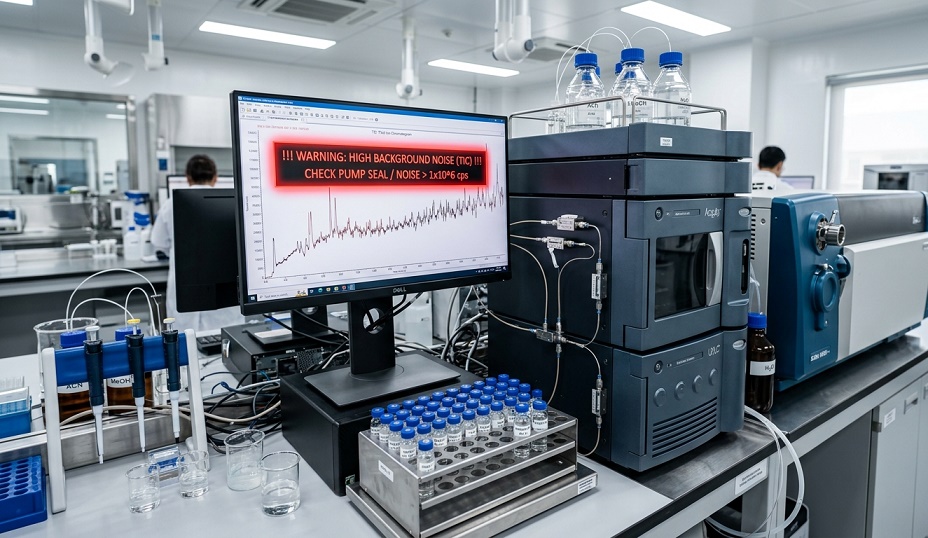
The cause is simple chemistry: these stray carbon molecules compete with your target analytes for charge in the electrospray ionization source. This mechanism leads directly to ion suppression, where your actual sample signal is artificially lowered, or ion enhancement, where the signal is falsely inflated. The real-world symptom is a skyrocketing baseline that swallows low-level peaks and destroys your signal-to-noise ratio.
If you ignore high TOC levels, your quantitative assays will fail validation due to poor reproducibility and drifted calibration curves. You are not just losing a day of work; you are risking regulatory non-compliance.
- Baseline drift: Continuous upward or downward movement of the baseline during a gradient run.
- Ion suppression: Loss of sensitivity for target analytes due to competition in the plasma.
- Mass shift: Minor fluctuations in mass accuracy caused by space-charge effects in the trap.
To stop this bleeding, we first need to figure out exactly where these rogue molecules are coming from.
Ghost Peak Identification Tactics
Ghost peaks are the bane of any analytical chemist, appearing out of nowhere and mimicking real compounds. When troubleshooting ghost peaks, you must systematically isolate your solvents from your instrument hardware to find the root cause.
The mechanism behind ghost peaks usually involves a phenomenon called on-column enrichment. Organic impurities present at parts per billion levels in your mobile phase gradually accumulate at the head of the analytical column during the equilibration phase. When the gradient starts and the organic solvent percentage increases, these trapped impurities elute all at once, creating perfect, symmetrical peaks that look exactly like real analytes.
If you suspect your water is the culprit, run a blank gradient with a 10 minute equilibration time, followed by another run with a 30 minute equilibration time. If the ghost peak grows in proportion to the wait time, your water or your mobile phase A is contaminated.
Ghost Peak Troubleshooting Decision Matrix
| Symptom Observed | Probable Source | Corrective Action |
|---|---|---|
| Peak height increases with equilibration time | Ultrapure water or buffer salts | Replace water source or use higher purity salts |
| Peak height remains constant regardless of time | Injector contamination or carryover | Perform system wash or replace rotor seal |
| Peaks appear only in gradient blank, not isocratic | Solvent impurities or gradient mixer | Check organic solvent grade (LC-MS grade required) |
Understanding these peak behaviors is crucial, but prevention starts at the water purification system itself.
Ultrapure Water for Mass Spectrometry Standards
You cannot use standard reagent grade water for modern mass spectrometry and expect reliable results. While ASTM D1193 Type I water is excellent for general chemistry, LC-MS requires a much stricter definition of purity.
The mechanism of purification must go beyond simple deionization. Traditional ion exchange resins remove charged inorganic ions, bringing resistivity to the theoretical limit of 18.2 MΩ·cm, but they do nothing to stop neutral organic molecules. To combat this, modern systems utilize dual-wavelength ultraviolet (UV) photo-oxidation at 185 nm and 254 nm. This process generates hydroxyl radicals that aggressively chop organic molecules down into carbon dioxide and water, driving TOC levels down below 5 ppb.
According to the Clinical and Laboratory Standards Institute (CLSI), water used for high-sensitivity mass spectrometry should ideally maintain TOC levels below 5 ppb to ensure low background noise. For more on setting up a compliant system, see the ultimate guide to precision water in critical applications.
Relying on a system that only displays resistivity without active TOC monitoring is a massive gamble.
Selecting Point of Use Filters
Even if your central water system is perfect, organics can leach into the water as it travels to your bench. Point of use filters act as your final line of defense before the water enters your mobile phase bottles.
The mechanism here is size exclusion and targeted adsorption. A high-quality point of use dispenser filter combines a 0.22 µm membrane to catch bacteria with a specialized activated carbon or ultrafiltration polisher to trap residual organics. Without this final barrier, any volatile organics present in the laboratory air or plasticizers leaching from delivery tubing will contaminate your fresh water instantly.
When shopping for these filters, you need to look at the specifications rather than just the brand name.
- Pore Size: Ensure it is rated at 0.22 µm or smaller to prevent bacterial breakthrough.
- Adsorbent Material: Look for virgin activated carbon rather than recycled media.
- Housing Material: Only accept low-extractable polypropylene or fluoropolymer housings.
Once your filtration is locked down, you need to look at the actual plumbing of your LC system.
Minimizing LC-MS Background Noise
Reducing background noise in LC-MS requires aggressive, proactive maintenance of your entire flow path. Over time, organic residues from samples and mobile phases create a microscopic biofilm or chemical coating on the interior walls of your degasser, pump heads, and capillaries.
This buildup creates a continuous leaching mechanism. As your fresh mobile phase flows through the system, it slowly dissolves these deposited organics, creating a high continuous background current in the mass spec. The real-world symptom is a high base peak chromatogram (BPC) count even when you are pumping 100% pure water.
To clean the distribution lines, you must bypass the analytical column and flush the system with a mixture of 1:1:1:1 water, acetonitrile, methanol, and isopropanol with 0.1% formic acid. Run this at a high flow rate for at least 2 hours to strip the lines clean.
For a complete breakdown on testing your system for organic load, read the total organic carbon water testing guide.
But there is one final habit that destroys more analyses than anything else: stale water.
The Role of Fresh Water
Storage tanks are where ultrapure water goes to die, and they are the primary enemy of low TOC LC-MS applications.
The mechanism of degradation begins the second ultrapure water leaves the purification system. Water is an incredibly aggressive solvent; it will actively leach plasticizers (like bisphenol A and phthalates) from the walls of plastic storage reservoirs. Furthermore, air vents on storage tanks, if not properly fitted with carbon filters, will allow volatile organic compounds (VOCs) from the laboratory atmosphere to dissolve directly into the water.
Within just 24 hours of storage in a plastic carboy, a water sample with an initial TOC of 3 ppb can easily skyrocket to over 30 ppb.
To prevent this, follow these strict standard operating procedures:
- Never store water: Dispense ultrapure water directly from the system into your mobile phase bottles immediately before use.
- Use glass only: Use borosilicate glass bottles that have been rinsed with LC-MS grade solvent.
- No parafilm: Do not seal your mobile phase bottles with parafilm, as the wax contains leachables that dissolve in organic solvents.
By treating your water as a fresh reagent rather than a utility, you will eliminate the vast majority of your organic contamination issues.
Leave a Reply
You must be logged in to post a comment.