
Choosing between EDI vs DI water systems requires a hard look at your facility’s long term operational budget and purity requirements. Most labs overspend on consumables because they fail to calculate the true cost of chemical regeneration versus electrical maintenance.
This guide breaks down the ROI to ensure your next water system upgrade is a financial win.
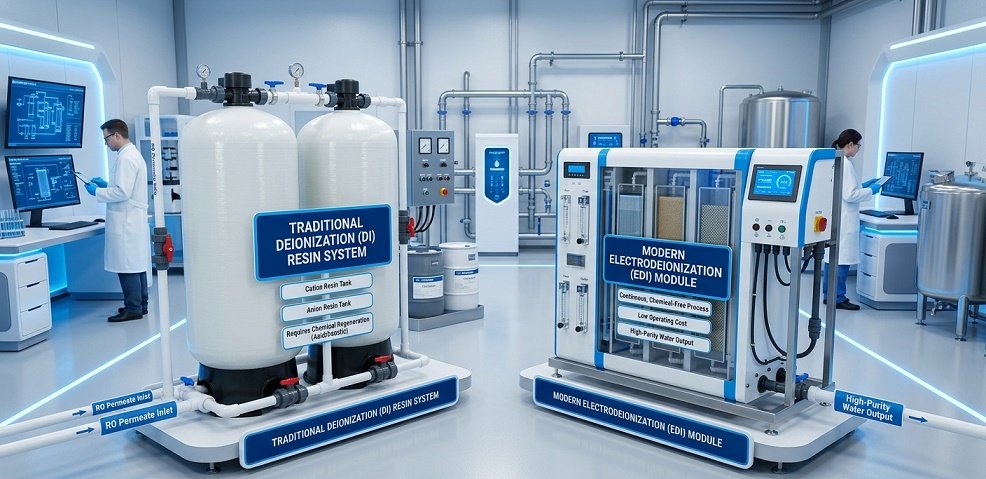
You might think the lower upfront cost of DI makes it the safer bet for your budget. But the numbers tell a much more expensive story.Most lab managers think they are buying a water purification system, but they often overlook the long-term impact of lab water system maintenance.
How Electrodeionization Technology Replaces Chemical Cycles with Electrical Shifts
Electrodeionization technology represents a fundamental shift in how we achieve high purity water. Traditional DI relies on chemical exhaustion; once the resin beads are saturated with ions, they are useless until regenerated with harsh acids or bases. EDI changes the game by using an electric field to do the heavy lifting.
The Mechanics of Continuous Ion Migration
In an EDI cell, water passes through resin filled chambers sandwiched between cation and anion permeable membranes. An electric current pulls the impurities across these membranes, effectively cleaning the water as it flows. Because this process happens continuously, there is no downtime for cartridge changes or regeneration cycles.
Electrical Resin Regeneration Thresholds
The beauty of EDI is that the electric current does not just move ions; it also splits water molecules into H+ and OH- ions. These ions constantly regenerate the resin beads in situ. This eliminates the need for external chemicals, keeping the system in a perpetual state of readiness.
For a deeper dive into the specific water grades these systems produce, see our guide on Type 1 vs Type 2 water lab needs.
It sounds like a maintenance free dream; however, the hidden cost of the simpler alternative is lurking in your procurement invoices.
Calculating Deionization Resin Cost and the Drain of High Volume Cartridge Swaps
If you are running a high volume facility, deionization resin cost is likely your biggest invisible leak. Standard DI systems are essentially subscription models for resin. You buy the hardware once, but you pay for the cartridges forever.
The Variable Price of Consumables
The price of resin is tied to global chemical markets and petroleum prices. When supply chains tighten, your cost per gallon of pure water spikes. Furthermore, the labor involved in monitoring, swapping, and disposing of these cartridges adds a significant soft cost that many managers overlook.
Throughput and Replacement Frequency
| Daily Volume (Liters) | DI Cartridge Lifespan | Estimated Annual Consumable Cost |
|---|---|---|
| 50 | 6 Months | $800 |
| 200 | 45 Days | $3,200 |
| 500+ | 15 Days | $9,000+ |
As shown in the table above, the costs scale aggressively with volume. High throughput labs often find themselves spending more on resin in two years than the entire cost of a new EDI system.
- Shipping and handling fees for heavy resin tanks.
- Labor costs for manual exchange and logbook tracking.
- Risk of water quality drift as resin nears exhaustion.
The bills keep piling up; yet the real shock comes when you project these costs over half a decade.
Your Five Year Lab Water System ROI Comparison for Electricity and Consumables
When calculating lab water system ROI, you must look past the initial purchase price. EDI systems have a higher capital expenditure. However, their operational expenditure is remarkably flat.
Comparing OpEx for Electricity and Consumables
An EDI system consumes about as much electricity as a standard light bulb. According to the ASTM D1193 standard, maintaining specific resistivity requires consistent ion removal. EDI achieves this with pennies’ worth of power, whereas DI requires hundreds of dollars in plastic and resin components.
Maintenance and Downtime Costs
DI systems are prone to human error during swaps, which can lead to contamination or air locks. EDI systems are solid state with few moving parts. Over five years, the lack of touch time translates into thousands of dollars saved in technician hours.
- Year 1: DI is cheaper due to lower initial investment.
- Year 2: EDI break even usually occurs here for high volume users.
- Years 3 to 5: EDI provides 60% to 80% savings on operating costs.
If you are managing a facility with strict purity requirements, check out our Ultra-pure water systems definitive Type I guide.
Efficiency is one thing; but in today’s market, green is also gold.
Sustainable Water Purification Benefits and Reducing Your Environmental Footprint
Sustainability is no longer a buzzword; it is a regulatory and corporate necessity. Traditional DI systems produce a mountain of plastic waste and chemical byproduct.
Reducing Chemical Waste and Resin Disposal
Spent resin is often sent to landfills or requires energy intensive off site regeneration. Off site regeneration involves transporting heavy tanks to a facility that uses bulk hydrochloric acid and sodium hydroxide.
By switching to EDI, you eliminate the carbon footprint of this transport and the chemical hazard of the regeneration process itself.
Meeting ISO and EPA Standards
Organizations like the Environmental Protection Agency prioritize waste reduction at the source. EDI aligns perfectly with these mandates by producing no hazardous waste stream. This can assist your facility in maintaining ISO 14001 certification or meeting internal environmental goals.
Even with all these benefits, EDI is not always the right choice for every lab.
Identifying Specific Use Cases Where Traditional Resin Regeneration Remains Superior
Despite the ROI of electrodeionization technology, traditional DI still has a place in the market. It is not about which technology is better in a vacuum; it is about which fits your specific workflow.
Low Volume Facilities and Intermittent Use
If your lab only needs 10 liters of pure water a week, the upfront cost of an EDI system will never pay for itself. DI cartridges are perfect for low demand environments. They offer on demand purity without the complexity of an electrical power supply.
Limited Infrastructure and Mobility
EDI systems require stable power and specific inlet water pressures. If you are working in a temporary field lab or a facility with limited plumbing, a simple DI gravity fed or pump fed system is much easier to deploy.
- Emergency backup systems for critical assays.
- Mobile research units with limited power.
- Labs with extremely low daily water requirements.
Let’s clarify the remaining doubts before you sign that purchase order.
Industry References and Technical Standards
To ensure your facility remains compliant, validate your system performance against these high authority sources.
- ASTM D1193 Standard Specification for Reagent Water ASTM Standard D1193 (https://www.astm.org/standards/d1193) defines the resistivity and TOC levels required for various lab grades.
- EPA Laws and Regulations regarding Waste Management The Environmental Protection Agency (https://www.epa.gov/laws-regulations) provides guidelines on the disposal of chemical waste and industrial byproducts.
- ISO 14001 Environmental Management Systems The International Organization for Standardization (https://www.iso.org/iso-14001-environmental-management.html) offers a framework for labs to reduce their environmental impact.
Let’s clarify the remaining doubts before you sign that purchase order.
Frequently Asked Questions
Does EDI require pretreatment
Yes, EDI is sensitive to scaling and organic fouling. You must use reverse osmosis as a pretreatment step to remove the bulk of the ions and particles before the water reaches the EDI module. This ensures the membranes and resin inside the EDI remain functional for years.
Can EDI produce Type 1 water
EDI typically produces high quality Type 2 water with a resistivity of 10 to 15 $M\Omega\cdot cm$. For ultra pure Type 1 water, the EDI product is usually passed through a small polishing DI cartridge. Because the EDI has already done 95% of the work, these polishing cartridges last for a very long time.
How long does an EDI module last
With proper RO pretreatment, an EDI module can last 7 to 10 years. This is significantly longer than the life of a standard DI tank. The key is monitoring the inlet water quality to prevent hardness scale from forming on the internal membranes.
Leave a Reply
You must be logged in to post a comment.