
Water moves naturally toward impurity. Left to its own devices, it flows from cleaner to dirtier, pulled by the chemical tendency known as osmosis, a process that has been driving water across membranes in living cells for billions of years.
Reverse osmosis works against that tendency entirely. By applying external pressure to water on the contaminated side of a semi-permeable membrane, a reverse osmosis system forces pure water molecules through while blocking dissolved salts, heavy metals, and contaminants at a molecular level, leaving clean, drinkable water on one side and everything you did not want on the other.
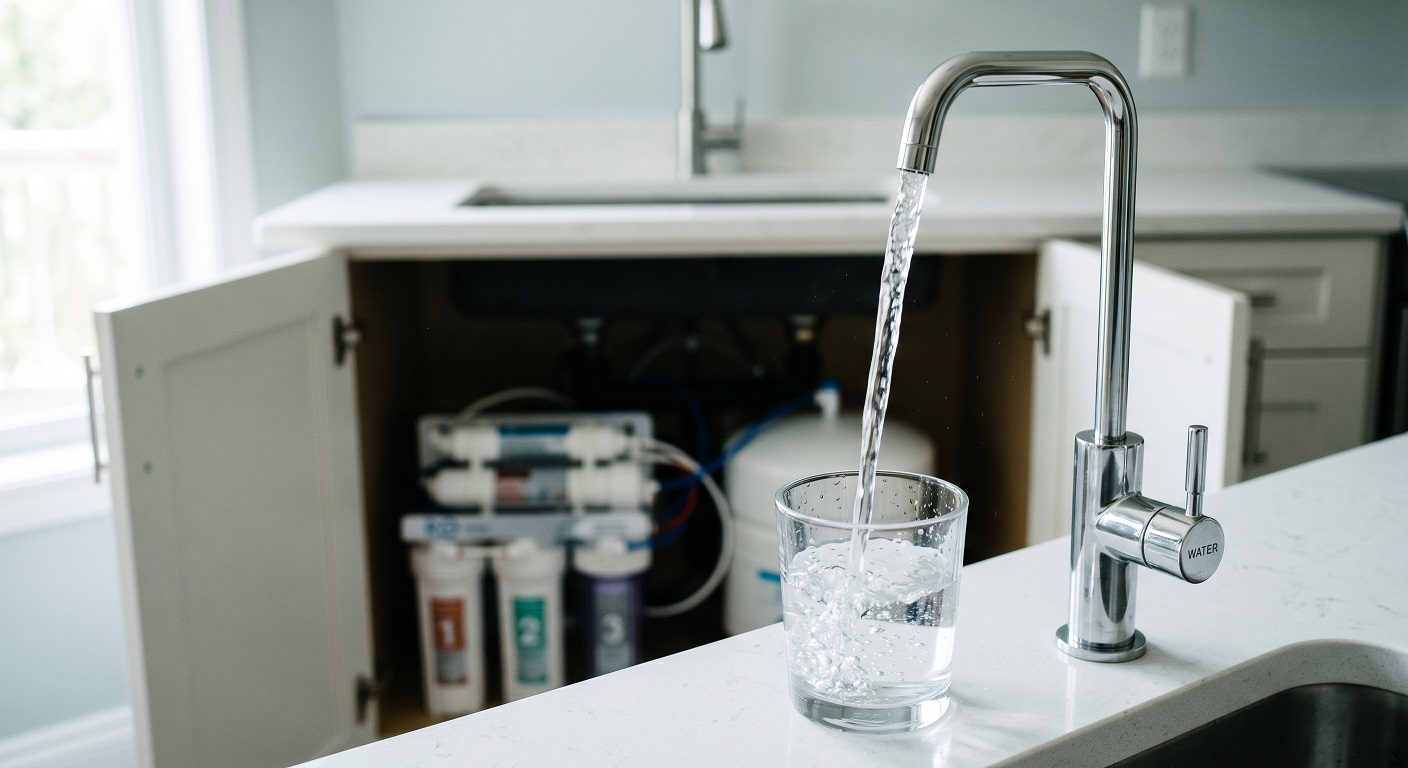
This article covers the full decision journey. By the time you finish reading, you will know exactly how reverse osmosis works, which contaminants it removes, how much a system costs, and, critically, whether it is the right choice for your water quality situation or whether a different treatment method would serve you better.
What Is Reverse Osmosis?
Reverse osmosis is a pressure-driven membrane separation process. Incoming water is pushed against a semi-permeable membrane, a barrier that allows water molecules to pass while rejecting many of the dissolved substances carried along with them. The result is two separate streams: the permeate, which is the purified water that reaches your tap, and the concentrate (sometimes called reject water or brine), which carries the rejected contaminants away from the system.
That distinction between permeate and concentrate is what separates reverse osmosis from conventional filtration. A carbon filter works by adsorption, trapping certain chemicals onto a media surface as water passes through. Reverse osmosis works differently. It physically separates water molecules from dissolved salts, heavy metals, and many other substances at a molecular level, handling a much wider range of contaminants simultaneously.
The mechanism is also more complex than the common description of water passing through very fine holes. Rejection depends on molecular size, ionic charge, and the chemistry of the membrane itself. This is why some contaminants are removed at very high rates while others pass through more easily. A certified reverse osmosis system tested for lead removal does not work the same way as one tested only for taste improvement.
One important nuance: reverse osmosis reduces contaminants, but the degree of reduction depends on membrane condition, operating pressure, feed water chemistry, and whether the system carries a certification for the specific contaminant you are concerned about. It does not produce laboratory-grade pure water, and it is not the right tool for every water quality problem.
How Does Reverse Osmosis Work?
The common explanation is that reverse osmosis pushes water through a very fine filter. That description is not wrong, but it leaves out the physics that make the process work, and understanding those physics matters when you are comparing systems or troubleshooting performance.
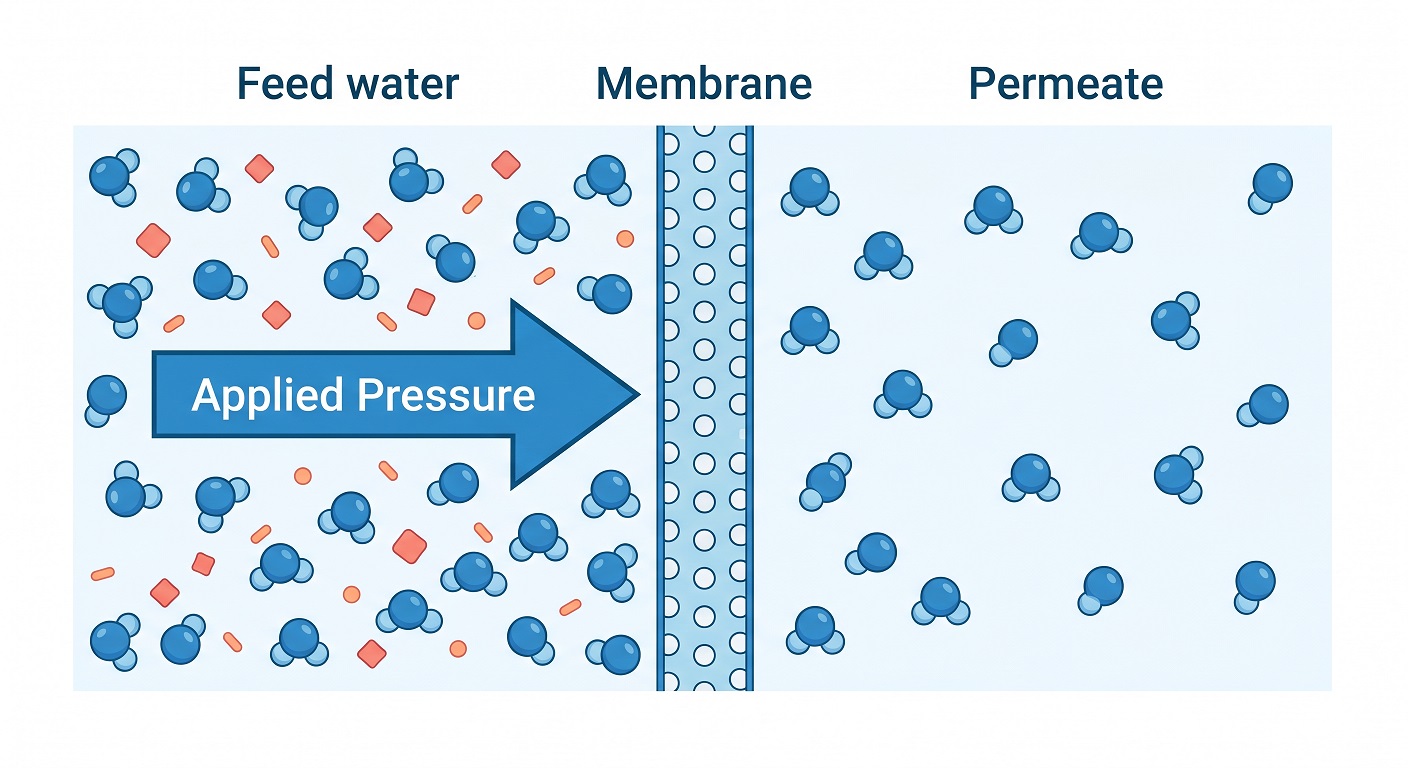
Water has a natural tendency to move toward higher concentrations of dissolved substances. That tendency is osmotic pressure, and overcoming it is the first job of a reverse osmosis system.
External pressure is applied to the untreated water. That pressure must exceed the natural osmotic pressure of the solution. Once it does, water molecules are forced toward and through the membrane. Dissolved contaminants cannot follow. They are left behind on the pressurised side and flushed away in a continuous reject stream.
Two things happen simultaneously. Purified water passes through the membrane and moves toward your tap. Contaminant-rich water flows across the membrane surface and exits as concentrate. That continuous crossflow is not incidental. Without it, rejected contaminants would accumulate at the membrane surface, reduce efficiency, and eventually foul the membrane entirely.
What the membrane actually does is more nuanced than blocking oversized particles. Rejection depends on molecular size, ionic charge, and how a contaminant interacts with the membrane chemistry and surrounding water molecules. This is why divalent ions such as calcium, magnesium, and lead are typically rejected at higher rates than monovalent ions such as sodium and chloride. Standard residential membranes reject dissolved salts at roughly 85 to 98 percent, depending on membrane quality, water temperature, and operating pressure.
The Stages of a Reverse Osmosis System
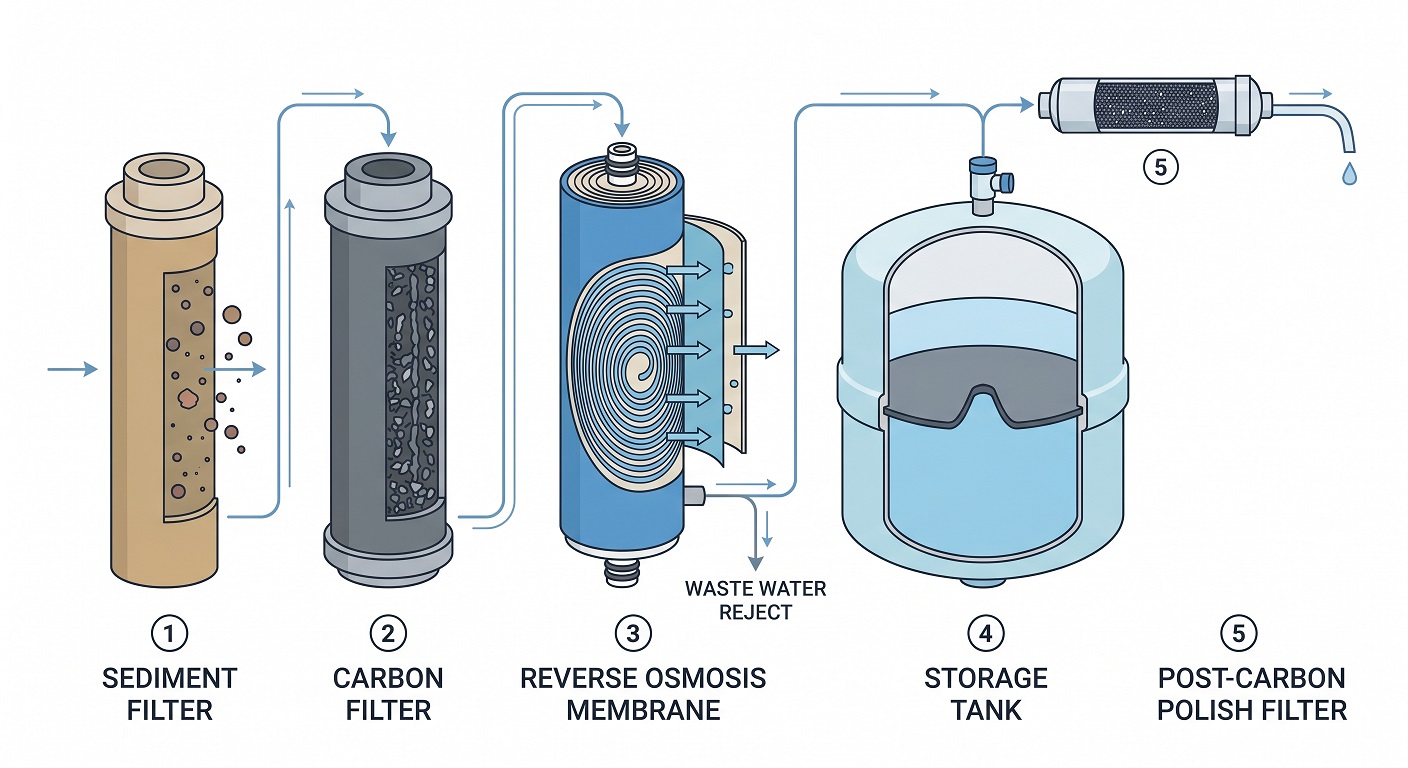
Most residential reverse osmosis systems move water through three to five distinct stages before it reaches your tap. Each stage has a specific job, and understanding what each one does helps you evaluate what a complete system includes before comparing products or add-ons.
Stage 1: Sediment pre-filtration
A sediment filter catches the largest physical particles first. Sand, rust, silt, and debris are removed here before the water reaches any downstream component. Skipping or neglecting this stage accelerates wear on everything that follows, including the membrane.
Stage 2: Carbon pre-filtration
One or two carbon filters remove chlorine, chloramines, and volatile organic compounds from the water. This stage is critical for membrane protection. Many polyamide membranes degrade when exposed repeatedly to chlorine, so the carbon stage acts as a chemical buffer before the most sensitive part of the system.
Stage 3: Membrane separation
This is the core of the system. Pressurised water is forced against the semi-permeable membrane. Water molecules pass through. Dissolved salts, heavy metals, and many other contaminants are rejected and flushed away as concentrate. What exits on the clean side is the permeate, the water that will eventually reach your glass.
Stage 4: Storage
Most under-sink systems store treated water in a small pressurised tank, typically holding two to four gallons, so that water is available on demand without waiting for the membrane to produce it in real time. Tankless systems skip this stage by using a booster pump to deliver water directly, at the cost of a higher upfront price.
Stage 5: Post-carbon polishing
A final carbon filter removes any residual taste or odour picked up from the storage tank before the water reaches your tap. This stage is brief but noticeable: it is the difference between flat-tasting treated water and water that is genuinely pleasant to drink.
What Does Reverse Osmosis Remove?
Key takeaways
- Certified reverse osmosis systems remove lead, arsenic, fluoride, PFAS, nitrates, and dissolved salts at rates typically ranging from 85 to 98 percent, depending on the contaminant and system certification.
- Removal rates vary by contaminant type, membrane condition, and operating pressure — a system must be certified for a specific contaminant to reliably address it.
- Reverse osmosis does not reliably remove dissolved gases or certain small uncharged molecules; for microbiological concerns, a UV post-treatment stage is the recommended complement.
Reverse osmosis is one of the most comprehensive water treatment methods available for residential use, but its removal capability is not uniform across all contaminants. What a system removes, and how completely it removes it, depends on the contaminant type, the membrane quality, operating conditions, and whether the system carries a third-party certification for that specific substance.
The following contaminants are commonly addressed by certified reverse osmosis systems, with typical removal rates where data is available:
Lead
Typically removed at 95 to 98 percent by certified systems. Lead exists in water as hydrated ions that cannot efficiently cross the membrane, making reverse osmosis one of the most reliable residential treatment methods for lead contamination.
Arsenic
Removal rates of 85 to 95 percent are typical for arsenate (As V), the most common form in drinking water. Arsenite (As III) is harder to remove and may require oxidation pre-treatment to convert it to the more rejectable form first.
Fluoride
Removed at approximately 85 to 92 percent under standard operating conditions. Removal efficiency decreases as membrane age increases, making timely membrane replacement particularly important for fluoride-sensitive households.
PFAS (per- and polyfluoroalkyl substances)
Certified reverse osmosis systems can significantly reduce many PFAS compounds. EPA investigations have confirmed that membrane systems reduce PFAS exposure, though removal rates vary by specific compound and system certification.
Nitrates
Removed at approximately 85 to 95 percent. This is particularly relevant for households on private wells in agricultural areas, where nitrate contamination from fertiliser runoff is common.
Dissolved salts and total dissolved solids (TDS)
Standard membranes reduce TDS by 85 to 98 percent. This is the primary reason reverse osmosis is used in desalination and why treated water often tastes noticeably cleaner than untreated tap water.
Heavy metals (including cadmium, chromium, and barium)
Generally removed at high rates due to their ionic charge and molecular size. Specific removal percentages vary by metal and membrane type.
Some bacteria and viruses
Reverse osmosis membranes can physically block many microorganisms, but systems are not typically certified as standalone disinfection devices. For microbiological concerns, a UV post-treatment stage is the recommended complement.
Volatile organic compounds (VOCs)
Partially removed by the carbon pre-filtration stages rather than the membrane itself. The membrane offers limited protection against low-molecular-weight VOCs, which is why the carbon stage in a multi-stage system matters.
Two contaminants that reverse osmosis does not reliably address are dissolved gases such as carbon dioxide and hydrogen sulfide, and certain small uncharged molecules. These pass through the membrane more easily than ionic contaminants. If dissolved gases are a concern in your water, pre-treatment or a separate aeration step is the more effective solution.
Certification matters more than marketing claims. A system advertised as removing a contaminant is not the same as a system certified by NSF International or the Water Quality Association to a specific standard for that contaminant. When evaluating systems, look for NSF/ANSI 58 certification, which covers reverse osmosis systems specifically, and check which contaminants are included in the certification scope.
Is Reverse Osmosis Water Safe? Pros and Cons
Reverse osmosis water is safe to drink. The process does not introduce any chemicals or byproducts into your water, and treated water from a properly maintained system consistently meets or exceeds drinking water safety standards. The safety question that does come up, and reasonably so, concerns minerals.
Reverse osmosis removes a significant portion of naturally occurring minerals from water, including calcium and magnesium. Some readers encounter claims that this makes the water “dead” or harmful. The evidence does not support that concern.
The minerals removed by reverse osmosis are present in water in very small quantities, and dietary intake from food is the primary source of these minerals for almost everyone. The World Health Organization has noted that low-mineral water is not a meaningful health risk for people with a balanced diet, though it acknowledges that very low mineral content may be a consideration for populations with marginal nutritional intake.
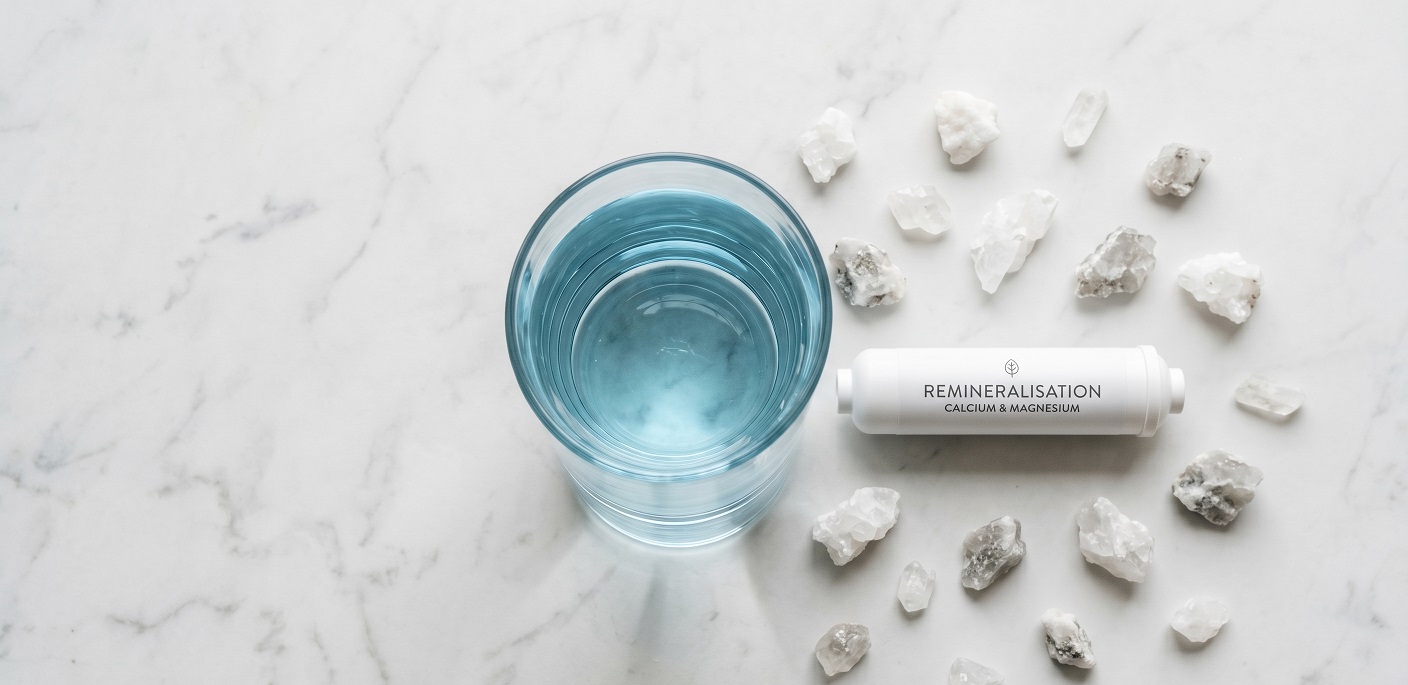
If mineral taste or content is a priority, a remineralisation filter can be added as a final stage. These add a small amount of calcium and magnesium back into the treated water, improving taste and addressing the mineral concern directly. It adds cost, typically between $30 and $80 for the filter stage, but it is a straightforward solution for households where this matters.
The practical pros and cons of reverse osmosis break down as follows:
| Type | Point | Detail |
|---|---|---|
| Pro | Broad contaminant removal | Few residential treatment methods address as wide a range of dissolved contaminants simultaneously. A certified system handles lead, arsenic, fluoride, nitrates, PFAS, and dissolved salts in a single pass, without requiring separate treatment stages for each. |
| Pro | No chemicals required | Unlike municipal water treatment, which uses chlorine and other disinfectants, reverse osmosis relies entirely on physical pressure and membrane separation. No chemicals are added to the water during treatment. |
| Pro | Consistent performance when maintained | A well-maintained system with timely filter and membrane replacement delivers consistent water quality. Performance does not degrade suddenly, it declines gradually, giving users time to respond before treatment quality drops significantly. |
| Con | Water waste | Standard systems produce roughly four to five gallons of reject water for every gallon of treated water. This is the most significant practical drawback and is covered in detail in the next section. |
| Con | Slow production rate | Residential systems typically produce 50 to 75 gallons of treated water per day, which is sufficient for drinking and cooking but not for high-volume uses. A storage tank addresses this for most households, but it adds to the system footprint under the sink. |
| Con | Removes beneficial minerals | This is manageable with a remineralisation stage, but it is a real trade-off worth factoring into the purchase decision. |
| Con | Ongoing maintenance required | Filters need replacement every six to twelve months, and the membrane every two to five years. A system that is not maintained loses effectiveness gradually and can become a source of contamination if biological growth develops in a neglected storage tank. |
For most households with a confirmed water quality concern, the pros outweigh the cons. The water waste issue and the maintenance requirement are the two factors most likely to affect a buying decision, and both are addressed in the sections that follow.
How Efficient Is Reverse Osmosis? Water Waste Explained
Water waste is the most common objection raised against reverse osmosis, and it is a legitimate one. A standard residential system produces roughly four to five gallons of reject water (concentrate) for every one gallon of treated water it delivers. That is a 4:1 or 5:1 waste ratio, meaning a household that uses one gallon of treated water per day is sending four to five gallons down the drain in the process.
The reject stream exists for a necessary reason. Contaminants rejected by the membrane have to go somewhere, and continuous crossflow flushes them away from the membrane surface to prevent fouling and maintain performance. Without that reject stream, the system would degrade rapidly. The waste is a function of the physics, not a design oversight.
Tip: If water efficiency is a priority, look for systems rated with a permeate pump. The upfront cost difference is modest, and the long-term water savings are substantial compared to a standard tank system.
The ratio varies considerably between system types. Standard systems without a permeate pump typically operate at a 4:1 ratio.
High-efficiency systems equipped with a permeate pump can bring that ratio down to approximately 1:1, producing one gallon of reject water for every gallon of treated water. For a household consuming one gallon of treated water per day, the difference between a standard and a high-efficiency system amounts to more than 1,400 gallons of water saved annually.
A few other factors affect the waste ratio in practice:
| Factor | Effect on waste ratio |
|---|---|
| Operating pressure | Lower inlet pressure produces a higher waste ratio. If your home’s water pressure runs below 40 psi, a booster pump improves both efficiency and production rate. |
| Feed water quality | Harder water or higher TDS levels increase the concentration gradient the membrane must work against, which can reduce efficiency and increase reject volume. |
| Membrane age | As membranes age and foul, rejection rates decline and waste ratios can increase. Timely membrane replacement maintains efficiency. |
| Tankless systems | These typically include a built-in booster pump and operate at a better efficiency ratio than standard tank systems, though they come at a higher upfront cost. |
For households with water scarcity concerns or high water costs, efficiency is worth factoring into the system selection decision. A permeate pump upgrade typically adds $50 to $150 to the system cost and pays back that difference through reduced water bills within one to two years for average household usage.
Do You Need Reverse Osmosis?
Reverse osmosis is a capable technology, but it is not the right solution for every household or every water quality situation. The decision comes down to three questions: what contaminants are actually present in your water, whether those contaminants fall within the range that reverse osmosis addresses effectively, and whether the cost and maintenance commitment are proportionate to the problem you are solving.
The section below gives you a direct framework for answering those questions. The following H3 covers the conditions under which reverse osmosis is clearly the right choice. The H3 after that covers water testing, which is the step that makes any treatment decision reliable rather than speculative.
Reverse Osmosis Is Right for You If…
Match the conditions below against your situation. If two or more apply, reverse osmosis is likely the most practical treatment solution available at the residential level.
- Your water contains confirmed levels of lead, arsenic, nitrates, fluoride, or PFAS. These contaminants are not reliably addressed by carbon filtration alone. Certified reverse osmosis systems are among the few residential treatment methods tested and rated for removal of all five.
- You are on a private well with elevated total dissolved solids (TDS) or unknown contamination history. Municipal water is regularly tested and reported. Well water is not. High TDS, agricultural runoff, and naturally occurring minerals are common in private well supplies, and reverse osmosis addresses the broadest range of these simultaneously.
- Your municipal water report shows contaminants at or near regulatory limits. Legal limits are not the same as health-optimal limits. If your water report shows lead, nitrates, or disinfection byproducts approaching the maximum contaminant level (MCL), a reverse osmosis system provides a meaningful additional margin of protection.
- You want drinking water that is consistently clean regardless of seasonal variation or infrastructure changes. Municipal water quality can shift with seasonal source changes, pipe aging, or treatment plant adjustments. A point-of-use reverse osmosis system at your tap gives you a consistent final barrier independent of upstream variability.
- You have a health condition that makes contaminant exposure a higher-than-average concern. Immunocompromised individuals, pregnant women, infants, and elderly household members face higher risk from contaminants such as lead, nitrates, and certain microorganisms. Reverse osmosis provides a reliable reduction layer for households where this applies.
If none of the above conditions apply to your situation, reverse osmosis may be more treatment than your water requires. The next section covers how to find out for certain.
Test Your Water Before You Buy
Buying a reverse osmosis system without testing your water first is like buying medication before you know your diagnosis. The system may work perfectly and address nothing you actually have. Water testing takes the guesswork out of the decision and confirms whether reverse osmosis is the right tool for your specific contamination profile.
Note: If you are on a private well, a certified laboratory test is not optional. It is the only way to know what is actually in your water before selecting any treatment system.
There are three practical testing routes, each suited to a different situation:
- Your municipal water quality report (Consumer Confidence Report). Every public water supplier in the United States is required by law to publish an annual water quality report, known as a Consumer Confidence Report (CCR). It lists the contaminants detected in your water supply, the levels found, and how those levels compare to EPA regulatory limits. This is the fastest and lowest-cost starting point for municipal water users. It is free, available online through your supplier’s website or the EPA’s database, and covers the most common contaminants of concern. Its limitation is that it reflects water quality at the treatment plant, not at your tap. Lead contamination, for example, typically occurs in household pipes rather than the supply itself and will not appear in a CCR.
- A certified laboratory water test. For the most reliable picture of what is actually coming out of your tap, a certified lab test analyses a water sample you collect at home and returns results for a specified panel of contaminants. A basic panel covering common minerals, metals, and bacteria typically costs between $100 and $150. A comprehensive panel including PFAS, pesticides, and volatile organic compounds runs $200 to $400. The EPA maintains a searchable database of certified laboratories by state at epa.gov. If you are on a private well, a certified lab test is not optional. It is the only reliable way to understand your water quality.
- Home test kits. Inexpensive strip-based test kits are available at hardware stores and online for $10 to $30. They provide a quick indication of pH, hardness, chlorine, and a handful of other parameters. They are useful for a rough initial screen but are not a substitute for a certified lab test when a purchase decision is at stake. Strip kits cannot test for PFAS, lead at low concentrations, or most regulated contaminants reliably.
Once you have your test results, match the contaminants identified against the removal capabilities covered in the What Does Reverse Osmosis Remove section above. If your confirmed contaminants fall within the range that a certified reverse osmosis system addresses, you have a clear basis for the purchase. If they do not, the next section covers the alternatives that may serve you better.
When Reverse Osmosis Is Not the Right Choice
Reverse osmosis is a capable treatment method, but recommending it for every water quality situation would be poor advice. There are circumstances where a simpler, cheaper, or more targeted solution does the job better. Knowing when not to choose reverse osmosis is as useful as knowing when to choose it.
Consider an alternative if any of the following applies to your situation:
- Your only concern is taste and odour from chlorine or chloramines. A quality activated carbon filter addresses chlorine and chloramines effectively and costs a fraction of a reverse osmosis system. Under-sink carbon filters are available from $50 to $150 and require nothing more than periodic cartridge replacement. If your municipal water report shows no heavy metals, nitrates, or other dissolved contaminants of concern, carbon filtration is the proportionate solution.
- You need whole-home treatment for sediment, hardness, or iron. Reverse osmosis at the whole-home level is expensive, water-inefficient, and unnecessary for most households. A sediment filter, water softener, or iron filter installed at the point of entry addresses these concerns more efficiently and at lower running cost than a whole-home reverse osmosis system.
- Your primary concern is microbiological contamination. While reverse osmosis membranes can physically block many bacteria and some viruses, systems are not certified as standalone disinfection devices. Ultraviolet (UV) treatment is specifically designed and certified for microbiological reduction and is the more reliable and cost-effective choice when bacteria, viruses, or cysts are the confirmed concern.
- You want highly pure water and water waste is not a concern. Distillation produces water of comparable or greater purity to reverse osmosis by boiling water and condensing the steam, leaving dissolved solids and most contaminants behind. It requires no membrane, produces no reject stream, and is effective against a broad range of contaminants. The trade-off is energy consumption and slow production rate. For small volumes of very high purity water, distillation is a practical option worth considering.
- Your water source is microbiologically unsafe at the source level. Reverse osmosis is a point-of-use treatment, not a whole-water-supply solution. If your water supply is subject to boil-water advisories or confirmed bacterial contamination at the source, a point-of-use reverse osmosis system alone is not a sufficient response. Municipal treatment, source remediation, or a combined UV and reverse osmosis system is the appropriate approach.
The common thread across these scenarios is proportionality. Water treatment should address the actual contamination profile of your water, not the broadest possible range of contaminants. Matching the treatment method to the confirmed problem saves money, reduces water waste, and produces water that is just as safe as a more complex system would.
Where Should You Use Reverse Osmosis?
Reverse osmosis systems are available in two broad placement categories: point-of-use and point-of-entry. Understanding the difference between them is the first step toward choosing the right format for your situation.
Point-of-use systems (installed at a single tap or outlet) treat water at the location where you consume it. An under-sink system fitted to your kitchen tap is the most common example. These systems treat only the water drawn from that tap, which means the rest of your household water supply remains untreated.
For most residential buyers, this is entirely appropriate: drinking and cooking water accounts for a small fraction of total household water use, and treating the full supply to drinking water standards is neither necessary nor cost-effective for the majority of households.
Point-of-entry systems (installed where the water supply enters your home) treat all water entering the building before it reaches any tap, shower, or appliance. These are sometimes called whole-home systems.
They make sense in a narrow set of circumstances: where the contamination concern affects all water uses, where a vulnerable household member requires consistently treated water from every outlet, or where a commercial or industrial application demands treated water at scale. For most residential users, the cost, water waste, and infrastructure requirements of a point-of-entry reverse osmosis system are difficult to justify against the more targeted and affordable point-of-use alternative.
The sections below cover the two most common point-of-use formats (under-sink and countertop) and the whole-home option, with the practical trade-offs for each.
Under-Sink and Countertop Systems
Under-sink and countertop systems are the two most common formats for residential point-of-use reverse osmosis. Both treat water at a single outlet and are sized for drinking and cooking water only. The practical differences between them come down to installation, space, and how you use your kitchen.
Under-sink systems are installed inside the cabinet beneath your kitchen sink, connected to the cold water supply line and fitted with a dedicated tap on the countertop above. Most residential under-sink systems include a storage tank holding two to four gallons of treated water, which means water is available immediately on demand rather than waiting for the membrane to produce it in real time. The system is hidden from view, which most users prefer, but it requires cabinet space, a connection to the drain line for the reject stream, and a small hole drilled through the countertop or sink deck for the dedicated tap.
Installation is straightforward for most under-sink setups. A standard system comes with all fittings and a step-by-step guide. Connecting the feed line, mounting the tap, and running the drain line to the sink drain takes most homeowners two to three hours with basic tools.
The main variables are cabinet depth and whether your sink deck has a pre-drilled hole for an additional tap.
The choice between them is almost entirely practical: under-sink for permanent installations where cabinet space is available, countertop for flexibility or where a permanent tap modification is not possible.
Countertop systems sit on the counter and connect directly to your existing tap via a diverter valve, requiring no drilling, no permanent plumbing changes, and no installation beyond attaching the diverter. They are the right choice for renters, for households that want to try reverse osmosis without a permanent commitment, and for anyone who moves frequently. The trade-off is bench space: a countertop system typically occupies a footprint of roughly 10 to 14 inches and sits visibly on the counter at all times.
Countertop systems are also available in tankless formats that produce water on demand without a storage tank. These are slower than tank systems for large draws but are compact and eliminate the maintenance concern associated with a storage tank. For a single person or couple using reverse osmosis water primarily for drinking, a countertop tankless system is a practical and low-commitment entry point.
On performance, both formats deliver comparable water quality when the membrane and filters are maintained on schedule. The choice between them is almost entirely practical: under-sink for permanent installations where cabinet space is available, countertop for flexibility or where a permanent tap modification is not possible.
Whole-Home Systems: Are They Worth It?
A whole-home reverse osmosis system, installed at the point of entry where the water supply enters the building, treats every litre of water in the house before it reaches any tap, shower, or appliance. For most residential buyers, this is significantly more treatment than the situation warrants. Understanding why helps clarify when it does make sense.
The core problem with whole-home reverse osmosis for residential use is scale. A typical household uses 80 to 100 gallons of water per day across all purposes: showering, laundry, flushing toilets, watering plants, and washing dishes, as well as drinking and cooking. Drinking and cooking account for roughly one to three gallons of that total.
A whole-home system treats all 80 to 100 gallons to drinking water standards, which means the vast majority of treated water is used for purposes that do not require that level of treatment. The water waste generated by treating the full supply at a 4:1 ratio would amount to 320 to 400 gallons of reject water per day for an average household.
The cost reflects this scale. Whole-home reverse osmosis systems start at approximately $1,000 to $5,000 for the equipment alone, with installation adding $500 to $2,000 depending on plumbing complexity and whether pretreatment stages are required. Ongoing filter and membrane replacement costs are proportionally higher than point-of-use systems because the volume of water being processed is far greater.
For a household where only one to three gallons per day actually need drinking water treatment, the economics are difficult to justify.
Whole-home systems are warranted in a narrower set of circumstances:
- Private well water with contamination concerns affecting all household uses. If arsenic, nitrates, or heavy metals are present at levels that make skin contact or inhalation during showering a concern, whole-home treatment addresses the problem at the source rather than at individual taps.
- Households with members who require treated water from every outlet. Immunocompromised individuals or infants who require consistent water quality across all uses, including bathing, may benefit from whole-home treatment where a point-of-use system at a single tap is insufficient.
- Commercial or light industrial applications. Food service operations, laboratories, or small manufacturing facilities where treated water is required at multiple outlets simultaneously are the most practical use case for whole-home or building-wide reverse osmosis systems.
For the vast majority of residential buyers, a point-of-use under-sink or countertop system addresses the actual need at a fraction of the cost, with far less water waste and infrastructure complexity. The whole-home option is worth investigating only when the contamination concern genuinely extends beyond the drinking and cooking water supply.
How Much Does a Reverse Osmosis System Cost?
The cost of a reverse osmosis system varies considerably by type, and the upfront equipment price is only part of the picture. A complete cost assessment covers the system itself, installation, and the ongoing filter and membrane replacement costs that determine what you actually spend over the life of the system.
Countertop systems: $100 to $300
The most affordable entry point. Countertop systems require no installation cost and no plumbing modifications. The lower price reflects a simpler design, smaller production capacity, and typically fewer filtration stages than under-sink systems. For renters or buyers who want to evaluate reverse osmosis before committing to a permanent installation, this tier is a practical starting point.
Under-sink systems: $150 to $500
The most common residential choice. Systems at the lower end of this range are basic three-stage or four-stage units suitable for municipal water with moderate TDS.
Systems at the upper end typically include additional filtration stages, higher production capacity, a permeate pump for improved efficiency, or a remineralisation stage. The price difference between a $150 and a $400 under-sink system usually comes down to membrane quality, the number of filtration stages, and whether a booster pump is included.
Whole-home systems: $1,000 to $5,000 and above
Equipment cost alone falls in this range. Installation adds $500 to $2,000 depending on plumbing complexity, and pretreatment stages (sediment filtration, water softening, or iron removal) may add further cost depending on source water conditions. As discussed in the previous section, the economics of whole-home reverse osmosis are difficult to justify for most residential buyers unless the contamination concern genuinely affects all household water uses.
Commercial systems: $5,000 to $20,000 and above
Commercial systems are engineered for high-volume continuous production and are outside the scope of most residential purchase decisions. Pricing at this level reflects industrial-grade membranes, high-capacity pressure vessels, automated monitoring, and professional installation requirements.
For most households, the total cost of owning a mid-range under-sink reverse osmosis system runs approximately $300 to $500 upfront and $100 to $200 per year in ongoing maintenance and water costs.
Ongoing ownership costs apply to all tiers and should factor into the purchase decision:
| Cost item | Typical range |
|---|---|
| Pre-filters and post-filters | $50 to $150 per year for a standard under-sink system, depending on the number of stages and cartridge prices for your specific model. |
| Membrane replacement | $30 to $80 for a residential membrane, replaced every two to five years depending on water quality and usage. |
| Water cost | At a standard 4:1 waste ratio and average US water rates, the additional water cost from reject water amounts to roughly $20 to $50 per year for a household using one to two gallons of treated water per day. A high-efficiency system with a permeate pump reduces this cost substantially. |
| Professional servicing | Not required for most residential systems on a regular basis, but a periodic system check every two to three years is advisable for systems with storage tanks, at a typical cost of $100 to $200. |
For most households, the total cost of owning a mid-range under-sink reverse osmosis system runs approximately $300 to $500 upfront and $100 to $200 per year in ongoing maintenance and water costs. Over a five-year period, that amounts to a total ownership cost of roughly $800 to $1,500, depending on the system and local water rates.
Installation, Maintenance, and Running Costs
Owning a reverse osmosis system involves three practical commitments beyond the upfront purchase: getting it installed, keeping the filters and membrane on schedule, and monitoring performance so you know when something needs attention. None of these is particularly demanding, but understanding what each involves helps you budget accurately and avoid the most common ownership mistake, which is neglecting maintenance until performance noticeably drops.
Installation varies by system type and is covered in the H3 below. Maintenance applies to every system regardless of type, and the schedule is more straightforward than many buyers expect. The two H3s that follow cover each in detail.
Do You Need a Professional to Install It?
For most under-sink and countertop systems, professional installation is not required. Many residential reverse osmosis systems are designed explicitly for homeowner installation and come with all fittings, tubing, and a step-by-step guide. The question is not whether you can install it yourself, but whether your specific situation makes DIY installation practical.
DIY installation is viable if:
- You are installing an under-sink system with standard plumbing and an accessible cold water supply line under the sink.
- Your sink deck has a pre-drilled hole for an additional tap, or you are comfortable drilling one yourself with a standard hole saw.
- You have a drain line connection point within reach of the system location.
- Making push-fit or compression plumbing connections with basic hand tools is within your comfort range.
- You are installing a countertop system, which requires only attaching a diverter valve to your existing tap, with no tools required beyond hand tightening.
Professional installation is recommended if:
- You are installing a whole-home or point-of-entry system, which requires cutting into the main supply line, integrating pretreatment stages, and configuring a reject water drain at the building level.
- Your plumbing is older, non-standard, or uses materials (such as galvanised steel or lead pipe) that complicate fittings and connections.
- Your system requires a booster pump installation, which involves electrical connections in addition to plumbing work.
- You are on a private well system with pretreatment components (softener, sediment filter, UV unit) that need to be integrated with the reverse osmosis system.
- You are not comfortable with any of the DIY conditions above and want the installation warrantied by a professional.
For a standard under-sink system in a modern kitchen, DIY installation typically takes two to three hours and requires a bucket, an adjustable wrench, and a drill if a tap hole is needed. The most common installation issues are a loose drain saddle clamp causing slow drips and a feed line connection that was not fully seated. Both are easy to identify during the initial system flush and straightforward to fix without professional help.
Filter Replacement and Membrane Lifespan
The maintenance schedule for a residential reverse osmosis system is built around four components, each with a different replacement interval. Keeping to this schedule is the single most important thing you can do to maintain water quality and extend the life of the membrane, which is the most expensive component to replace.
The standard replacement schedule for a typical under-sink system is as follows:
| Component | Replace every | Why it matters |
|---|---|---|
| Sediment pre-filter | 6 to 12 months | Catches physical particles before they reach the carbon stage and membrane. When clogged, flow rate drops and downstream components work harder. In high-sediment supplies, replacement may be needed closer to 6 months. |
| Carbon pre-filter | 6 to 12 months | Removes chlorine and chloramines before the water reaches the membrane. Chlorine exposure is one of the primary causes of polyamide membrane degradation, and an exhausted carbon filter provides no protection against it. If you are on municipal water with chloramine treatment, verify your carbon filter is rated for chloramine removal, not just chlorine. |
| Post-carbon polishing filter | 12 months | Improves the taste of treated water after it leaves the storage tank. An exhausted post-filter will not compromise the safety of the water, but the taste will deteriorate noticeably. |
| RO membrane | 2 to 5 years | Lifespan depends more on water quality and pretreatment maintenance than on a fixed calendar date. A membrane in a municipal system with moderate TDS and consistent filter changes may last toward the upper end of that range. A membrane exposed to high hardness, iron, or chlorine due to neglected pre-filters may fail significantly earlier. Rising TDS in treated water signals declining rejection performance. |
Two signs that maintenance is overdue regardless of the schedule: a noticeable drop in flow rate from the dedicated tap, and a change in the taste of the treated water. Flow rate decline usually indicates a clogged pre-filter or a fouled membrane. Taste deterioration usually points to an exhausted post-filter or, in more serious cases, biological growth in a storage tank that has not been sanitised.
A TDS meter is the most practical tool for monitoring membrane performance between scheduled replacements. Measuring the TDS of your treated water at installation gives you a baseline. A reading that has risen by 20 percent or more above that baseline is a reliable indicator that the membrane is losing rejection efficiency and replacement is approaching.
Is Reverse Osmosis Right for You?
Reverse osmosis is one of the most effective water treatment technologies available for residential use, but effectiveness alone is not the right measure for a purchase decision. The right measure is fit: does the contamination profile of your water match the range of contaminants that a certified reverse osmosis system reliably addresses, and is the cost and maintenance commitment proportionate to the problem you are solving?
If your water contains confirmed levels of lead, arsenic, nitrates, fluoride, or PFAS, reverse osmosis is likely the most practical solution available at the residential level. No other point-of-use treatment method addresses that range of dissolved contaminants simultaneously in a single system.
For taste and odour concerns from chlorine alone, a carbon filter is the proportionate and more affordable solution. If bacteria or viruses are the primary concern, UV treatment is the more targeted and certified option. Matching the treatment to the confirmed problem is always the better approach.
Water waste and maintenance are the two practical trade-offs that most affect satisfaction with reverse osmosis ownership. A high-efficiency system with a permeate pump addresses the water waste concern substantially. A consistent filter replacement schedule, built around the intervals in this article, addresses the maintenance concern. Neither requires significant effort once the system is set up and the schedule is established.
The recommended next step is straightforward. If you do not yet have a water test, start there. Request your municipal Consumer Confidence Report or commission a certified laboratory test for the contaminants most relevant to your source water. Match the results against the contaminant removal capabilities in this article.
If reverse osmosis is the right fit, select a system certified to NSF/ANSI 58 for the specific contaminants identified in your test. If it is not the right fit, the alternatives section above gives you the starting point for a more targeted solution.
Clean water is not a complicated goal. The technology to achieve it is well understood, widely available, and within reach for most households at a reasonable cost. The only step that makes the difference between a good purchase and an unnecessary one is knowing what is actually in your water before you decide how to treat it.
Leave a Reply
You must be logged in to post a comment.