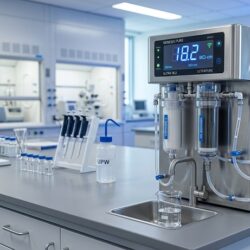
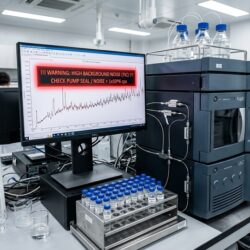
Validating your lab water quality means systematically testing resistivity, TOC, conductivity, and microbial load against recognized benchmarks like ASTM D1193-24, ISO 3696, and USP, using calibrated inline sensors and scheduled point-of-use sampling.
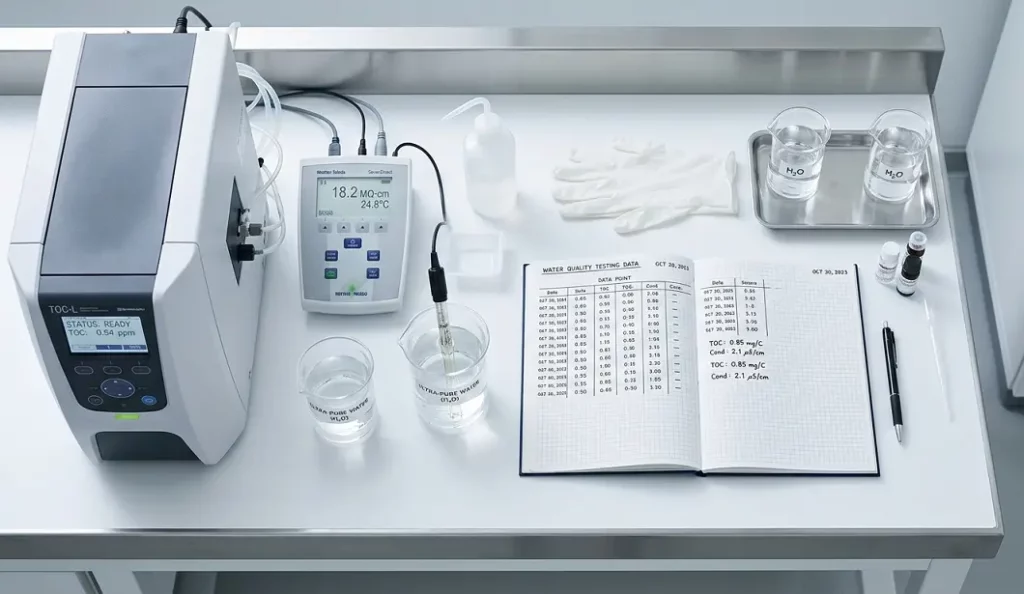
This is not a guesswork process; it is a structured, evidence-based discipline. A properly validated water system transforms an invisible risk factor into a documented, controlled variable.
Here is the uncomfortable truth…
The water coming out of your purification unit right now may look perfectly clear and pass a quick resistivity check, yet still carry enough dissolved organics, trace ions, or biofilm fragments to corrupt your most sensitive assays.
If your lab does not have a written validation procedure, you are essentially running experiments on an unqualified reagent.
Understanding the Standards
Before you can validate anything, you need a target. Three major standards frameworks define what “acceptable” lab water actually means, and they do not all agree.
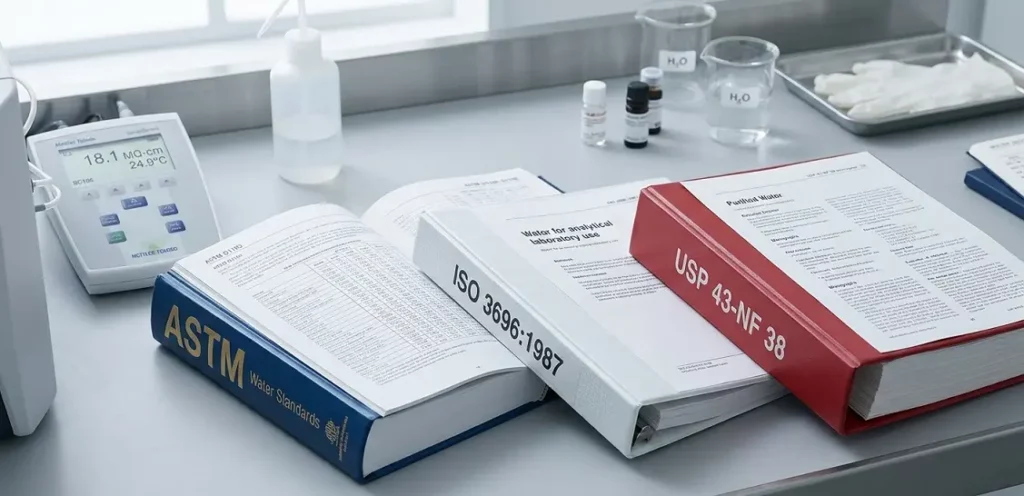
ASTM D1193-24 is the most recently revised specification from ASTM International. It defines four water types based on resistivity, TOC, sodium, chloride, silica, and endotoxin thresholds. Type I is the highest purity tier, requiring a minimum resistivity of 18 MΩ·cm at 25°C and a TOC ceiling of 50 ppb. The 2024 revision notably decouples water type from production technology: you are now free to use any purification method as long as the output meets the specified parameters.
ISO 3696:1987 uses a three-grade scale (Grade 1 through Grade 3) instead of types. Grade 1 is functionally equivalent to ASTM Type I and is intended for the most demanding analytical applications, including HPLC. It is produced by further treating Grade 2 water through ion exchange or reverse osmosis followed by 0.2-µm membrane filtration.
USP standards, primarily General Chapters <1231> and <643>, govern water used in pharmaceutical manufacturing and testing. USP focuses heavily on online, real-time monitoring of conductivity and TOC, and it sets specific microbial action limits for Purified Water (100 cfu/mL) and Water for Injection (10 cfu/100 mL).
Choosing Your Target Purity Grade
Picking the wrong standard is just as costly as having no standard at all. Your target purity grade must match the sensitivity of your downstream application.
A quick reference:
For a detailed breakdown of how Type I and Type II water differ in practice, see Type 1 vs. Type 2 Lab Water.
The gap between standards matters in regulatory contexts too. If your lab operates under GLP or GMP, USP requirements are likely non-negotiable, and the documentation burden escalates significantly. Choose your target grade based on the most demanding application in your lab, then build your SOP around meeting and proving it.
Once you know what you are aiming for, the real question becomes: how do you actually prove you are hitting it? That is where the three-pillar framework comes in.
The 3-Pillar Validation Framework
No single test is sufficient to declare your water validated. Genuine lab water quality validation rests on three interdependent pillars: physical, chemical, and biological. A gap in any one of them leaves a blind spot in your quality system.
Pillar 1: Physical Validation (Resistivity and Conductivity)
Resistivity and conductivity are mirror images of the same measurement. Resistivity tells you how strongly your water resists the flow of electrical current, which is a direct proxy for ionic purity. The gold standard for Type I water is 18.18 MΩ·cm at 25°C, which represents theoretical pure water. In practice, any reading consistently above 18.0 MΩ·cm is acceptable.
The key word is inline. Measuring resistivity from a collected sample introduces atmospheric CO₂ almost immediately, which dissolves into carbonic acid, drops the pH, and suppresses your resistivity reading. An inline sensor at the point of dispense is the only way to measure your actual water quality.
For a deeper look at how these parameters interact and what the numbers really mean, Conductivity Measurement and Water Purity lays it out clearly.
Sensor calibration requirements:
Pillar 2: Chemical Validation (TOC and Ionic Impurities)
Total Organic Carbon (TOC) is the single most informative non-ionic water quality parameter you can measure. It quantifies the total mass of carbon in organic compounds dissolved in your water, expressed in parts per billion (ppb). For ASTM Type I water, the upper limit is 50 ppb. For USP Purified Water, the limit is also 500 ppb, but many analytical labs set internal action limits far tighter, around 10-20 ppb, to catch degradation early.
TOC creeps up gradually. A reading that was 8 ppb last week and is now 22 ppb is a signal that your polishing resin or activated carbon is nearing exhaustion, or that biofilm is establishing itself upstream. A jump from 8 ppb to 85 ppb overnight is a different kind of problem entirely, likely a cartridge failure or a contamination event.
For a practical guide to interpreting TOC in context with conductivity readings, TOC vs. Conductivity in Water Quality is an excellent resource. You should also review the Total Organic Carbon Water Testing Guide for method details.
Beyond TOC, ionic impurity testing should cover sodium, chloride, and silica, especially for Type I applications. Silica, in particular, is problematic for semiconductor and trace analysis work because it is not removed by ion exchange alone and requires dedicated silica-selective resins.
Pillar 3: Biological Validation (Bacteria and Endotoxins)
Biological validation is non-negotiable if your lab conducts cell culture, molecular biology, or any work under GMP/GLP. Bacteria and endotoxins behave differently from chemical contaminants and require different testing strategies.
Bacterial counts are reported in colony-forming units per milliliter (cfu/mL). Action limits vary by standard: USP allows up to 100 cfu/mL for Purified Water. Life science applications often demand far less, with internal limits set at 1-10 cfu/mL or even below detection.
Endotoxins are lipopolysaccharides (LPS) shed from the cell walls of gram-negative bacteria. Even dead bacteria leave endotoxins behind, so a sterile-filtered water supply can still carry a significant endotoxin burden if biofilm was ever present. The pharmacopoeial limit for Water for Injection is 0.25 EU/mL, measured using the validated Limulus Amebocyte Lysate (LAL) method as described in USP <85>. For molecular biology-grade water, many labs target below 0.03 EU/mL.
Biological testing requires a different sampling protocol. You cannot use the same inline sensor approach you use for resistivity. Grab samples must be collected aseptically into pre-sterilized containers, transported under controlled conditions, and plated or assayed within defined hold times.
The framework is now clear…
The harder question is: how do you turn it into something your team actually executes consistently? That comes down to your SOP.
Developing a Standard Operating Procedure
A validation framework without a written SOP is just a theory. Your SOP defines who tests what, where, when, and what they do with the data. Without it, testing frequency drifts, sampling locations change informally, and you have no defensible record when an auditor or an out-of-spec result demands an explanation.
Testing Frequency: Daily, Weekly, and Monthly Tasks
Daily checks (takes under 5 minutes):
Weekly checks (15-30 minutes):
Monthly checks (1-2 hours):
Point-of-Use Sampling vs. Reservoir Sampling
This is where most labs make a critical error. Sampling from the reservoir tells you how clean your stored water is. Sampling at the point of use tells you the quality of water entering your experiment.
These two values are often not the same.
Dispensing nozzles accumulate biofilm. Tubing downstream of the polishing cartridge can leach plasticizers into the water. A dead leg in your plumbing loop allows stagnant water to warm and microbes to multiply. The only way to know what your assay is actually using is to sample at the point of dispense, under normal operating flow conditions, not after flushing for two minutes.
Where errors most commonly originate:
H3 Headlines
For a comprehensive overview of the parameters you need to track at each sampling point, Water Quality Monitoring Parameters Explained walks through the full list.
Documenting Results for GLP and GMP Audits
Documentation is not optional if you operate under any form of regulated environment. Under Good Laboratory Practice (GLP) and Good Manufacturing Practice (GMP) principles, if it was not documented, it did not happen.
Your water quality log must include:
An audit-ready record is one that tells a complete, unambiguous story. A regulatory inspector reviewing your lab should be able to pick up your water quality log and trace every batch of results forward to the instruments they fed and backward to the purification system state at the time of testing.
For guidance on building compliant documentation systems for regulated environments, the FDA’s guidance on 21 CFR Part 58 (GLP regulations) and the WHO guidelines on water for pharmaceutical use are authoritative references.
Knowing your schedule and your documentation requirements is step one. But even a well-run SOP can miss problems that masquerade as normal variation until it is too late. That is why you need to know exactly what a genuine red flag looks like.
Identifying Validation Red Flags
Most water quality failures give you a warning before they become a catastrophe. The key is knowing which warning signs demand immediate action and which ones can be addressed through routine maintenance.
Sudden Resistivity Drop vs. Gradual TOC Increase
These two failure patterns have completely different causes and call for different responses.
A sudden, steep drop in resistivity (for example, from 18.1 MΩ·cm to 14 MΩ·cm within hours) almost always indicates one of three things: ion exchange resin exhaustion, a resin bed fracture allowing channeling, or a sudden influx of ionic contamination from the feed water. This is an immediate, stop-work-level event. Water quality that drops this sharply cannot be trusted for any sensitive application until the root cause is identified and corrected.
A gradual, slow increase in TOC over days or weeks is a different signal entirely. It suggests progressive degradation: your carbon adsorption stage is loading up, your UV oxidation lamp is aging, or early-stage biofilm is beginning to shed organic matter into your product water. This is a predictive maintenance signal. You have time to act, but you should not ignore it. By the time TOC has doubled from your baseline, you are already behind.
The Water Quality Monitoring Parameters guide at WHO and the ASTM International standards portal both provide reference data for interpreting parameter excursions in context.
When to Change a Cartridge vs. When to Call a Technician
This is one of the most practically useful distinctions you can make.
Change the cartridge yourself when:
Call a certified technician when:
For a full breakdown of maintenance cost modeling and what routine vs. unscheduled service typically costs a lab annually, see Lab Water System Maintenance Costs.
The distinction matters because an unnecessary technician call costs you time and money, but a delayed call during a genuine failure event costs you something worse: compromised experiments and potentially the need for a full system decontamination.
You now know what to test, how to test it, when to test it, and what a warning looks like. There is one more piece: the mindset that makes all of this sustainable.
Conclusion: Building a Culture of Purity
A validated water system is not a one-time achievement. It is an ongoing commitment, and the labs that do it best treat water quality the same way they treat instrument calibration: as a non-negotiable baseline, not a box to check during an audit cycle.
The ROI of Proactive Validation
The business case for rigorous water quality validation is straightforward, even if it rarely gets framed that way.
Consider a single lost batch in a cell biology lab. Depending on the cell line and the reagents involved, the direct material cost of a contaminated culture can run from a few hundred to several thousand dollars. Add the time lost, the opportunity cost of delayed results, and the downstream impact on your timeline, and a single contamination event caused by poor water quality easily justifies months of routine testing costs.
A pharmaceutical water system that revalidated its loop by eliminating dead legs and tightening its sanitization schedule reduced water-related deviations by over 80%, moving from eleven documented deviations per year to just two. That improvement required no major capital spending; it required a better process and more consistent execution.
Proactive validation also protects you from the worst outcome of all: discovering a water quality problem through a failed experiment rather than through a failed QC test. Failed experiments waste resources silently. Failed QC tests are visible, documentable, and correctable.
For systems capable of delivering consistent Type I water quality with continuous online monitoring, the Analytica 100 Pro is worth evaluating alongside a review of ultra-pure water system options to find the right fit for your throughput and application requirements.
Water quality is invisible until it is not. Make it visible before it costs you.
Lab Water Quality Validation Checklist
Use this checklist as your monthly audit tool. Mark each item [PASS] or [FAIL] and file it in your water quality log.