
Implementing AI in laboratory maintenance requires a stack of IoT lab sensors, cloud-based predictive algorithms, and digital water logs to eliminate downtime. This high-stakes transition from reactive repairs to data-driven facility management is the only way to ensure 99.9% system reliability.
By integrating these smart lab technologies, you move from a state of constant anxiety to a predictable, optimized environment where compliance is a byproduct of the system itself.
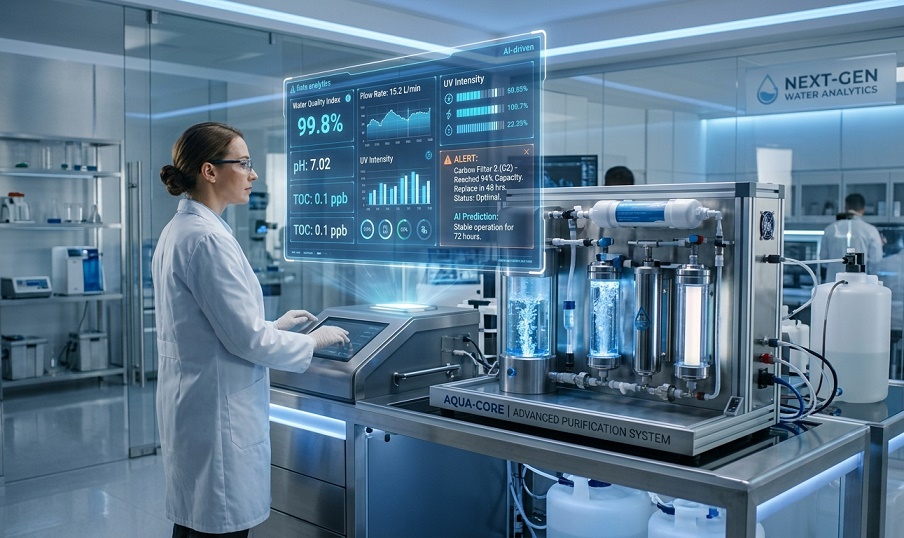
You might think your current maintenance schedule is “good enough” because the lights are still on and the water is still flowing. But beneath the surface, microscopic drifts in purity and mechanical wear are silently eating your budget and threatening your next big breakthrough.
If you don’t look closer at the data, you are essentially flying a plane with a broken altimeter; and the ground is coming up faster than you think.
The Evolution of Predictive Maintenance
Traditional maintenance is a relic of the past. For decades, labs relied on “calendar-based” service, replacing parts because it was Tuesday, not because they were actually worn out. This led to massive waste or, even worse, catastrophic failure because a part decided to quit on a Monday.
AI changes the game by analyzing historical data and real-time inputs to create a “digital twin” of your equipment. By comparing current performance against millions of data points, the system identifies the exact moment a component will fail. This allows you to schedule repairs during planned downtime, ensuring your research never misses a beat.
Moving Beyond the Calendar
In 2026, the industry standard has shifted toward Condition-Based Maintenance (CBM). According to the International Organization for Standardization, CBM protocols significantly reduce the “mean time to repair” by providing technicians with the exact cause of a fault before they even arrive on site.
The Cost of Reactive Maintenance vs. AI-Driven Maintenance
| Feature | Reactive Maintenance | AI Predictive Maintenance |
|---|---|---|
| Cost Basis | High (Emergency fees + Downtime) | Low (Planned parts replacement) |
| Asset Lifespan | Reduced due to stress | Extended through optimization |
| Compliance | Manual/Prone to error | Automated/Real-time |
| Uptime | Unpredictable | 99.9% Guaranteed |
But even the smartest AI is useless if it doesn’t have eyes on the ground, which brings us to the hardware that makes this magic possible.
How IoT Lab Sensors Detect Drift
The “drift” is a silent killer in water purification. It starts as a tiny fluctuation in resistivity or a fractional increase in Total Organic Carbon (TOC). Humans can’t see it until the lab results come back tainted, but IoT lab sensors catch it in milliseconds.
These sensors act as the nervous system of the laboratory. They feed a constant stream of telemetry to the AI, which looks for “signatures” of failure. For example, a slight increase in pump vibration coupled with a rise in temperature is a classic signature of an impending bearing failure.
Early Warning Signs in Water Purity
In high-purity water systems, maintaining ASTM Type I standards is non-negotiable. If you want to dive deeper into the specifics of these requirements, check out our 2026 guide on autoclave water quality.
- TOC Spikes: Suggesting organic breakthrough or biofilm growth.
- Resistivity Drops: Indicating ion exchange exhaustion.
- Pressure Fluctuations: Signaling membrane scaling.
2026 Regulatory Precision Standards
The latest guidance from the Environmental Protection Agency suggests that real-time monitoring is now the preferred method for ensuring environmental compliance in lab discharge. Sensors must now be calibrated to a precision of ±0.01% to meet the most stringent AI-validation protocols.
The real power, however, isn’t just in knowing something is wrong; it is in seeing it from anywhere in the world.
Benefits of Remote Monitoring
Gone are the days when a facility manager had to walk from room to room with a clipboard. Remote monitoring allows you to oversee a global network of laboratories from a single dashboard. Whether you are at your desk or at a conference in Switzerland, you have total visibility.
This centralization allows for “expert-level” oversight across every site. If a system in a satellite lab starts showing signs of membrane fatigue, a specialist at the headquarters can diagnose the issue remotely. This eliminates the need for expensive “investigatory” service visits.
Managing Multiple Systems from One Dashboard
Modern interfaces use “Heat Maps” to show the health of your entire facility. A green icon means the system is within its 2026 baseline parameters; amber means a service is due within 30 days; red means immediate intervention is required.
- Customized Alerts: Get a text or email the moment a parameter drifts.
- Historical Trends: Compare the performance of different units to find the “best-in-class” setup.
- Vendor Integration: Automatically notify your service provider when a filter needs replacing.
If you can see the problem before it happens, you can ensure that your lab never, ever goes dark.
Achieving Uptime Optimization
Uptime is the only metric that truly matters in a high-throughput lab. Every hour of downtime is an hour of lost revenue and stalled progress. By using AI in laboratory maintenance, you aren’t just fixing things; you are optimizing the very heartbeat of your facility.
Optimization means pushing the limits of your equipment without crossing the line into failure. AI calculates the “Sweet Spot” of performance, adjusting flow rates and pressures to maximize the life of your consumables.
Reducing Emergency Service Calls
Emergency calls are the most expensive way to run a business. They involve rush shipping, overtime labor rates, and the “hidden cost” of rescheduled experiments. Data shows that AI integration reduces emergency calls by up to 70%.
The SOP for AI-Response
- Detection: Sensor identifies a 0.05% deviation in pump efficiency.
- Validation: AI cross-references with ambient temperature and usage load.
- Action: System generates a work order for a non-peak hour replacement.
- Verification: Post-repair telemetry confirms the system is back to baseline.
The result is a lab that runs like a Swiss watch, but getting there requires a specific set of tools.
Implementing Smart Lab Technology
You can’t just “install AI.” It requires a foundation of smart lab technology that can talk to your network. This involves upgrading legacy hardware with “Edge Computing” modules that can process data locally before sending it to the cloud.
The goal is to create an ecosystem where every piece of equipment is “aware” of its own state. This is not a future fantasy; it is the 2026 reality for top-tier research institutions.
The Hardware Required for AI Integration
- IoT Gateways: The bridges that connect your water systems to the internet.
- Edge Processors: Units that handle high-speed data without lag.
- Smart Actuators: Valves and pumps that can receive “correction” commands from the AI.
For those looking to ensure their systems meet the highest standards, understanding how to validate your lab water quality is the first step toward smart integration.
This level of tech doesn’t just improve performance; it makes your next audit a walk in the park.
Digital Water Logs and Compliance
Audits used to be a week of digging through dusty binders and fragmented spreadsheets. In 2026, auditors expect more. They want to see digital water logs that are immutable, timestamped, and verified by AI.
This level of transparency builds incredible trust with regulatory bodies like the FDA. When you can show a continuous, second-by-second record of your water purity, you prove that your processes are under total control.
Real-Time Data for Auditors
Digital logs eliminate human error. No more “pencil whipping” the logs at the end of a shift. The AI records the data as it happens, creating a permanent trail of compliance.
- Encrypted Storage: Ensure your data is safe from tampering or loss.
- Instant Reporting: Generate a full compliance report in 30 seconds.
- Anomaly Flagging: Automatically explain any minor deviations with root-cause analysis.
Mastering the Audit
If you want to stay ahead of the curve, you need to be mastering the FDA water quality audit using these digital tools. The precision required in 2026 means that “close enough” is no longer an option.
The future of your lab is written in the data. The only question is: are you ready to read it?
Leave a Reply
You must be logged in to post a comment.