
Executing a successful FDA water quality audit requires a rigorous combination of real-time TOC monitoring, validated digital logbooks, and a pristine audit trail that proves data integrity at every drop. You must treat your water system as a living organism that breathes data, ensuring every byte is backed by a verified GLP timestamp.
Master these protocols now, or risk the catastrophic fallout of a Form 483 that could dismantle your reputation in a single afternoon.
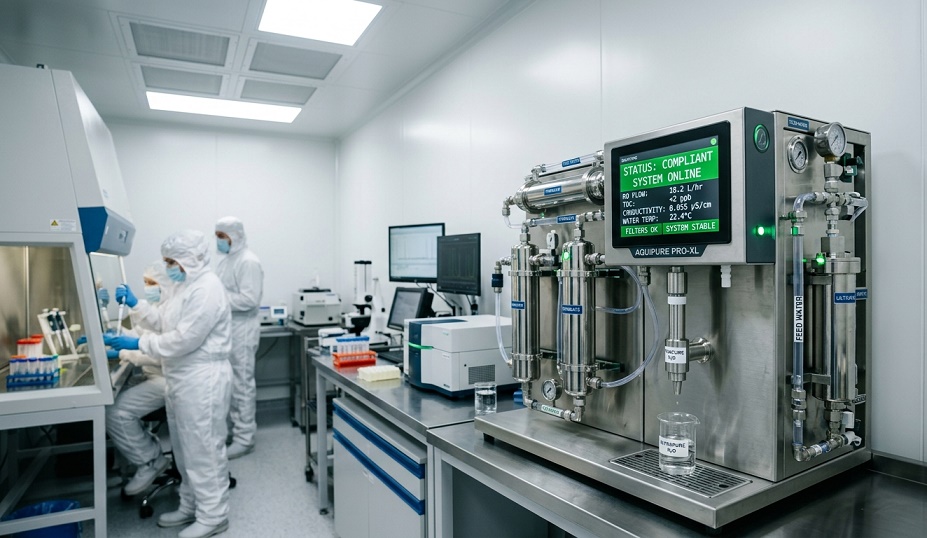
Most lab managers treat their water systems as an afterthought, assuming the tap will always deliver purity. This complacency is exactly what FDA inspectors look for, and once they find one loose thread in your documentation, they will pull until your entire compliance strategy unravels.
Preparing for an FDA Water Quality Audit
Preparation is not about doing a quick sweep the night before the inspector arrives. It is about maintaining a “ready-to-read” state where every piece of equipment has a digital shadow.
You need to prove that your water quality has met USP <1231> standards every second of every day for the past three years. If you cannot produce a calibration record within five minutes of being asked, you have already lost the inspector’s trust.
The 2026 Technical Documentation Standard
By 2026, the FDA has tightened its grip on electronic records. You must maintain a master file that includes your P&ID (Piping and Instrumentation Diagram), a comprehensive sampling plan, and your specific action and alert limits.
These limits are not suggestions; they are the boundaries of your legal safety net.
- Current P&ID reflecting all system modifications.
- Annual calibration certificates for conductivity and TOC sensors.
- Sanitization logs (chemical or thermal) with verified temperature charts.
- Training records for every technician who touches the system.
The inspector is not just looking at your water; they are looking at your discipline. If your paperwork is sloppy, they assume your science is sloppy too. But documentation is only half the battle; the real danger lies in how that data is actually captured.
Principles of GLP/GMP Compliance: Keeping water data attributable and legible
n the world of Good Laboratory Practice (GLP), if it is not written down, it did not happen. However, in 2026, the FDA has evolved the ALCOA+ principles to be even more aggressive regarding “Attributable” and “Legible” data.
You can find more about these foundational expectations at the FDA Data Integrity Resources.
Deciphering ALCOA+ in Water Monitoring
Every single data point in your water system must be attributable to a specific person or a specific automated sensor. There is no room for “General User” logins or shared passwords.
If a conductivity spike occurred at 3:00 AM on a Sunday, your system must record exactly which sensor flagged it and what automated response was triggered.
The Legibility Trap in 2026
Legibility does not just mean “readable handwriting” anymore. For digital systems, it means the data must be stored in a format that remains accessible throughout the entire record retention period.
If you upgrade your software but cannot open the files from two years ago, you are in violation of CFR Part 11 compliance.
| Feature | Manual Logbooks | Digital Compliance Systems |
|---|---|---|
| Data Attribution | Signatures (easy to forge) | Biometric or Secure Unique Logins |
| Error Correction | White-out (Illegal) | Linked Audit Trail with Reason Codes |
| Searchability | Hours of page flipping | Instant Keyword/Date Search |
| Time Stamping | Back-dating possible | Network-synced Atomic Clock |
Establishing this level of detail is the only way to survive a deep-dive inspection. But even the best data entry is useless if the system capturing it is inherently flawed.
The Shift to Digital Logbooks: Why manual entry is a regulatory risk
Paper is a liability. If you are still using a binder to track your TOC vs conductivity levels, you are inviting a regulatory nightmare. Manual entry is prone to “dry-labbing,” where technicians enter data they never actually measured because they were too busy.
The FDA knows this happens, and they are trained to find the patterns that reveal it.
The Risks of “Human-Centric” Documentation
When a human records a value, they often round the numbers. In a high-stakes FDA water quality audit, the difference between 0.054 and 0.05 is the difference between a pass and a failure.
Automation removes the temptation to “smooth out” the data. Digital logbooks ensure that the values are pulled directly from the PLC (Programmable Logic Controller), leaving no room for human bias or error.
Eliminating the Transcription Error
Think about the chain of custody for a single water sample. A tech takes a reading, writes it on a sticky note, walks to the office, and types it into a spreadsheet. Each step is a chance for a typo. By automating this, you create a direct pipeline from the sensor to the final report. This is why water quality monitoring parameters must be digitally integrated.
This shift to digital is not just about convenience; it is about building a wall of evidence that no inspector can tear down. And that wall starts with the very first day you install your system.
Water System Validation Protocols: IQ/OQ/PQ simplified for lab managers
Validation is the process of proving that your system does what it claims to do. It is broken down into three critical phases: Installation Qualification (IQ), Operational Qualification (OQ), and Performance Qualification (PQ).
You can learn more about the specifics of how to validate your lab water quality through our internal guides.
Breaking Down the IQ/OQ/PQ Hierarchy
- IQ (Installation Qualification): Did we plug it in right? This confirms that the equipment was delivered as specified and installed according to the manufacturer’s instructions.
- OQ (Operational Qualification): Does it work? We test the alarms, the flow rates, and the software to ensure the system functions in its environment.
- PQ (Performance Qualification): Does it stay consistent? This is a long-term test, often lasting 21 to 28 days, to prove the system produces USP-grade water under normal operating loads.
The 2026 Re-Validation Requirement
In 2026, any significant change to your facility’s plumbing or even a major software update requires a partial re-validation. You cannot simply “set it and forget it.” The International Society for Pharmaceutical Engineering (ISPE) provides updated frameworks for these continuous validation life cycles.
Once the system is validated, the work moves from the hardware to the heartbeat of the system: the audit trail.
Audit Trail Management: Ensuring data integrity across all monitoring points
An audit trail is a secure, computer-generated, time-stamped electronic record that allows for the reconstruction of the course of events.
If you change a setting on your reverse osmosis system, the audit trail must record who did it, when they did it, and what the value was before the change.
The Inspector’s Favorite Question: “Show me the deletions.”
During an FDA water quality audit, inspectors will often ask to see a list of deleted records or modified entries. If your system allows users to delete data without a permanent “ghost” record remaining, you are in immediate breach of 21 CFR Part 11.
Your audit trail should be a “read-only” history that even the administrator cannot erase.
- Every login and logout attempt.
- Any change to alarm setpoints.
- System power cycles or interruptions.
- Calibration adjustments.
A robust audit trail is like a flight recorder for your lab. It tells the truth even when it is uncomfortable. But having the data is one thing; making it work for you is another.
Logbook Automation Benefits: Reducing human error in daily purity checks
Automation is the ultimate shield. When you automate your logbooks, you are not just saving time; you are eliminating the “fatigue factor” that leads to compliance gaps.
Modern systems can now perform self-checks and alert you via mobile notification before a parameter even hits the “Action” limit.
Real-Time Intervention vs. Reactive Correction
Traditional monitoring is reactive. You find out the water was bad yesterday when you check the logs today. Automation turns this into a proactive defense.
In 2026, the best systems use predictive analytics to tell you that your DI resin will likely fail in three days based on current flow rates.
The ROI of Compliance Automation
While the initial investment in digital logbook automation might seem high, the cost of a single batch rejection due to water contamination is infinitely higher. You are buying insurance against the most unpredictable variable in your lab: human nature.
The transition to a fully automated, digitally validated water system is the only way to walk into an FDA audit with total confidence. Are you ready to stop fearing the inspector and start inviting the scrutiny?
Leave a Reply
You must be logged in to post a comment.