Water quality monitoring parameters are the measurable indicators that determine whether your water is safe, compliant, and fit for its intended purpose across pharmaceutical, industrial, and municipal applications.
These are the proven, scientifically validated metrics that regulatory bodies worldwide use to define water purity standards. Understand them fully, and you transform your water system from a compliance risk into a competitive advantage.Most lab managers think they are buying a water purification system, but they often overlook the long-term impact of lab water system maintenance.
Why Multiple Parameters Always Beat One
No single water quality parameter tells the whole story. Each one is designed to detect a specific category of contamination. Relying on just one creates blind spots that can compromise your product, your process, and your regulatory standing.
Specifically, here is what happens when you monitor only one parameter:
According to the WHO Guidelines for Drinking Water Quality, a multi-parameter approach is the globally recommended framework for comprehensive water safety assessment. No single test is sufficient on its own.
Therefore, the question is never which single parameter to monitor. It is which combination of parameters gives your specific process complete coverage. But before you can build that combination, you need to understand what each parameter actually measures.
The Core Water Quality Parameters Every Lab Should Know
There are six parameters that form the foundation of any serious water quality monitoring program.
Total Organic Carbon (TOC)
TOC measures the concentration of carbon-based organic compounds in water. It is the primary indicator of organic contamination and is mandated by USP <643> for pharmaceutical Purified Water and Water for Injection at a target limit of 500 ppb.
Conductivity
Conductivity measures dissolved ionic content. It is required by USP <645> for pharmaceutical water and serves as the fastest real-time indicator of ionic contamination. Ultrapure water registers at 0.055 microsiemens per centimeter at 25 degrees Celsius.
pH
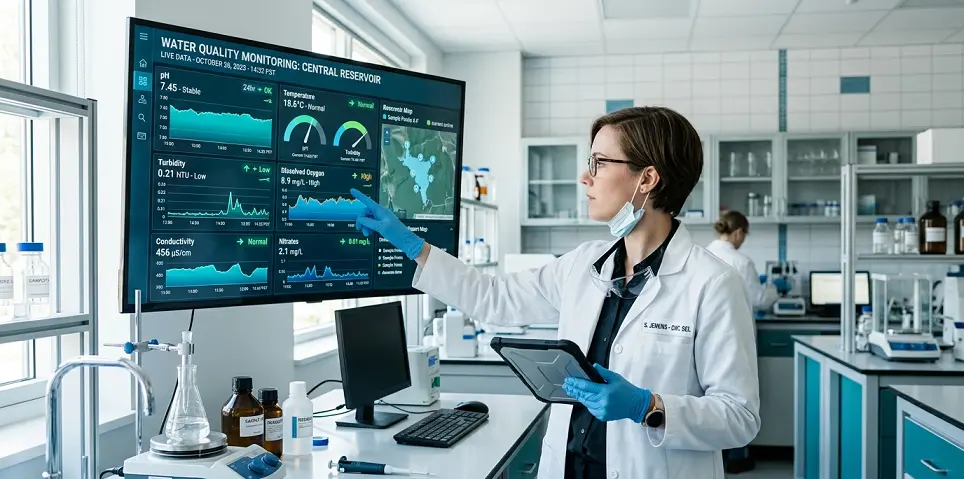
pH measures the hydrogen ion concentration in water, indicating acidity or alkalinity on a scale of 0 to 14. The EPA Secondary Drinking Water Standards recommend a pH range of 6.5 to 8.5 for drinking water. Note that this is a secondary, non-enforceable guideline focused on aesthetic and corrosion concerns, not a primary health-based standard.
Turbidity
Turbidity measures water clarity by quantifying how much light is scattered by suspended particles. It is expressed in Nephelometric Turbidity Units (NTU). According to the EPA National Primary Drinking Water Regulations, for systems using conventional or direct filtration, turbidity must never exceed 1 NTU at any time, and 95 percent of monthly samples must be at or below 0.3 NTU.
Total Dissolved Solids (TDS)
TDS measures the total concentration of all dissolved substances in water, including salts, minerals, and metals. It is closely related to conductivity and is often calculated from conductivity readings using a conversion factor.
Microbial Count
Microbial count measures the number of viable microorganisms per milliliter of water. For pharmaceutical Purified Water, USP <1231> sets an action limit of 100 colony-forming units per milliliter. For Water for Injection, the limit is stricter at 10 CFU per 100 mL.
Now that you know each parameter, here is how to decide which ones your specific process actually needs.
How to Choose the Right Parameter Combination
Your parameter combination should be driven by three factors: your industry, your regulatory framework, and your contamination risk profile.
Here is a practical reference table:
| Application | Required Parameters | Recommended Add-ons |
|---|---|---|
| Pharmaceutical PW/WFI | TOC, Conductivity, Microbial Count | pH, Endotoxin |
| Semiconductor ultrapure | Conductivity, TOC, Particles | Dissolved oxygen |
| Municipal drinking water | Turbidity, pH, Microbial Count | TDS, Conductivity |
| Food and beverage | pH, Microbial Count, TDS | Conductivity, TOC |
| Boiler and cooling water | Conductivity, pH, TDS | Hardness, Silica |
| Laboratory reagent water | TOC, Conductivity | pH, Microbial Count |
According to ASTM D1193, reagent water is classified into four grades (Type I through Type IV), each with specific conductivity, TOC, and other parameter requirements. Consequently, your grade determines your monitoring program.
For a focused comparison of the two most debated parameters in this table, read TOC vs. Conductivity: What Matters More?.
The right combination is now clear. But setting up your monitoring program incorrectly can still undermine even the best parameter selection.
Building a Monitoring Program That Actually Works
A monitoring program is only as strong as its sampling frequency, alert limits, and response protocols.
Here is a proven framework for building one:
The FDA Guidance on Water for Pharmaceutical Manufacturing specifically emphasizes that alert and action limits must be based on actual system performance data, not simply set at the regulatory limit.
Second, always review your monitoring program after any significant system change, new product introduction, or contamination event. A static monitoring program in a dynamic facility is a compliance liability waiting to happen.
Your parameters are set. Your limits are defined. Now the data will tell you everything.