
Consistent UV lamp maintenance in labs is the only way to prevent silent organic spikes from ruining your most sensitive analytical results. You cannot rely on visual inspections because a glowing lamp often fails to provide the energy required for complete molecular degradation.
By prioritizing proactive service, you ensure maximum system uptime and preserve the integrity of every sample you process.
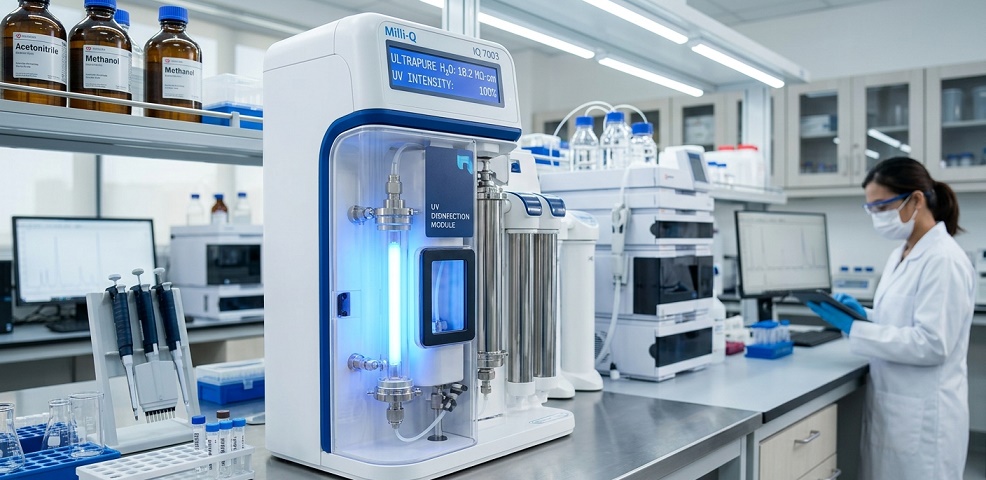
But the glowing blue light is a master of deception, hiding a slow decay that threatens your data right now.Most lab managers think they are buying a water purification system, but they often overlook the long-term impact of lab water system maintenance.
The Science of Photo Oxidation
To understand why your maintenance schedule matters, you have to understand what is happening inside that stainless steel chamber. We are talking about photo oxidation. This is not just shine and hope; it is high energy physics.
In high purity water systems, we typically use dual wavelength lamps. These lamps emit light at two primary peaks: 185nm and 254nm. Each serves a distinct, critical purpose in your lab workflow.
Dual Wavelength Mechanisms
The 254nm wavelength is the workhorse of disinfection. It penetrates the cell walls of bacteria and disrupts their DNA. This prevents them from replicating and effectively kills them.
However, the 185nm wavelength is the real star for lab water consumables. This high energy light breaks the chemical bonds of oxygen molecules to create ozone. More importantly, it splits water molecules to generate hydroxyl radicals (OH.). These radicals are aggressive oxidants. They attack organic contaminants and chop them into smaller, ionized fragments.
Breaking Down TOC
When we talk about TOC reduction, we are describing the process of turning complex carbon chains into CO2. These smaller particles are then easily captured by downstream ion exchange resins. Without that 185nm punch, your resins will saturate prematurely.
The efficiency of this process depends entirely on the photon flux hitting the water. If the energy levels drop even slightly, the “kill rate” for organics plummets. You might still see a blue glow, but the chemical heavy lifting has stopped.
| Wavelength | Primary Function | Target Contaminants |
|---|---|---|
| 185nm | Photo Oxidation | Total Organic Carbon (TOC) |
| 254nm | Germicidal | Bacteria and Viruses |
- 185nm light creates hydroxyl radicals for organic destruction.
- 254nm light prevents microbial biofilm formation.
- The combination ensures both chemical and biological purity.
But understanding the light is only half the battle. You need to know when that light starts to lose its edge.
Identifying UV Intensity Drift
UV intensity drift is the silent killer of lab productivity. Unlike a light bulb in your office, a UV lamp does not always give you the courtesy of burning out completely. Instead, it undergoes a slow, measurable decline in output.
This decline is usually caused by two factors. First, the mercury within the lamp eventually coats the interior of the glass. Second, the quartz sleeve itself undergoes a process called solarization. Over time, the high energy radiation changes the structure of the quartz, making it less transparent to the very wavelengths you need.
The Solarization Effect
Think of solarization like a fog rolling in. The lamp is still producing energy, but that energy cannot reach the water. This is particularly problematic for 185nm light.
Because 185nm is a shorter, more delicate wavelength, it is the first to be blocked by a fouled or solarized sleeve. You might find that your germicidal protection at 254nm is still adequate, but your TOC levels are beginning to creep up. This is a classic sign of drift.
Monitoring TOC and Resistivity
You must monitor your system’s output closely. If you notice that your TOC levels are rising despite regular cartridge changes, the lamp is the likely culprit.
Refer to this Total Organic Carbon (TOC) Water Testing Guide for specific baseline measurements. High purity water should typically maintain TOC levels below 5 ppb (parts per billion). If you see 10 or 15 ppb, your photo oxidation process is failing.
Don’t confuse this with conductivity issues. You can have high resistivity (18.2 MΩ·cm) and still have high TOC. For a deeper dive into this distinction, see our guide on TOC vs Conductivity Water Quality.
- Monitor daily TOC readings for upward trends.
- Check the lamp “hours of operation” meter weekly.
- Inspect quartz sleeves for physical fouling or cloudiness.
Monitoring is your first line of defense; however, the real solution lies in your calendar.
Planning for Lab Water Consumables
Stop being reactive. Waiting for the system to alarm is a recipe for downtime. If the alarm goes off on a Friday afternoon while you are mid-experiment, you have a crisis. If you replace the lamp on a scheduled Tuesday morning, you have a process.
Most high quality UV lamps are rated for approximately 8,000 to 10,000 hours of use. That is roughly one year of continuous operation.
The 8,000 Hour Threshold
Why 8,000 hours? Because that is the point where the decay curve typically becomes steep. Manufacturers like those cited by the International Union of Pure and Applied Chemistry note that photochemical efficiency is heavily dependent on the integrity of the emission source.
Once you pass the 8,000 hour mark, the risk of experimental interference increases exponentially. The cost of a new lamp is negligible compared to the cost of repeating a week of LC-MS work.
Developing a Replacement Strategy
You need a proactive inventory system. Always keep at least one spare lamp and one spare quartz sleeve on site. According to standards set by ISO 15858, maintaining the physical integrity of UV-C devices is paramount for both safety and performance.
- Log the installation date: Mark the date on the system or in your lab management software.
- Set a 10 month reminder: This gives you two months to order parts and schedule the 15 minute downtime required for the swap.
- Clean the quartz: Every time you change a lamp, clean the quartz sleeve with high purity ethanol or a specialized scale remover.
Even a fingerprint on the lamp can cause a “hot spot” that leads to premature glass failure. Use gloves. Be precise. Treat the lamp like the sensitive instrument it is.
The EPA UV Disinfection Guidance Manual emphasizes that even minor surface contamination can reduce effectiveness by 10% or more. In a lab environment, 10% is the difference between a successful run and a retracted paper.
Your strategy is now ready for implementation, but what about the questions your team will inevitably ask?
Frequently Asked Questions
Can I just clean the lamp instead of replacing it?
No, cleaning the exterior of the lamp will not reverse internal mercury degradation or quartz solarization. While cleaning the quartz sleeve is vital, the lamp itself has a finite lifespan based on gas depletion and internal coating. Expecting a cleaned lamp to perform like new is a dangerous assumption for your data.
Why does my system show a blue light if the lamp is failing?
The visible blue light is actually a byproduct of the mercury discharge and not the invisible 185nm or 254nm wavelengths that do the work. A lamp can glow brightly in the visible spectrum while emitting almost zero functional UV-C radiation. Always trust the hour meter and TOC readings over your eyes.
What happens if I ignore the UV lamp replacement alarm?
Ignoring the alarm leads to a gradual buildup of organic molecules that will eventually foul your expensive purification cartridges and analytical columns. This results in “ghost peaks” in chromatography and can interfere with sensitive cell culture growth. The long term cost of instrument repair and lost time far outweighs the price of a lamp.
Do all lab water systems need 185nm lamps?
Only systems designed for Type 1 ultrapure water or those requiring low TOC levels require 185nm lamps. If your lab only needs general grade water for rinsing glassware, a 254nm germicidal lamp may be sufficient. However, for HPLC, GC, or mass spectrometry, the 185nm wavelength is non-negotiable.
Leave a Reply
You must be logged in to post a comment.