
The success of your research depends on precise Lab water system installation to prevent sensor drift and mechanical fatigue. As a lab manager, you must treat your water system as a high-stakes clinical instrument rather than a simple utility. Getting the layout right today means ensuring consistent ASTM Type I water quality and avoiding the nightmare of “ghost” impurities tomorrow.
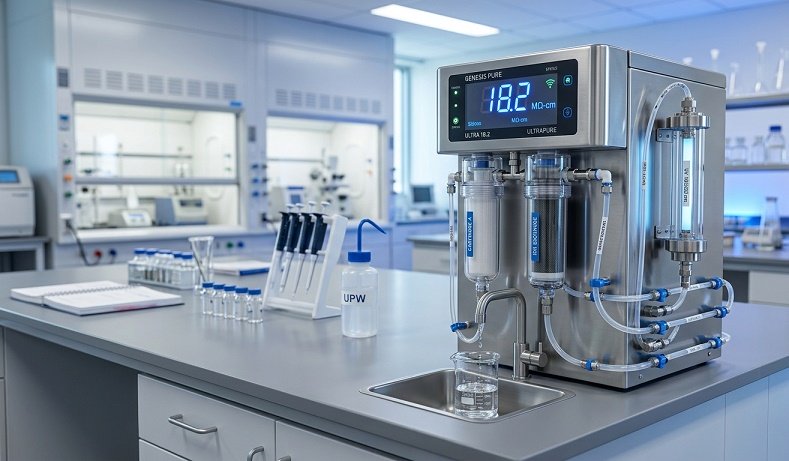
Think of your lab bench as a living ecosystem where every piece of hardware fights for stability. If you ignore the physical environment surrounding your water system, you are essentially gambling with your most critical reagent; and the house always wins.
The Physics of Micro Vibration Impact
Most researchers believe that as long as the water flows, the system is fine. They are wrong. Micro vibrations from nearby equipment like large scale centrifuges or even heavy HVAC units can induce mechanical resonance in the delicate internal components of your purification unit.
Why Mechanical Resonance Destroys Accuracy
In 2026, the standard for Type I water remains a strict 18.2 MΩ-cm at 25°C according to ASTM D1193-06 guidelines. However, micro vibrations can cause:
- Fitting Fatigue: Constant oscillation leads to microscopic hairline fractures in polymer connectors.
- Sensor Noise: Vibrations interfere with the electrode-to-water interface, creating “noisy” data that fluctuates even when water quality is stable.
- Particulate Shedding: Movement can dislodge tiny fragments from the resin bed or tubing walls, introducing contaminants into your “pure” stream.
If your system sits on the same bench as a vortex mixer or a high-speed centrifuge, you are asking for trouble. Vibration isolation pads are no longer optional; they are a requirement for hardware longevity.
Does your current setup have a “hidden” tremor that is slowly shaking your sensors to death?
Solving Resistivity Sensor Drift
When your display starts jumping between 18.2 and 17.5 MΩ-cm, your first instinct is to change the cartridges. Stop. While exhausted resin is a common culprit, “sensor drift” is often a symptom of environmental interference rather than water chemistry.
Distinguishing Quality from Interference
You must differentiate between actual ionic contamination and mechanical drift. In many 2026 smart-lab configurations, electromagnetic interference (EMI) from nearby power supplies can mimic the signal of falling resistivity.
The 2026 Calibration Standard
Current ISO/IEC 17025 protocols suggest that high-use sensors should be checked monthly. If your system is placed too close to a high-voltage refrigerator compressor, the magnetic field can pull your readings out of spec.
| Symptom | Probable Cause | Immediate Action |
|---|---|---|
| Rapid Fluctuations | EMI or Micro Vibrations | Move system 24 inches from power sources. |
| Slow, Steady Decline | Resin Exhaustion | Check conductivity measurement trends. |
| Instant Drop to 0.0 | Sensor Failure/Cable Loose | Inspect physical connections and shielding. |
A system that cannot stay at 18.2 MΩ-cm is a system you cannot trust with your HPLC or ICP-MS runs.
But even a perfectly calibrated sensor is useless if you cannot reach the machine to maintain it.
Optimizing Lab Bench Organization
Organization is not just about aesthetics; it is about accessibility and safety. A cramped Lab water system installation leads to kinked tubing, blocked air vents, and neglected filter changes because the “machine is too hard to get to.”
The Reach Zone and Serviceability
According to the 2026 Lab Design Guide by MaxLab, your primary controls and dispense points must reside within a 15-18 inch “reach zone.”
- Heat Dissipation: Leave at least 4 inches of clearance on all sides to prevent the internal pump from overheating.
- Vertical Space: Use wall mounts for the main unit to free up valuable bench real estate for samples.
- Drainage Logic: Ensure the waste line has a continuous downward slope to prevent backflow and bacterial growth.
Managing Utility Interference
Keep your water lines physically separated from your power cables. A leak is bad; a leak onto a 220V power strip is a catastrophe that ends your week in an insurance meeting.
By designing your layout with maintenance in mind, you ensure that endotoxin control remains a routine task rather than a panicked response to a failed audit.
Are you ready to stop treating your water system like an afterthought and start treating it like the heartbeat of your lab?
Leave a Reply
You must be logged in to post a comment.