
Correctly identifying laboratory water grades requires a rigorous audit of resistivity and Total Organic Carbon (TOC) thresholds against your specific analytical sensitivity.
As a senior consultant who has seen multimillion dollar research projects derailed by a single microscopic ion, I can tell you that water is your most volatile reagent. Mastering these technical tiers transforms your lab from a site of uncertainty into a high-precision compliance powerhouse.
You are currently one contaminated batch away from a total system failure. The invisible ghost of silica or a stray bacterial endotoxin could be sandpapering your expensive HPLC columns as we speak. If you walk away now, you are betting your entire data integrity on the quality of a simple tap.
The Hierarchy of Purity: Type 1, 2, and 3
ASTM D1193 defines the four primary types of reagent water, but for most professional settings, the focus remains on the first three.
You cannot swap these out like generic ink cartridges; each grade serves a specific, non-negotiable function within the hierarchy of precision.
Type 1 Ultrapure Water for Trace Analysis
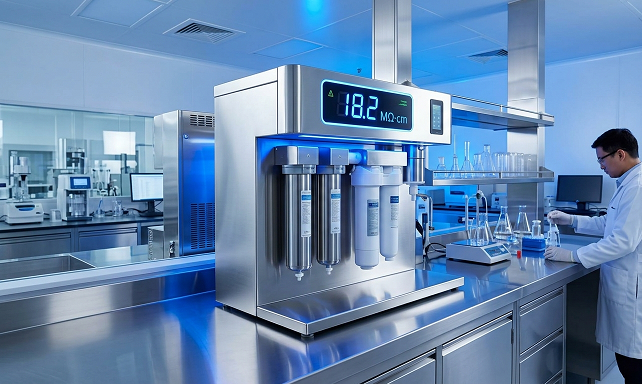
Type 1 water is the gold standard for analytical chemistry. It is characterized by a resistivity of 18.2 MΩ·cm at 25 degrees Celsius and a TOC level typically under 50 parts per billion (ppb).
In 2026, the push for parts per trillion (ppt) detection limits has made even lower TOC levels, often under 5 ppb, the expected baseline for LC-MS and ICP-MS applications.
The 18.2 MΩ·cm Threshold and Ionic Interference
The measurement of 18.2 MΩ·cm is the theoretical limit of pure water’s resistance to electrical current.
If your system drops even to 18.0, you are introducing enough ionic “noise” to mask trace metals in sensitive samples. You can find more about these specific thresholds in the latest ASTM D1193 standards.
Type 2 and Type 3 for General Lab Utility
Type 2 water is your workhorse; it is intended for general reagent preparation and microbiological media.
Type 3, or Primary Grade water, is often produced via Reverse Osmosis (RO) and serves as the essential feedwater for your Type 1 systems. Using Type 1 for glassware rinsing is a financial sin, while using Type 3 for analytical work is a scientific one.
| Water Grade | Resistivity (MΩ·cm) | TOC (ppb) | Typical 2026 Application |
|---|---|---|---|
| Type 1 | 18.2 | < 5 | HPLC, ICP-MS, Molecular Biology |
| Type 2 | > 1.0 | < 50 | Reagent Prep, Clinical Analyzers |
| Type 3 | > 4.0 | < 200 | Autoclaves, Feedwater for Type 1 |
| CLRW | > 10.0 | < 500 | Clinical Chemistry, Pathology |
Selecting the right grade is the first step, but the clinical sector demands an entirely different level of regulatory scrutiny.
Why “Clean” Isn’t Enough for Analyzers
In pathology and clinical diagnostics, the standard isn’t just ASTM; it is Clinical Laboratory Reagent Water (CLRW). The CLSI GP40-A4 guidelines specify that CLRW must be utilized to prevent “interference” in high-throughput chemistry analyzers.
The Non-Negotiable Nature of CLRW in Pathology
Clinical analyzers are sensitive to bacterial byproducts and silica that standard deionization might miss. CLRW mandates a bacterial count of less than 10 Colony Forming Units per milliliter (CFU/mL).
If your water exceeds this, the bacteria will release alkaline phosphatase or other enzymes that can lead to false-positive results in immunoassays.
Managing Silica and Dissolved Oxygen
While often overlooked, silica can coat the internal sensors of an analyzer, causing drift and calibration errors. CLRW standards require proactive monitoring of silica to ensure it remains below 0.05 mg/L.
Failure to monitor this leads to “silent failures” where the machine appears to be running correctly but the data is subtly compromised. For a deeper look into these specific risks, view our Lab Insights.
Understanding these standards is purely academic unless you have the hardware to maintain them under heavy load.
Choosing the Right System for Your Throughput
Your purification technology must match your daily volume, or you will find yourself in a perpetual cycle of cartridge changes and downtime. For modern laboratories, the choice usually comes down to Electrodeionization (EDI) versus traditional ion-exchange resin.
EDI vs. Resin: The ROI Equation
Electrodeionization is a “green” technology that uses electricity to continuously regenerate ion-exchange membranes. For a high-throughput lab, the ROI of EDI is superior because it eliminates the need for chemical regeneration or frequent cartridge disposal.
We breakdown the specific requirements for different system scales in our guide on what kind of water to use.
The Role of UV Photo-oxidation and Ultrafiltration
If your lab performs PCR or DNA sequencing, you must incorporate 185nm UV lamps to reduce TOC to the absolute minimum and ultrafiltration to remove nucleases.
Without these polishing steps, your Type 1 water isn’t truly “ultrapure” for molecular biology. You can cross-reference these requirements with the ISO 3696 standards for international compliance.
Point-of-Use vs. Centralized Systems
In 2026, the trend is moving toward centralized Type 2 loops that feed localized Type 1 polishing stations. This hybrid approach reduces the risk of contamination in long distribution lines. If you are still relying on a single centralized Type 1 system, you are likely losing purity with every meter of piping.
The blueprint for your facility’s compliance is now in your hands; now you must decide if you are ready to enforce it.
Leave a Reply
You must be logged in to post a comment.