
In the high-stakes world of 2026 green energy, your PEM (Proton Exchange Membrane) electrolyzer is only as resilient as the water you feed it. As global policy shifts toward gigawatt-scale deployment, the technical delta between “purified” and “ultrapure” has become the difference between a high-performing asset and a catastrophic stack failure.
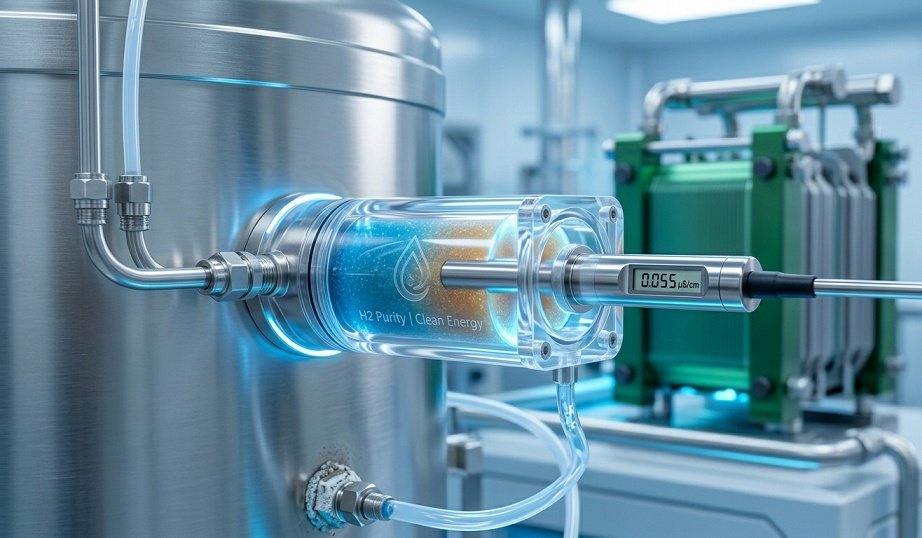
You must master the science of ultra low conductivity now or watch your membrane longevity vanish into a cloud of expensive ionic contamination.
This is not a theoretical exercise in lab chemistry; it is a battle for the mechanical survival of your infrastructure. If you ignore the invisible killers lurking in your water supply, your entire R&D budget is a ticking time bomb and the fuse is shorter than you think.
Water Quality for PEM Electrolyzers
The 2026 industry landscape has moved beyond the “pilot” phase into aggressive industrialization. According to the World Bank’s recent technical reports on electrolyzer technologies Electrolyzers for hydrogen Production, the demand for high-efficiency PEM units is skyrocketing.
But here is the hard truth…
PEM stacks are incredibly sensitive to metallic cations like iron, copper, and chromium.
Why Ions Poison the Catalyst
When you operate a PEM electrolyzer, the membrane is designed to transport protons. However, if your water quality slips, stray ions compete for the sulfonic acid sites on the membrane.
This process, often called “cationic poisoning,” leads to a localized loss of conductivity and a massive spike in overpotential.
In 2026, where efficiency gains of even 2% can define a project’s bankability, allowing catalyst degradation via poor water is professional negligence. You are essentially suffocating the platinum-group metal (PGM) catalysts that drive the reaction
Numerical Thresholds for 2026 Stack Safety
Recent updates to ISO 22734:2025 emphasize a risk management approach to gas crossover and stack integrity ISO 22734-1 revised. To stay within warranty and safety limits, your water must maintain:
- Iron (Fe) levels below 5 ppb.
- Copper (Cu) levels below 2 ppb.
- Chloride (Cl-) levels effectively at zero to prevent membrane pitting.
If these numbers look intimidating, it’s because the technology is evolving faster than most facility managers can keep up.
But managing the ions is only half the battle; the real test comes when you look at the membrane itself.
Ensuring Membrane Longevity
The membrane is the most expensive component of your PEM system. In 2026, the focus has shifted from “can it work?” to “how long will it last under variable renewable loads?”. Water with high conductivity acts like a slow-acting acid on your membrane’s structural integrity.
You need to understand the correlation between conductivity and the chemical degradation of perfluorinated membranes.
The Role of Sub 0.1 Conductivity Water
To achieve the 2026 standard for membrane stability, you cannot settle for ASTM Type II water. You need Type I reagent-grade water with a conductivity of less than 0.056 µS/cm (resistivity of 18.2 MΩ-cm). This isn’t just a “nice to have” metric. High purity water prevents the formation of “hot spots” where current density becomes uneven, leading to premature membrane thinning and eventual rupture.
For a deeper dive into how these measurements impact your bottom line, see our guide on conductivity measurement and water purity.
| Water Grade | Conductivity (µS/cm) | Resistivity (MΩ-cm) | Recommended Application |
|---|---|---|---|
| ASTM Type I | < 0.056 | 18.2 | PEM Electrolysis / Trace Analysis |
| ASTM Type II | < 1.0 | 1.0 | General Lab Prep |
| ASTM Type III | < 0.25 | 4.0 | Feedwater for Type I systems |
| Tap Water | 50 – 800+ | 0.001 – 0.02 | Immediate Stack Destruction |
Standardizing on sub 0.1 µS/cm water ensures that the “chemical stress” on your membrane is minimized during the rapid cycling typical of wind and solar-coupled hydrogen production.
You might think your current filtration system is holding the line, but there is a hidden variable in your resin beds that is likely failing you right now.
Ion Exchange for Fuel Cell R&D
R&D facilities in 2026 are dealing with more than just basic deionization. As we push for higher current densities, the “purity of the polish” becomes critical. Standard off-the-shelf resins often leach organic compounds that can be just as damaging as the ions they remove.
You need to understand the difference between TOC (Total Organic Carbon) and ionic conductivity to truly protect your hardware.
Specialized Resin Requirements
For fuel cell R&D, you must use “nuclear grade” or “semiconductor grade” mixed-bed ion exchange resins. These resins are processed to ensure they do not shed particles or organics back into the permeate.
If your TOC levels rise above 50 ppb, you risk coating the membrane with a non-conductive organic film, which increases resistance and heat generation.
Step-by-Step SOP for Resin Maintenance in 2026
- Monitor Feedwater TOC: Use an inline TOC analyzer to ensure levels stay below 200 ppb before reaching the polishing bed.
- Conductivity Alarms: Set your system to “Auto-Divert” if conductivity exceeds 0.1 µS/cm for more than 30 seconds.
- Preventative Resin Swaps: Do not wait for a breakthrough. Replace polishing cylinders at 80% of their calculated ionic capacity.
Ignoring these steps is a gamble where the house always wins. If you want to compare the impact of organics versus ions, check out our analysis on TOC vs conductivity in water quality.
The stakes are high, but they get even higher when the regulatory inspectors from the national labs show up at your door.
Meeting Renewable Energy Lab Standards
By 2026, the International Renewable Energy Agency (IRENA) and national labs have tightened the leash on “Green Hydrogen” certification IRENA Green Hydrogen Strategy 2024.
It isn’t enough to just produce hydrogen; you must prove it was produced within strict environmental and technical parameters.
Future Proofing Your Facility
Future-proofing means moving beyond reactive maintenance. The current 2026 standards suggest that high-purity water loops should be integrated with real-time digital twins. This allows you to track the exact water quality fingerprint associated with every kilogram of hydrogen produced.
To maintain these standards without blowing your operations budget, you need a strategy for mastering your lab facility maintenance budget.
2026 Compliance Checklist for Water Systems
- ASTM D1193-06 Compliance: Ensure all reagent water meets Type I standards for stack-critical tasks ASTM Standards for Reagent Water.
- Redundant Polishing: Utilize a dual-polishing loop to ensure zero downtime during resin exhaustion.
- Daily Calibration: Validate your inline conductivity probes against a NIST-traceable standard every 24 hours.
If you don’t implement these standards today, you’ll be left holding the bill when the 2027 mandates make your current setup obsolete.
The path to green energy is paved with ultrapure water. Are you ready to lead, or are you waiting for your membrane to fail before you take this seriously?
Leave a Reply
You must be logged in to post a comment.