
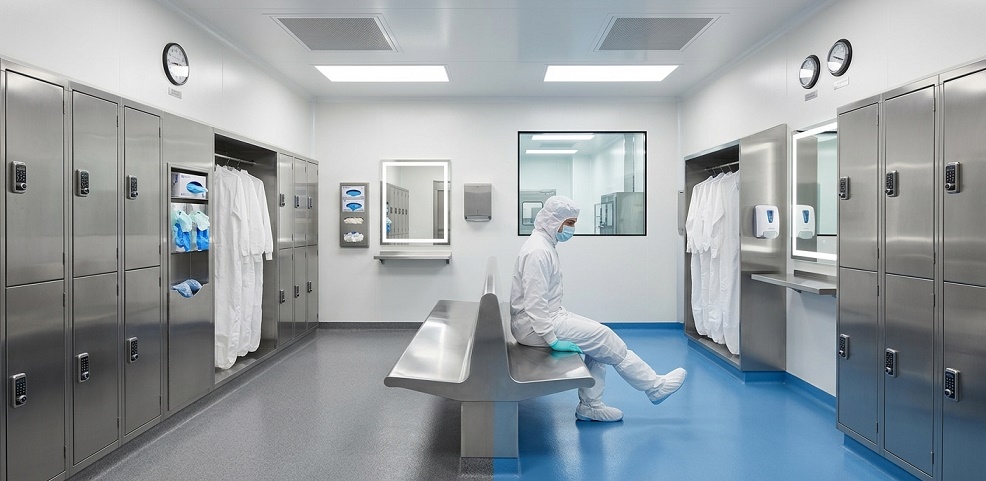
To master your contamination control, you must implement rigorous Cleanroom gowning room protocols using multi-stage tacky mats, antimicrobial flooring, and strict zone segregation. This is the only way to ensure that the $100,000 batches you are running today don’t end up in the biohazard bin tomorrow. Failing to lock down this single transition point compromises your entire ISO certification and puts your facility at extreme risk.
You might think your current setup is “good enough” because you haven’t seen a spike in particle counts yet. But the data shows a silent, invisible threat is already walking through your front door; and it is about to cost you everything.
The Flaw in Standard Gowning Area Design
Most facilities treat the gowning room as a locker room. This is a massive mistake. According to current ISO 14644-1 standards, the gowning area must function as a dynamic pressure airlock. The primary flaw isn’t usually the HVAC; it is the “line of demarcation.” If your staff can touch the “clean” side of the floor with “dirty” street shoes, your protocol has already failed.
The 2026 Standard for Zone Segregation
By the 2026 regulatory updates from the FDA, physical barriers are now preferred over simple floor tape. High-performance labs are moving toward internal airlocks with interlocking doors to prevent simultaneous opening. This ensures that the pressure differential, often required to be at least 10 to 15 Pascals between rooms, remains constant.
Human Traffic as a Particle Generator
Humans are the filthiest things in your lab. A person sitting still sheds 100,000 particles per minute. A person walking? That number jumps to 5,000,000. If your gowning room design allows for unnecessary movement or bottle-necks, you are essentially vibrating dust into the air. You need a linear flow where the operator never doubles back over a previously cleaned area.
But even with a perfect layout, your biggest enemy is still clinging to the soles of those shoes.
Maximizing Particle Entrapment: Adhesive vs. Active
When it comes to Cleanroom gowning room protocols, the floor is your primary filter. You have two main choices: peel-off sticky mats or high-performance polymeric flooring. The goal is simple. You need to strip as much particulate matter as possible before a foot touches the “clean” zone.
The Physics of Particle Retention
Adhesive mats work on a contact-transfer basis. However, their effectiveness drops by over 60% after only a few steps if they are not peeled regularly. Polymeric flooring, often called “active” flooring, uses a natural “tack” and surface tension to pull particles away from shoe covers.
Numerical Performance Thresholds
Research from the Institute of Environmental Sciences and Technology suggests that a minimum of three full strides (six footfalls) is required to remove 99% of footborne contamination. If your mat is too small, you are merely decorating your floor with expensive glue.
- Sticky Mat Contact: Requires 2-3 steps per foot.
- Active Flooring: Requires 3-4 steps for total entrapment.
- Peel Frequency: Standard mats must be changed every 2-4 entries in high-traffic zones.
This leads to a hard truth about your operational budget that most vendors won’t tell you.
Sticky Mats vs High Performance Flooring
The “cheap” option is often the most expensive in the long run. Let’s look at the math. A standard tacky mat costs very little upfront, but the labor required to peel it and the waste generated are significant. Furthermore, as soon as a mat is saturated, it becomes a “bridge” for contamination rather than a barrier.
| Feature | Disposable Sticky Mats | Polymeric Active Flooring |
|---|---|---|
| Initial Cost | Low | High |
| Particle Removal | 20-50% (variable) | 98-99.9% (consistent) |
| Service Life | 30-60 Peels | 3-5 Years |
| Environmental Impact | High Waste | Low Waste |
| Maintenance | Manual Peeling | Mop and Water |
The Hidden Costs of Tacky Mats
Beyond the purchase price, you must consider the cost of disposal. Used mats are often classified as industrial waste. If you are following the navigating ISO 14644-1 for lab managers guide, you know that keeping a consistent environment is key. Variations in mat “stickiness” create variables in your contamination data that are hard to track.
Total Cost of Ownership (TCO)
Over a three-year period, active flooring typically saves a facility 40% in material costs alone. This doesn’t even account for the reduced risk of a “failed lot” due to contamination. You are not just buying a floor; you are buying insurance for your product.
Wait until you see how your shoe covers are actually working against you, though.
Improving Shoe Cover Effectiveness
If you think a thin layer of polypropylene is a magic shield, you are in for a rude awakening. Shoe covers are porous. They are designed to keep particles in, but they can also act as a sieve for the particles already on the floor.
The “Sieve Effect” in Gowning
As an operator walks, the pressure of their weight forces small particles through the weave of the shoe cover. This is why the floor underneath the gowning bench is just as critical as the floor inside the cleanroom. You must ensure that the “dirty” side of the gowning room is cleaned as frequently as the “clean” side.
Selecting the Right Material
Not all covers are created equal. You should be looking for “low-linting” or “lint-free” materials. In high-stakes environments, like those discussed in our water distribution loop design guide, even a few stray fibers can cause catastrophic mechanical failures in sensitive equipment.
- Laminated Microporous: The gold standard for high-grade cleanrooms.
- Polypropylene (PP): Best for low-risk areas; breathable but porous.
- CPE/PVC: Waterproof and non-porous; better for liquid splash protection.
The Bench Protocol
The “Swing-Over” method is non-negotiable. The operator sits on a bench, puts a shoe cover on one foot, and swings that foot over to the “clean” side without ever touching the “dirty” floor. This physical separation is the cornerstone of effective Cleanroom gowning room protocols.
If you ignore these physical barriers, no amount of air filtration will save your results.
Summary of Gowning Room Optimization
To win the war on contamination, you must view your entryway as a tactical checkpoint. Every piece of equipment, from the mats to the benches, must serve the single purpose of particle immobilization. If you are still relying on a single sticky mat and a prayer, it is time to overhaul your SOPs.
Start by auditing your current footfall count. Measure the distance from your street-shoe area to your gowning bench. If it is less than six feet, you are inviting trouble into your lab. Precision isn’t just for the experiments; it starts at the door.
Leave a Reply
You must be logged in to post a comment.