
Modern field research demands the same analytical precision as a stationary flagship facility, but the logistics are a nightmare. You are fighting vibration, fluctuating feed water quality, and environmental dust, all while trying to maintain mobile laboratory water systems that meet stringent ASTM D1193-24 standards.
Whether you are running a containerized PCR lab in a remote jungle or a modular forensic unit in an urban center, your water system is the heartbeat of your operation. If it fails, your high-stakes data becomes nothing more than expensive noise.
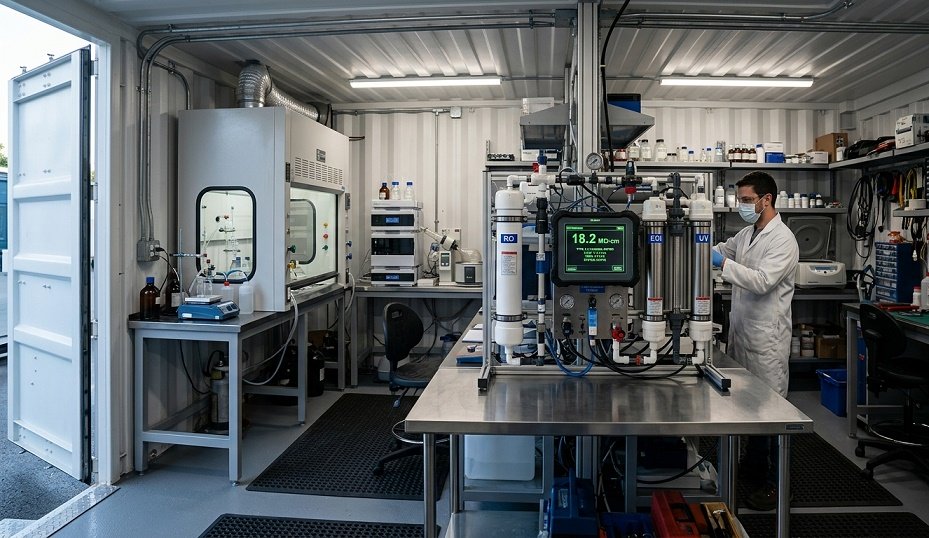
The transition from a stable building to a vibrating vehicle changes everything about how you treat H2O. You are no longer just a scientist; you are a tactical logistics manager who must ensure that your “lab on wheels” doesn’t become a “liability on wheels” due to overlooked contamination.
But here is the truth that most vendors won’t tell you: standard benchtop units will shake themselves to death on a gravel road before you even reach the site.
Designing Portable Water Purification
When you are designing for portability, every inch of space and every ounce of weight is a trade-off. You need a system that delivers Type I (18.2 MΩ·cm) and Type II water without the footprint of a traditional deionization (DI) rack.
In 2026, the industry has shifted toward “all-in-one” modules that combine Reverse Osmosis (RO), UV oxidation, and ultrafiltration into a single, shock-mounted chassis.
Compact Systems and Spatial Constraints
In a mobile setup, you don’t have the luxury of 50-liter storage tanks. You need “on-demand” production or innovative storage like the Arium Bagtank technology which prevents the secondary contamination common in vented plastic carboys.
These systems are designed to be “plug-and-play,” but you must verify that the internal piping is reinforced. Standard push-fit connectors are notorious for vibrating loose during transport, leading to catastrophic leaks in high-density electronic environments.
Expert Insight: Always spec a system with a built-in leak detector and automatic shut-off valve. In a 10×20 foot mobile lab, a 5-gallon leak isn’t just a mess; it’s an electrical fire hazard.
2026 Power Consumption and Recovery Rates
Modern modular labs often run on battery arrays or Tier 4 diesel generators. Your purification system must be energy-efficient. Look for systems with “Eco-mode” recirculation, which maintains water purity during idle times without running the high-draw RO pump at 100% capacity.
High-recovery RO membranes are now standard, pushing recovery rates above 50%, which is critical when your source water is being hauled in by a tanker.
If you think designing the system is the hard part, wait until you see what the “local” water looks like at your remote site.
Overcoming Remote Site Testing Obstacles
Remote site testing is where “standard operating procedures” go to die. Your feed water might come from a well, a river, or a municipal tap with 500 ppm of Total Dissolved Solids (TDS).
Most lab-grade systems are designed for “city water,” but out here, that’s a luxury you rarely have.
Managing Unreliable Feed Water Sources
To protect your expensive polishing cartridges, you must implement an aggressive pre-treatment stage. This isn’t optional. Without a dedicated multi-stage pre-filter (5-micron sediment followed by activated carbon), your RO membrane will foul in days.
| Water Quality Parameter | ASTM Type I Requirement | Field Challenge | Mitigation Strategy |
|---|---|---|---|
| Resistivity | 18.2 MΩ·cm | High Ion Content | Dual-stage RO + DI |
| TOC (Total Organic Carbon) | < 50 ppb | Organic Runoff | 185/254nm UV Lamp |
| Bacteria | < 10 CFU/100mL | Biofilms in Tanks | Point-of-use (POU) filters |
| Endotoxins | < 0.03 EU/mL | Source water spikes | Ultrafiltration (UF) |
Real-Time Monitoring and 2026 Standards
Relying on a “change filter” light is a rookie mistake. According to the updated CLSI GP40 guidelines, you should utilize electronic monitoring with real-time data logging.
In 2026, many ruggedized systems offer Bluetooth or cellular telemetry, allowing you to monitor water quality from a tablet while you’re out taking samples. This “digital twin” of your water quality ensures that if the TDS spikes, you know it before the sample is ruined.
You’ve mastered the water chemistry, but there is an invisible enemy in the air that wants to turn your Type I water into a Petri dish.
Modular Lab Contamination Control
In a mobile container, the boundary between the “dirty” outside world and your “clean” lab environment is paper-thin. Every time the door opens, you are fighting a losing battle against dust, exhaust fumes, and humidity.
This is where modular lab contamination control becomes your primary defense mechanism.
Preventing Dust and Particulates in Containerized Labs
Dust is the silent killer of sensitive analytical equipment like ICP-MS or HPLC. In a mobile lab, you must maintain positive pressure. Your HVAC system should be fitted with HEPA filtration, but you also need to worry about “white dust” caused by mineral-heavy water used in humidifiers.
Using the wrong water in your environmental control systems can coat your optics in a layer of calcium carbonate. You can find more on this in our guide to stopping humidifier white dust damage.
Cross-Contamination and Airflow Dynamics
In a small space, “dirty” activities (like sample prep) happen inches away from “clean” activities (like final analysis).
- Use localized laminar flow hoods for all water dispensing.
- Implement strict “zoning” within the container.
- Ensure the water system’s vent filters are changed monthly, as they clog faster in dusty field environments.
If you fail to control the environment, your water purity will drop the second it hits the beaker; and that brings us to the legal side of the house.
Field Based Lab Standards
Can you actually produce “regulatory grade” data in a truck? The answer is yes, but only if you adhere to field based lab standards that mirror ISO 3696:1987 specifications.
The FDA and EPA do not give you a “hall pass” just because you are in the middle of nowhere.
Maintaining GLP in Mobile Environments
Good Laboratory Practice (GLP) requires a documented chain of custody for every reagent, including your water.
- Validation: Perform a Qualification (IQ/OQ/PQ) on-site, not just at the factory.
- Calibration: Your resistivity meters must be calibrated annually against NIST-traceable standards.
- Documentation: Keep a digital log of every cartridge change and daily water quality check.
Using the right kind of water for your equipment is the first step in maintaining these standards. Without a “Standard Operating Procedure” (SOP) that includes a daily “flush” of the system, you risk bacterial buildup in the dispensing lines.
2026 Regulatory Audit Readiness
Auditors in 2026 are looking for “Continuous Verification.” They want to see that your mobile lab didn’t just have good water on Monday, but that it stayed good throughout the entire transit and testing phase.
If you are using bottled water as a backup, ensure you understand the difference between distilled and sterile water for safety and compliance.
Your protocols are solid, but if the hardware isn’t built for the road, the best SOP in the world won’t save you when a mounting bracket snaps.
Selecting Ruggedized Water Systems
Selecting a system for a mobile lab isn’t like shopping for a stationary one. You aren’t looking for the most features; you are looking for the most survivability.
A ruggedized water system is built with vibration-dampening mounts, reinforced frames, and shielded electronics.
Hardware that Survives the Road
Look for “Mil-Spec” or “Industrial Grade” ratings. The internal components should be secured with lock-washers or Loctite to prevent loosening.
- Connector Type: Prefer threaded DIN or high-quality compression fittings over “quick-connect” plastic.
- Chassis Construction: Stainless steel or high-impact polymer.
- Vibration Isolation: Rubber feet are not enough; look for internal spring mounts for the pump.
Maintenance Accessibility in Tight Spaces
In a mobile lab, you don’t have room to walk around the back of the machine. Every consumable (filters, UV lamps, RO membranes) must be accessible from the front panel. If you have to take the machine out of its rack to change a filter, you will eventually skip the maintenance. Choose a system designed for “front-service” and ensure you carry a “Mission Critical” spares kit that includes a backup RO membrane and a full set of DI cartridges.
You have the gear and the standards, but there is one final check you must perform before you hit the road.
Leave a Reply
You must be logged in to post a comment.