
To permanently eliminate humidifier white dust, you must utilize water with a Total Dissolved Solids (TDS) count of near zero, achieved specifically through steam distillation or high-grade demineralization filters. As a senior consultant in high-performance environments, I have documented how these inorganic particulates compromise both respiratory health and high-end circuitry.
Implementing a zero-mineral protocol ensures your indoor air remains pristine and your equipment remains operational.
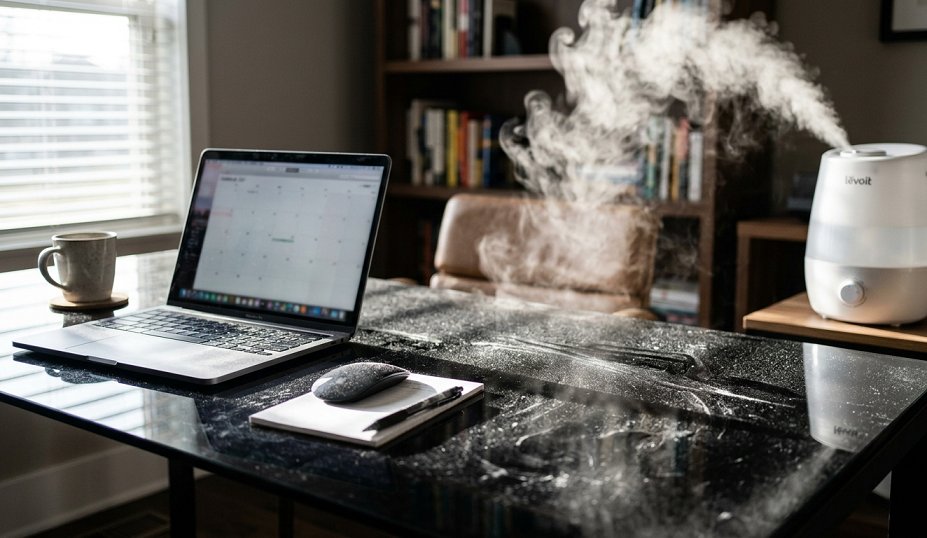
Most homeowners ignore this powder until their MacBook fans start screaming under the weight of mineral buildup.
By then, the microscopic “shrapnel” has already settled into the deepest crevices of your life. You are currently breathing in a chemical cocktail that your body was never meant to process, and the clock is ticking.
The Physics of Ultrasonic Mineral Mist
Ultrasonic humidifiers function by using a metal diaphragm vibrating at ultrasonic frequencies to create micro-droplets.
Unlike evaporative units that leave minerals behind in a wick, ultrasonic tech launches everything in your water directly into the air. This includes Calcium, Magnesium, and any heavy metals present in your local municipality’s supply.
The 1-5 Micron Shrapnel Problem
When these droplets evaporate mid-air, they leave behind solid mineral particulates. According to research cited by the Environmental Protection Agency (EPA), these particles often fall into the PM2.5 category. This size is small enough to bypass the natural filters in your nose and throat, settling directly into your lung tissue.
Defining Total Dissolved Solids (TDS) Thresholds in 2026
In 2026, air quality experts categorize water safety for ultrasonic use based on TDS parts per million (ppm). If your tap water exceeds 50 ppm, you are effectively running a dust factory. You can verify your local levels via the USGS Water Quality Data portal.
| Humidifier Type | Particulate Emission | Maintenance Level | Best Water Source |
|---|---|---|---|
| Ultrasonic | High (White Dust) | Low | Distilled / RO |
| Evaporative | Zero | High (Wick Change) | Tap / Filtered |
| Steam Vaporizer | Zero | Medium (Descaling) | Tap |
The mechanics of this “mineral mist” are undeniable, yet the physical damage to your home’s most expensive assets is where the real cost hides.
Why Your Electronics Are the First Victims
Your high-end workstation is a giant vacuum cleaner for mineral dust. Most modern electronics generate a static charge that acts as a magnet for the Calcium and Magnesium particulates emitted by your humidifier. While traditional household dust is mostly organic fibers, white dust is inorganic and abrasive.
Thermal Throttling in High-End Workstations
As your PC or gaming console pulls in air for cooling, these minerals coat the heat sinks and fan blades. This creates an insulating layer that prevents heat dissipation. Over time, your system will engage in “thermal throttling,” intentionally slowing down its processor to prevent melting. For a deep dive into how particulates affect hardware, see our Lab Insights.
Conductivity and PCB Corrosion
While pure Calcium isn’t highly conductive, the moisture in the air can mix with these mineral deposits on a Printed Circuit Board (PCB). This creates a bridge for “stray current,” which can lead to micro-shorts. Over a long enough timeline, this mineral “crust” absorbs environmental humidity and begins a slow, corrosive dance on your motherboard’s copper traces.
Understanding the mechanical failure of your tech is step one, but we need to pivot to the high-stakes ROI of your water choices.
Beyond Distilled: The 0-TDS Solution
Buying plastic jugs of distilled water is a logistical nightmare and an environmental disaster. If you are serious about air quality, you need a localized solution that strips the water of its mineral identity before it ever touches the humidifier’s transducer.
The ROI of Reverse Osmosis (RO) and Deionization (DI)
For a heavy user, an under-sink RO system pays for itself within six months compared to the cost of bottled distilled water. However, RO alone typically leaves 5 to 10 percent of minerals behind. For a true 0-TDS output, you must look at deionization (DI) stages. We discuss the specific water requirements for different environments in our guide on what kind of water to use.
Demineralization vs. Distilled Efficiency
Demineralization cartridges are the “quick fix,” but they are often the most expensive long-term route. These cartridges use ion-exchange resin to grab minerals. In high-hardness areas, these filters can saturate in as little as two weeks. You can check the health standards for indoor particulate matter at the CDC to see why keeping this filtration tight is non-negotiable.
The 2026 Standard for “Safe” Ultrasonic Use
The industry standard has shifted toward a “Zero-Emission” mandate for indoor air. If you cannot achieve a TDS of 0, you should stop using an ultrasonic unit immediately and switch to an evaporative model. The cost of a new humidifier is significantly lower than the cost of a lung specialist or a new GPU.
You now have the technical blueprint to save your air and your assets; the only question left is whether you will act before the next layer of dust settles.
Leave a Reply
You must be logged in to post a comment.