
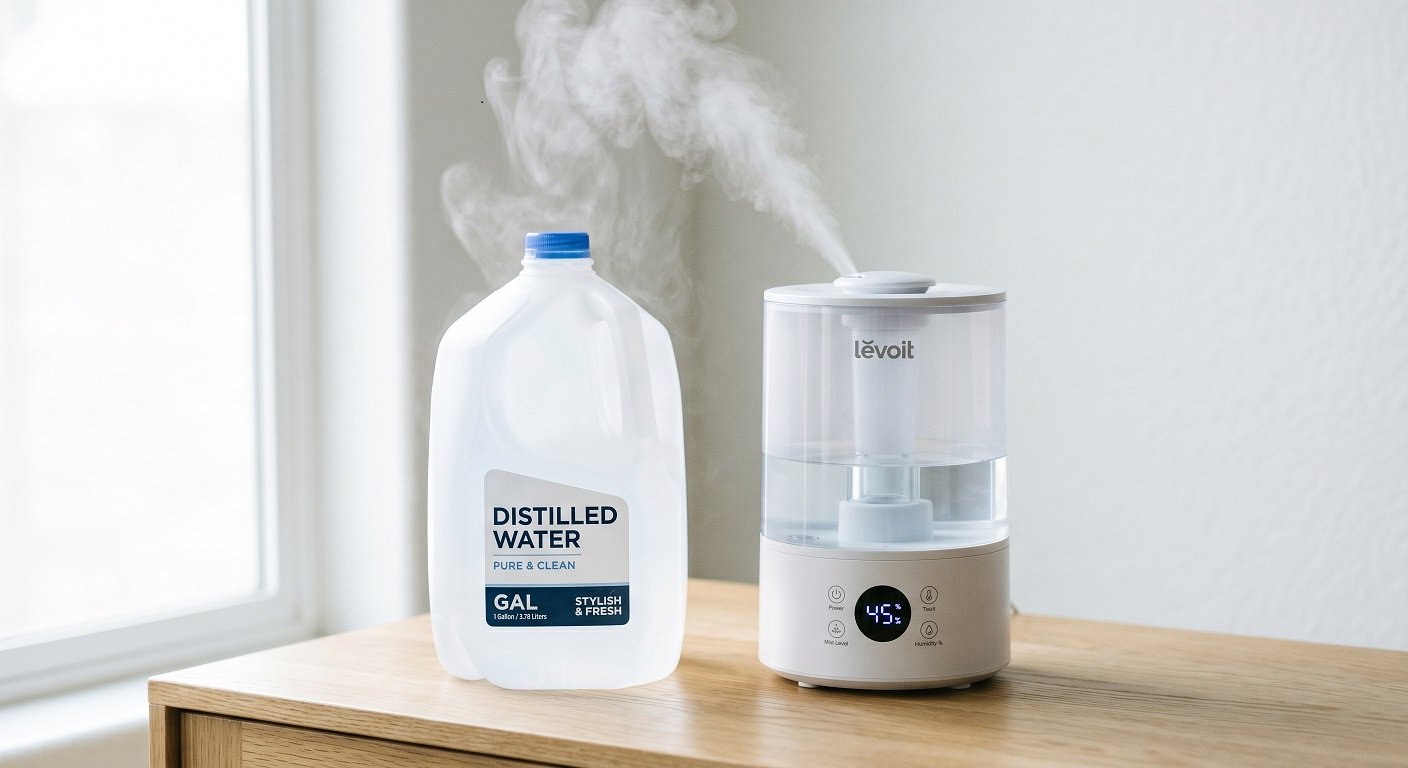
Using distilled water for your humidifier is one of those small decisions that affects three things at once: how well the device performs, how long it lasts, and what actually ends up in your air.
Most people fill the tank with whatever comes out of the tap and move on.
That works, until it doesn’t.
Tap water carries dissolved minerals that accumulate inside the unit, settle on your furniture as white dust, and create conditions where mold and bacteria can grow.
The fix is straightforward, and it costs less than most people expect.
Why the Water You Use in Your Humidifier Matters
Humidifier problems are often blamed on the device itself, but the water is frequently the actual cause.
US tap water typically carries 200–500 ppm of dissolved minerals, mostly calcium and magnesium, measured as total dissolved solids (TDS). They do not disappear when water enters your humidifier.
Where Tap Water Minerals Go Once They’re Airborne
Ultrasonic and impeller models break water into microscopic droplets and disperse them directly into room air. The minerals travel with those droplets.
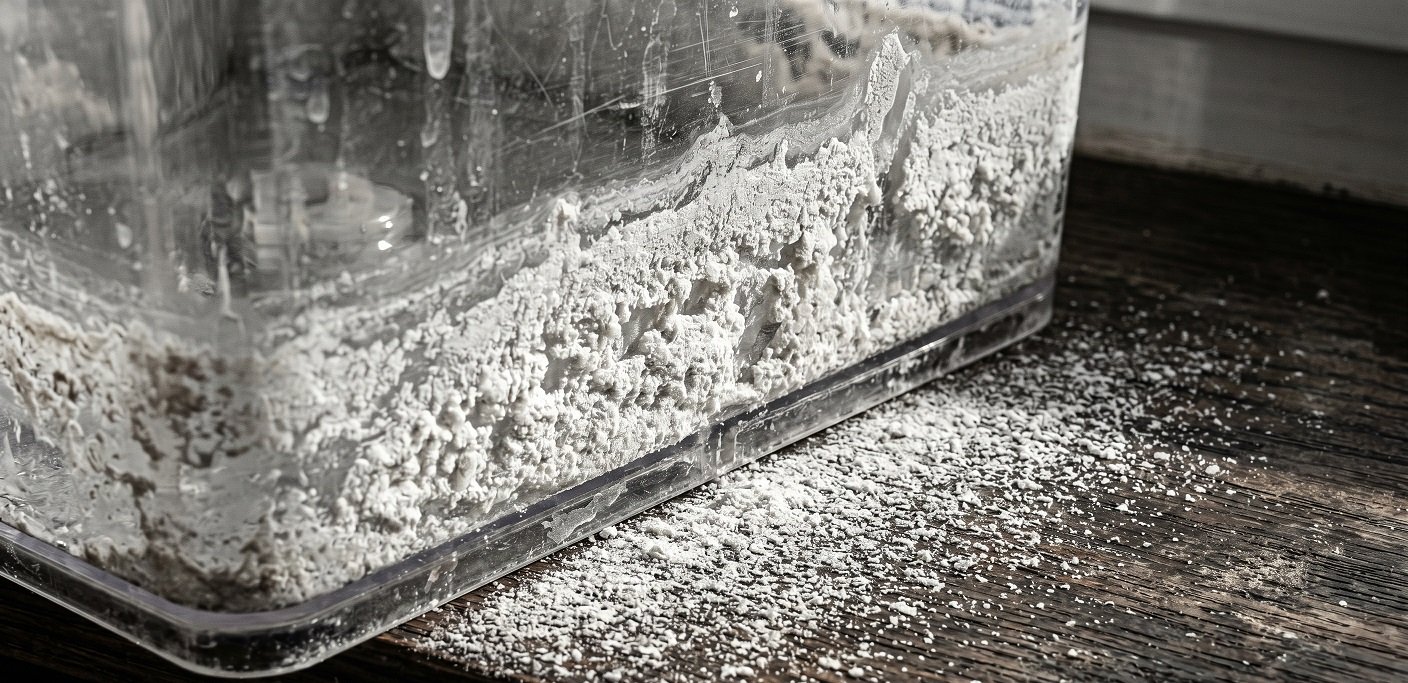
As moisture evaporates, they settle on nearby surfaces as fine white powder.
That powder is white dust, composed almost entirely of calcium and magnesium from your tap water. It collects on furniture, electronics, glossy surfaces, and floors within a few feet of the device.
The CPSC notes these particles can reach the lungs, a particular concern for people with asthma or respiratory sensitivities.
Scale Damages More Than Just the Tank
Minerals build up on tank walls, the ultrasonic plate, and other components as a hard deposit called mineral scale, or limescale. Scale forces the device to work harder, reduces mist output, increases energy use, and shortens the unit’s lifespan.
It is not just a cleaning inconvenience.
Scale also creates a physical problem beyond mechanical wear. Its rough, porous texture gives mold and bacteria structural anchor points on internal surfaces.
Mineral residue traps moisture and organic matter, and mold can take hold in standing water within 48 hours. The EPA recommends low-mineral water as a preventive measure against both scale buildup and microorganism growth.
How Common Water Types Compare
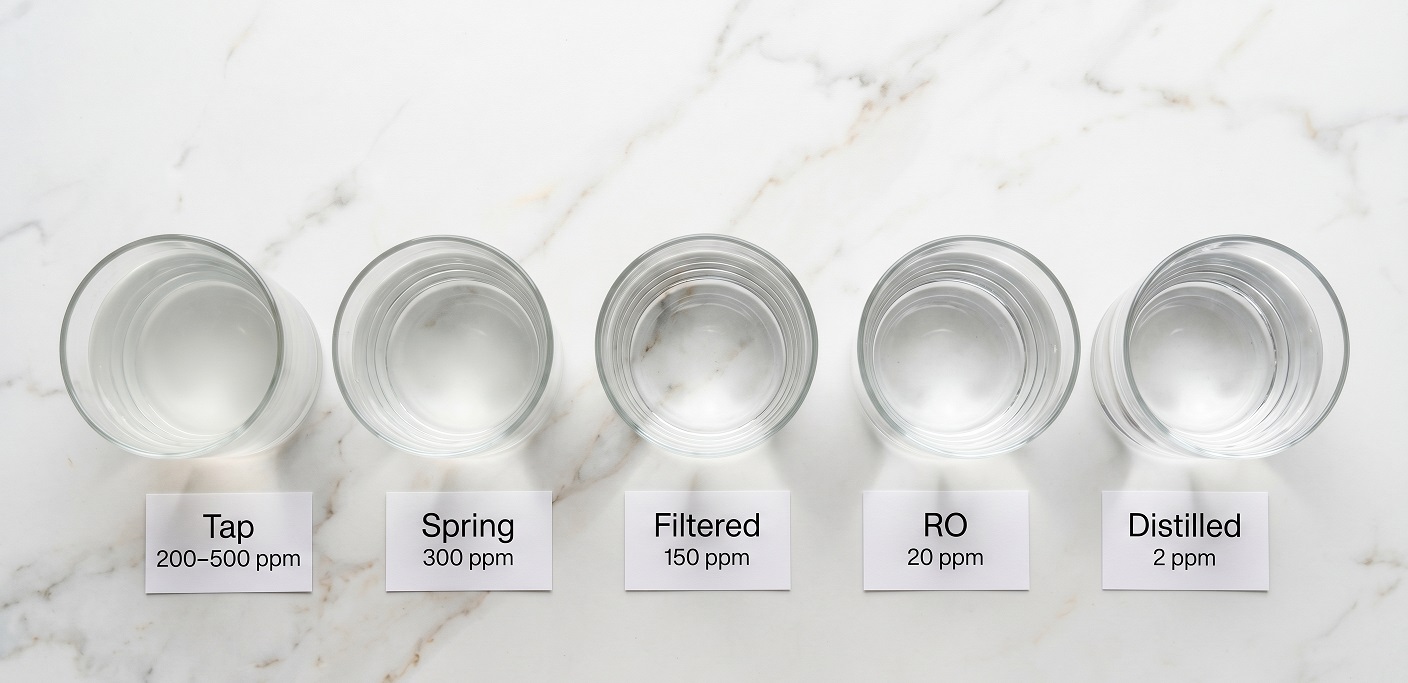
The single most useful way to evaluate water for a humidifier is total dissolved solids (TDS), already defined above. It tells you exactly how much mineral content is available to become white dust or scale.
The table below shows where six common water options land and what each means for your device.
| TDS | White dust | Scale buildup |
|---|---|---|
| 0–5 ppm | None | None |
The recommended standard for humidifiers.
| TDS | White dust | Scale buildup |
|---|---|---|
| 5–50 ppm | Very low | Very low |
A strong alternative to distilled water.
| TDS | White dust | Scale buildup |
|---|---|---|
| <10 ppm | Very low | Very low |
Equivalent to distilled for most purposes.
| TDS | White dust | Scale buildup |
|---|---|---|
| 150–500 ppm | High | High |
Avoid in ultrasonic models especially.
| TDS | White dust | Scale buildup |
|---|---|---|
| 50–300+ ppm | High | High |
Mineral content too high for safe use.
| TDS | White dust | Scale buildup |
|---|---|---|
| 300–600+ ppm | High | High |
Boiling concentrates minerals, making TDS worse than tap.
Two Common Workarounds That Fall Short
One entry in that table surprises most people: boiled tap water. Boiling kills bacteria but does nothing to dissolved minerals.
The result concentrates the remaining minerals, making it potentially worse for scale than untreated tap water.
Spring water causes the same confusion for different reasons. Naturally occurring minerals absorbed from rock and soil put its TDS in the same range as tap water.
In an ultrasonic humidifier, that means the same white dust and the same scale buildup.
What Filters Miss and What Things Cost
Standard pitcher and faucet filters, including options like Brita, are designed to reduce chlorine, taste compounds, and some heavy metals. Calcium and magnesium, the two minerals that drive white dust and scale, pass through largely unaffected.
Filtered water is not a substitute for distilled or RO water in a humidifier.
On cost, the gap between options is smaller than most people assume. Store-bought distilled water runs roughly $1.00–$1.50 per gallon. Home countertop distillers bring that down to around $0.25–$0.35 per gallon.
Why Distilled Water Is the Right Choice for Most Humidifiers
Using distilled water in your humidifier solves the mineral problem at its source rather than managing the symptoms. To understand why, it helps to know what distillation actually does to water before it ever reaches your tank.
How Distillation Removes the Problem Entirely
The process is straightforward. Water is heated until it boils into steam. That steam is collected and condensed back into liquid in a separate container.
Minerals and other dissolved solids cannot vaporize at water’s boiling point, so they remain behind in the original vessel. What gets collected reads 0–5 ppm TDS, compared to the 150–500 ppm typically found in municipal tap water.
That starting point is what makes distilled water effective in a humidifier.
No minerals enter the tank, so white dust cannot form and scale cannot build on internal components. The problem does not need to be cleaned away because it does not form in the first place.
Who Recommends It and What You Gain
The recommendation is not informal advice. Consumer Product Safety Commission (CPSC) guidance instructs users to use distilled or demineralized water and avoid tap water in room humidifiers. EPA (Environmental Protection Agency) guidance flags tap water mineral buildup as a maintenance concern and recommends low-mineral water as the preventive step.
Major humidifier manufacturers reach the same conclusion. Levoit explicitly recommends distilled water for its tanks, citing reduced white dust, less scale buildup, and cleaner operation.
For most households, the payoff is less frequent cleaning, longer device life, and cleaner mist output.
Exceptions and Edge Cases Worth Knowing
The recommendation to use distilled water applies most strictly to one specific humidifier type. Understanding the distinction can save you money and clarify what the rule actually requires in your situation.
Why Humidifier Type Changes the Rule
Ultrasonic humidifiers use a high-frequency vibrating diaphragm to break water into microscopic droplets dispersed directly into room air. No filtration occurs before that dispersal. Whatever is dissolved in the water enters the air directly, making distilled water especially critical for these units.
Evaporative humidifiers work differently. A fan draws air through a wet wick filter (an absorbent pad that draws water up from the tank), and only water vapor passes through into the airstream.
Minerals in the water stay trapped in the wick rather than becoming airborne. Tap water is tolerable in these models provided the wick and reservoir are cleaned and replaced on schedule.
Levoit makes the distinction explicit in its official guidance. The Superior 6000S uses elevated filtration and is explicitly approved by Levoit for tap water use. Its Dry Mode uses fan speeds to dry filters between cycles, reducing moisture buildup and mold risk.
What to Use When Distilled Is Unavailable
If you cannot find distilled water, the alternatives are not all equal. RO water is the strongest substitute, with 5–50 ppm TDS and 90–99% mineral removal.
Low-mineral bottled water is acceptable for short periods, though mineral content varies by brand. Pitcher-filtered water is not a substitute, as it leaves the hard minerals responsible for white dust and scale intact.
Boiled tap water is sometimes suggested as an emergency measure for microbial risk, and that use is reasonable. For mineral management it falls short, because minerals remain and may concentrate further as water volume reduces during boiling.
How to Clean Your Humidifier Properly
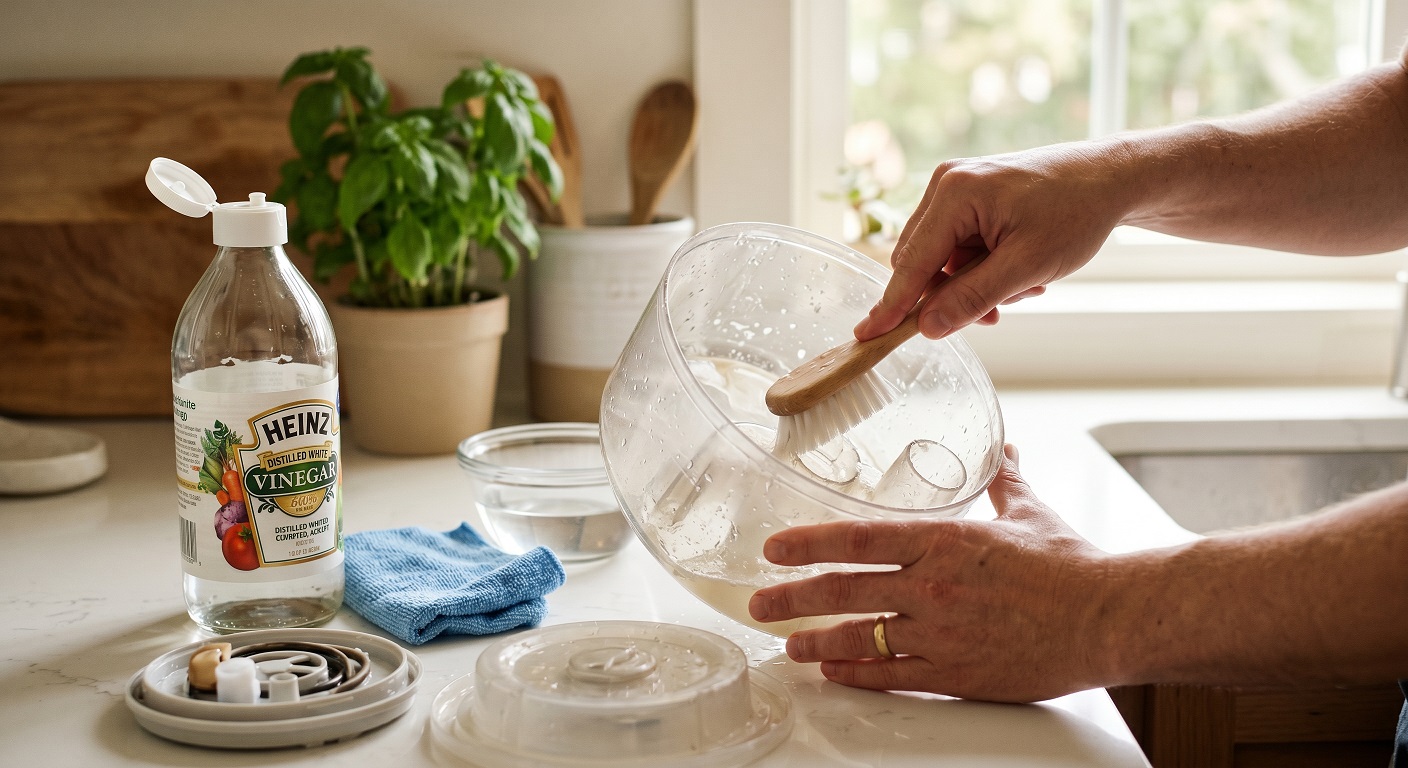
Choosing the right water reduces the cleaning burden significantly, but it does not eliminate it. The EPA recommends cleaning portable humidifiers every third day to limit scale and microbial buildup, regardless of water type.
The Cleaning Routine That Actually Works
Distilled water removes mineral scale as a cleaning driver. Bacteria and mold can still grow in stagnant water, fed by airborne spores rather than the water source alone.
Regular emptying, drying, and cleaning remain necessary on schedule even with distilled water.
1. Unplug and disassemble
Disconnect the humidifier from power. Remove the tank, base, and all detachable parts including any wick filter or demineralization cartridge (a replaceable filter that removes minerals from water before it enters the tank). Discard old water.
2. Soak in white vinegar solution
Fill the tank halfway with equal parts distilled white vinegar and water, or use undiluted vinegar for heavy scale. Pour a small amount into the base as well. Let all components soak for 20–30 minutes to dissolve calcium and magnesium deposits.
3. Scrub interior surfaces
Use a soft brush or old toothbrush to scrub the tank interior, base, and any components with visible deposits. For ultrasonic models, wipe the ultrasonic plate gently with a vinegar-dampened cotton swab. Do not use abrasive tools.
4. Disinfect
Apply 3% hydrogen peroxide or diluted bleach (one tablespoon per gallon of water) to the tank and base. Vinegar dissolves mineral scale but does not kill all pathogens. Let the disinfectant sit briefly, then drain.
5. Rinse thoroughly
Rinse all components with clean water multiple times until no vinegar or disinfectant smell remains. Inadequate rinsing can result in chemical aerosol when the unit operates.
6. Air dry completely before reassembling
Wipe all surfaces and allow every component to dry fully before putting the unit back together. Reassembling while wet recreates the moist environment that promotes mold and bacteria growth.
The Rule That Applies Regardless of Water Type
Even with distilled water, clean on schedule. It eliminates mineral scale, but stagnant water of any type can grow mold and bacteria within 48 hours. Wick filters and demineralization cartridges should be replaced every 30 to 60 days, or per the manufacturer’s schedule.
One Small Change Before Your Next Refill
Tap water minerals entering a device not built to filter them are behind most of the problems covered here.
Using distilled water for your humidifier removes that source: less white dust, less scale, longer device life.
The switch costs roughly a dollar per gallon at most grocery stores. If you run your humidifier regularly, a countertop distiller brings that cost down further.
Either way, the next time you refill the tank is a reasonable place to start.
Leave a Reply
You must be logged in to post a comment.