
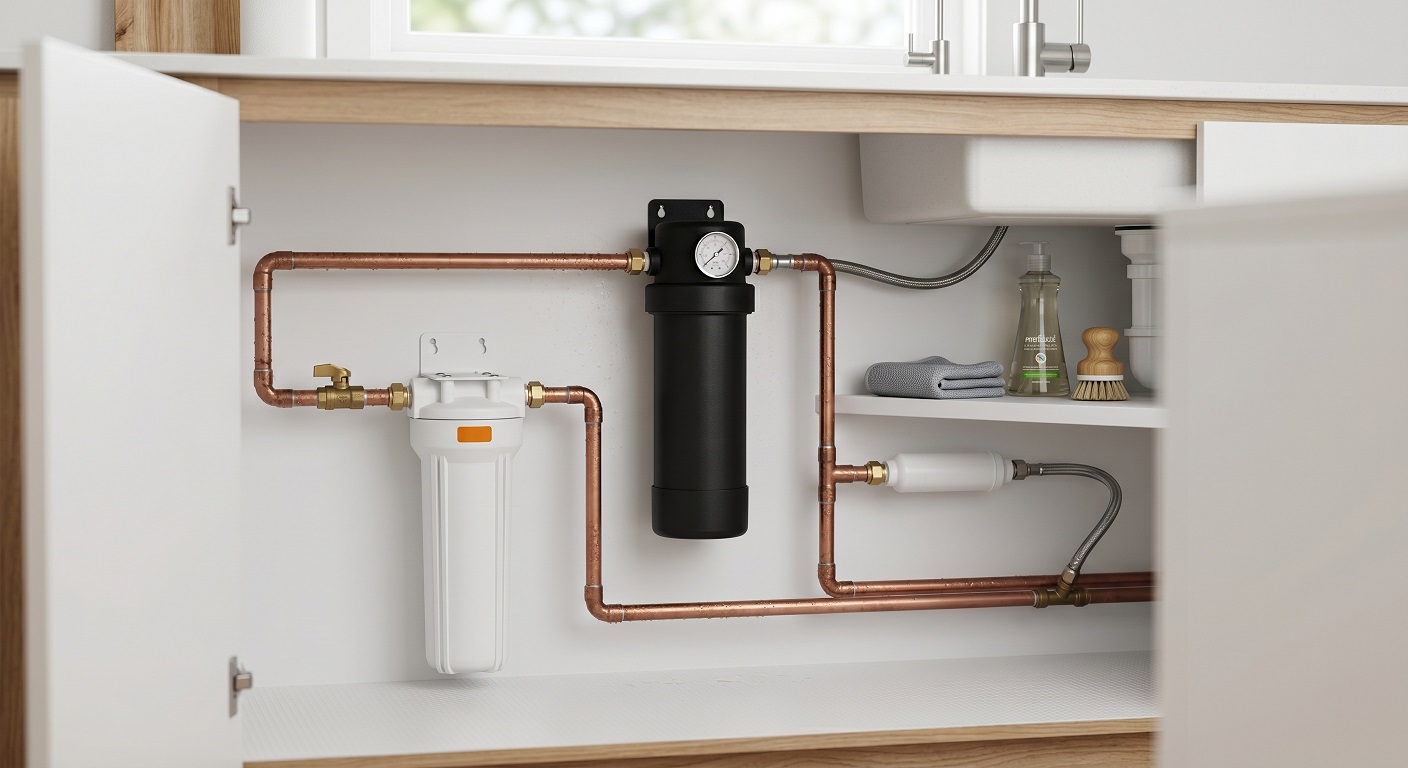
If you have been shopping for a solution to hard water and kept running into the term salt free water softener, you are not alone in finding it confusing.
The label sounds straightforward, but it describes a product that does not actually soften water in any measurable sense. That gap between the marketing and the reality is exactly what this guide is here to address.
What these systems do, and what they cannot do, depends on how water hardness is defined and which problems you are trying to solve.
Scale on your pipes is a different problem from dry skin or soap that will not lather. Understanding that distinction before you buy is the difference between a system that meets your needs and one that disappoints.
What a Salt-Free Water Softener Actually Is
The term “salt free water softener” appears on packaging, retailer listings, and manufacturer websites as though it describes a single, well-defined product category. It does not.
The Water Quality Association defines soft water as water measuring below 1 grain per gallon of hardness minerals, and no salt-free system on the market consistently achieves that threshold.
The Difference Between Softening and Conditioning
To understand why, you need to separate two terms that the industry treats as interchangeable but are not.
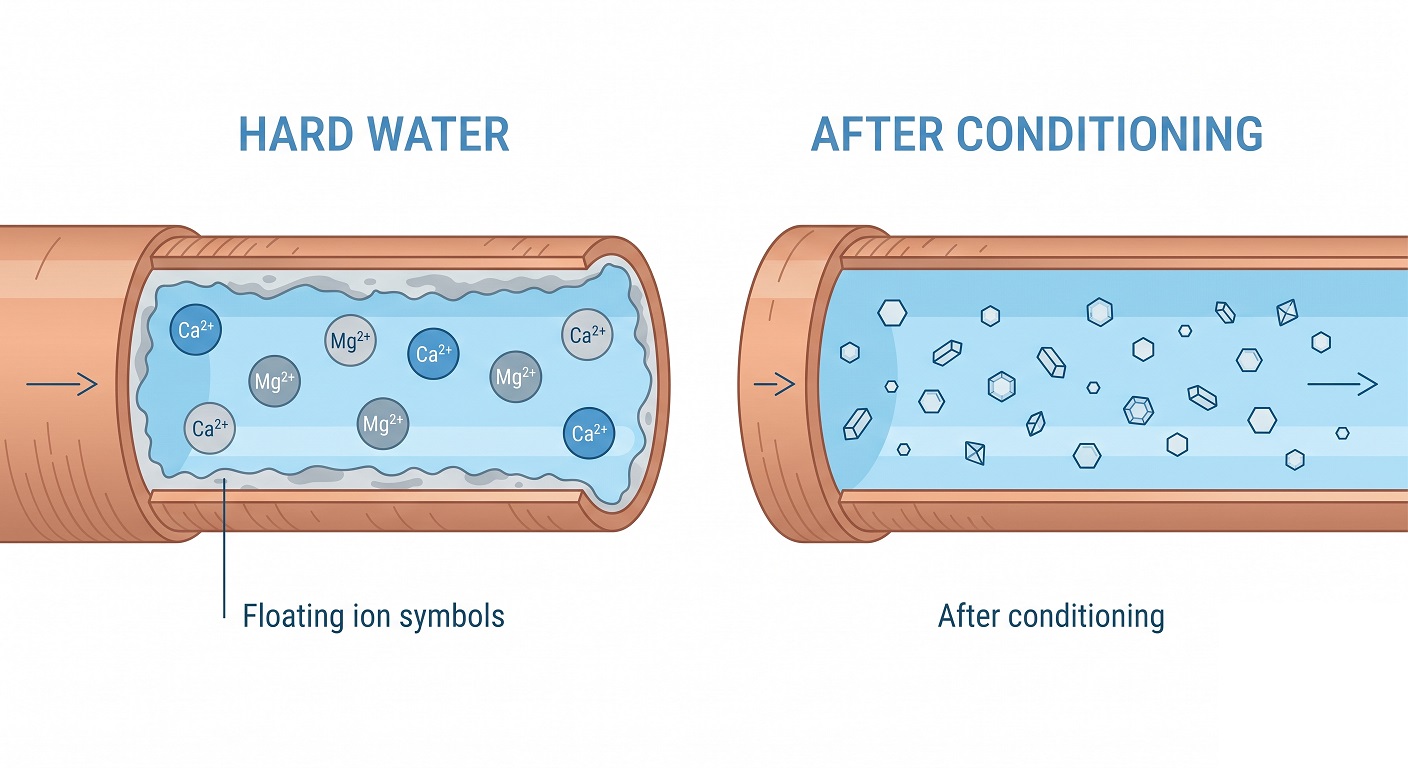
A water softener removes hardness minerals, specifically calcium and magnesium, from the water entirely through a process called ion exchange. A water conditioner leaves those minerals in place but alters their physical structure so they are less likely to stick to pipe walls and heating surfaces.
Salt-free systems fall into the conditioner category. They do not remove anything from your water.
Measured hardness before and after passing through a salt-free unit will show no meaningful difference on a test strip. The minerals are still there, in the same concentration, just in a different physical form.
Why Lathering and Skin Issues Stay Unresolved
That distinction has real consequences for what you can expect from the product. A salt-free water conditioner does not improve soap lathering.
Soap lathers poorly in hard water because calcium and magnesium ions interfere with the surfactant chemistry, and conditioning does not change the mineral concentration that drives that reaction. Dry skin linked to mineral content is similarly unresolved by conditioning alone.
Scale Prevention Is the One Confirmed Benefit
What conditioning does address is scale. Calcium and magnesium deposits harden on pipe interiors, heating elements, and fixture surfaces when water evaporates or heats up.
Scale prevention is the primary documented benefit of salt-free conditioning, and it is a real one. The U.S. Department of Interior and the Water Quality Association identify 120 mg/L, roughly 7 grains per gallon, as the hardness level at which scale becomes a meaningful household problem.
Salt-free conditioners are designed to address scale at and above that threshold.
The practical implication is straightforward. If your main concern is protecting pipes and appliances from mineral buildup, a salt-free conditioner may be a reasonable fit.
If you are expecting softer-feeling water, easier soap lather, or relief from skin dryness driven by hard water minerals, a conditioner will not deliver those outcomes. Knowing which problem you are actually trying to solve is the necessary first step before evaluating any product in this category.
How Template-Assisted Crystallization Works

Most salt-free conditioners on the market use a process called template-assisted crystallization, or TAC, to address scale. Understanding what happens inside the unit helps separate legitimate performance claims from the ones that do not hold up.
How the Crystallization Process Actually Works
The media inside a TAC system is covered in microscopic nucleation sites, meaning surface points where dissolved minerals can begin to crystallize. Think of these sites as tiny templates: when hard water passes through, dissolved calcium and magnesium latch onto those templates and crystallize into stable micro-particles.
Those particles are small enough to stay suspended in the water and flow through your plumbing without adhering to pipe walls, heating elements, or fixture surfaces.
Nothing is added to the water and nothing is removed. They remain present in the same concentration.
What changes is their physical form, from dissolved ions that can deposit on surfaces to stable crystals that pass through without sticking. That is the entire mechanism, and it is why TAC systems produce no wastewater and require no salt or electricity to operate.
TAC vs. Electromagnetic vs. Magnetic Devices
TAC is one of three categories of salt-free scale control you will encounter when shopping. Electromagnetic devices wrap a wire coil around the outside of your pipe and generate electric impulses believed to alter how minerals crystallize, but they use no media and no chemicals.
Magnetic devices work on a similar principle using a passive magnet, also with no media.
Of the three, TAC has the most peer-reviewed support. Studies indicate electromagnetic devices reduce limescale by roughly 17 to 70 percent, while TAC media systems have been found to reduce scale formation by greater than 88%.
Evidence for magnetic devices is weaker still, and manufacturer claims about their effectiveness on water heaters are not supported by independent research.
Where TAC Reaches Its Limits
TAC does have a documented performance ceiling. Studies indicate these systems cannot achieve true softness below 1 grain per gallon, the threshold the Water Quality Association uses to define soft water.
Your hardness reading on a test strip will not change after water passes through a TAC unit.
Performance also degrades when water contains elevated iron or manganese. Iron concentrations above 0.3 ppm coat the nucleation sites on the media, blocking the crystallization process and rendering the unit progressively less effective.
Your hardness reading on a test strip will not change after water passes through a TAC unit.
That limitation matters most for households on well water. City water typically contains little to no iron, which is why TAC performs most reliably in that context.
For households where the water source introduces iron or manganese, a different treatment approach is needed before scale control becomes meaningful.
Salt-Free Conditioner vs. Ion Exchange Softener
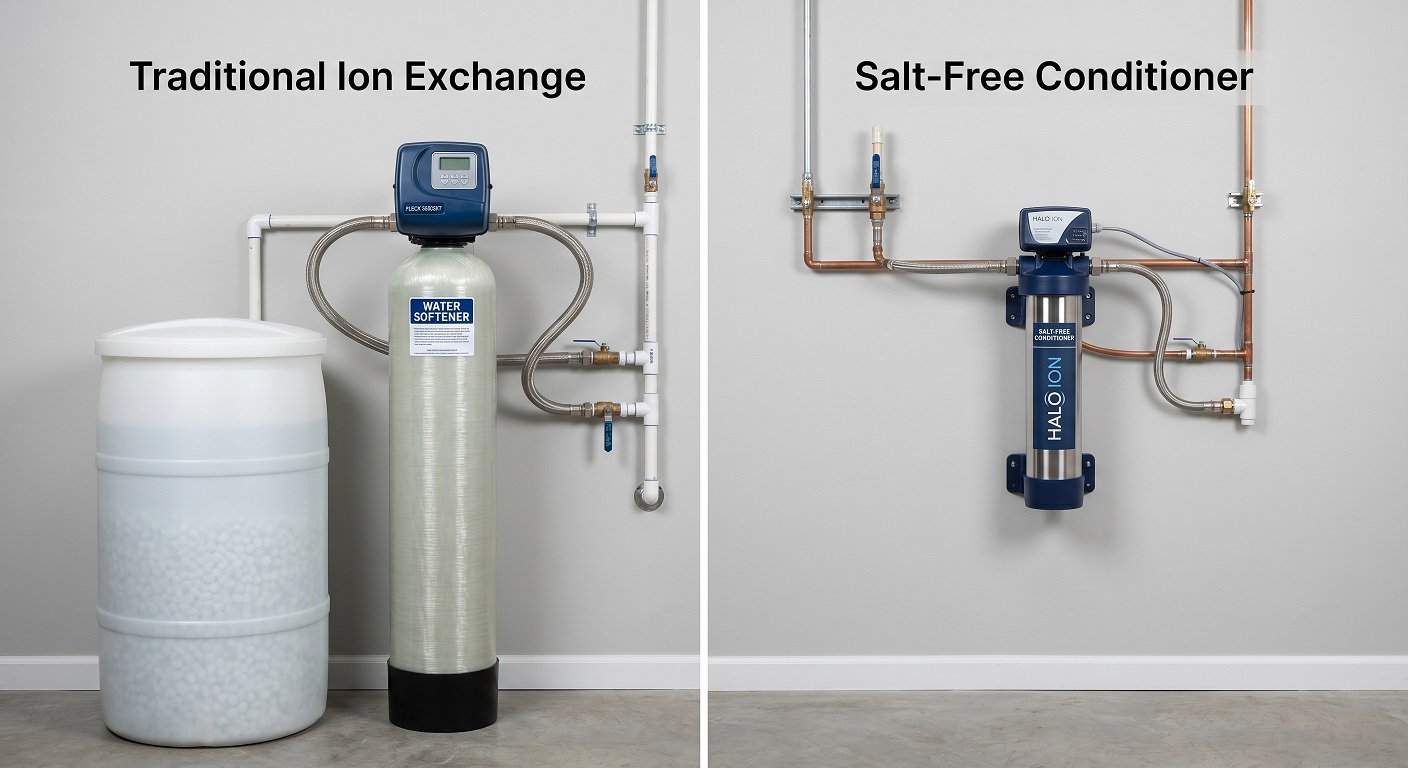
Choosing between these two systems comes down to which problems you are actually trying to solve. They are not competing versions of the same product. They address different aspects of hard water, at different costs, with different environmental consequences.
What Each System Actually Delivers
Ion exchange uses a resin bed, a tank of negatively charged beads, to attract calcium and magnesium and replace them with sodium ions.
The result is true soft water, consistently below 1 grain per gallon. That reduction resolves the full range of hard water symptoms: soap lathers properly, skin and hair feel different after washing, and scale does not form because the minerals driving it have been removed.
Salt-free conditioning leaves those readings unchanged. A household at 15 grains per gallon stays at 15 grains per gallon after conditioning. Scale is managed, but lathering and skin outcomes are not.
Maintenance and Ongoing Cost Compared
The maintenance profiles are meaningfully different. A salt-free conditioner requires media replacement every three to five years and nothing else: no salt purchases, no electricity, no wastewater produced.
An ion exchange softener requires regular salt refills, periodic resin replacement, and generates brine discharge during each regeneration cycle. The ongoing cost and attention required by ion exchange is higher, though the performance outcomes justify that for households where full softening is the goal.
The Environmental and Regulatory Tradeoff
That brine discharge carries an environmental cost that has led several municipalities to restrict or ban ion exchange softeners entirely. The high-chloride wastewater produced during regeneration is difficult for municipal treatment plants to process and raises salinity in recycled water supplies used for agriculture and groundwater recharge.
Salt-free conditioners produce no discharge and comply with brine restrictions in municipalities across California, Texas, and Arizona where ion exchange is prohibited or limited.
The decision rule is straightforward once you know your water. For very hard water above 25 grains per gallon, or for well water carrying significant iron, ion exchange is the appropriate system.
The hardness load is too high and the symptom profile too broad for conditioning to address adequately. For city water under 25 GPG where scale is the primary concern, a salt-free conditioner is often the right choice.
When a Salt-Free System Fits and When It Does Not
A salt-free conditioner performs well in some situations and fails in others. The difference is not about brand or price point. It comes down to your water source, your hardness level, and what else is in your water besides calcium and magnesium.
City Water Is Where This Technology Performs Best
City water with moderate hardness, under 25 grains per gallon, is the strongest use case. Municipal water treatment removes most of the iron and manganese that foul TAC media, which means the crystallization process runs as intended.
Scale buildup on fixtures, pipes, and appliances is reduced meaningfully. This is the scenario the technology targets, and it is where performance data is most consistent.
If you are on city water in California, Texas, or Arizona, a salt-free conditioner may also be your only compliant option. Santa Clarita Valley and parts of the San Joaquin region have banned self-regenerating salt-based softeners at the district level.
San Antonio and surrounding communities in Texas enforce brine-discharge restrictions that effectively prohibit ion exchange for residential use. A salt-free conditioner produces no brine discharge and meets these requirements without exception.
Tankless Heaters Benefit, Recirculation Systems Do Not
Tankless water heaters are a particularly well-matched application. Scale accumulates directly on the heating element in a tankless unit, and hot water accelerates that buildup faster than in a storage tank system.
A salt-free conditioner installed on the supply line upstream of the heater intercepts the minerals before they reach the element.
There is one documented failure point in this setup: hot water recirculation systems. Repeated cycling through high-temperature zones can exceed the crystallization window of TAC media, reducing effectiveness where protection matters most.
Households with recirculation loops should factor this limitation into any purchase decision.
Well Water Is the Wrong Application
Well water is where salt-free conditioning breaks down. Iron concentrations above 0.3 ppm coat the nucleation sites on the TAC media and block the crystallization process. Manganese has the same fouling effect.

The media degrades without visible warning, and the household continues paying for a system that is no longer functioning as intended.
Installing a salt-free conditioner on untreated well water with iron present is one of the more common and costly mistakes in this category. Ion exchange, with appropriate iron pretreatment if needed, is the correct approach for well water hardness.
Pairing with an RO System Extends Membrane Life
For city water households, installing a salt-free conditioner before a reverse osmosis system is a documented and effective pairing. The conditioner reduces scale on the RO membrane, which extends membrane life and reduces replacement frequency.
The RO system handles contaminant removal, covering what the conditioner does not address. Together they cover city water treatment concerns without brine discharge or chemical addition, each handling what the other cannot.
Honest Pros and Cons for the First-Time Buyer
Salt-free conditioners are not a bad product. They are a specific tool with a defined performance envelope. The problems arise when manufacturers market them as something broader, and buyers discover the gap after installation.
Here is what the evidence actually supports.
What Salt-Free Conditioning Genuinely Delivers
On the positive side, the operational profile is genuinely low-maintenance. No salt to purchase, no brine to discharge, no electricity consumed, and no wastewater produced. Media replacement runs every three to five years and is the only recurring expense.
Calcium and magnesium remain in the water, which some households consider a benefit given their dietary role. In restricted areas, it is the compliant option, and scale prevention on moderate city water is a documented outcome.
What It Will Not Fix After Installation
The limitations are equally real and worth stating plainly. Measured water hardness does not change after conditioning.
A test strip run on your tap water will show the same number before and after the unit is installed.
Measured water hardness does not change after conditioning.
Soap lathering, laundry outcomes, and dry skin from mineral content will not improve after installation. These are not edge cases or rare complaints. They are the predictable result of a system that leaves hardness minerals in place.
And at the extremes, performance degrades further. Well water with iron above 0.3 ppm fouls the media and renders the unit ineffective over time.
Hardness levels above 25 grains per gallon push past the reliable operating range of most TAC systems. Hot water recirculation setups reduce effectiveness at the heating element, the point where scale protection matters most.
A Realistic Example at 10 Grains Per Gallon
A household on city water at 10 grains per gallon is a realistic example of where the system earns its place. The WQA places 10 GPG in the hard range, where fixture and appliance scale becomes a real ongoing cost.
A salt-free conditioner will reduce that scale buildup meaningfully.
Compared to fully softened water, soap lathers less freely and the water will not feel as soft on skin. That trade-off is acceptable for many households. It is not acceptable for households where those outcomes are the primary motivation for installing a system.
How to Choose the Right System for Your Home
Everything covered in this article comes down to three questions answered in the right order. Skip one and you risk buying the wrong system. Work through them in sequence and the decision becomes straightforward.
Test Your Water Before Buying Anything
Step one is testing your water before spending anything. You need two numbers: your hardness level in grains per gallon and your iron concentration in parts per million.
The WQA identifies 7 GPG as the minimum hardness level where salt-free scale prevention becomes meaningful. Below that threshold, you may not have a scale problem worth solving with a whole-house system.
Hardware store test kits work, or your municipal utility can provide a water quality report with hardness data.
Match Your Source Water to the Right System
Step two is confirming your water source. City water with hardness under 25 GPG and iron below 0.3 ppm puts a salt-free conditioner in viable territory.
Well water, or city water where iron tests above 0.3 ppm, points toward ion exchange instead. The iron threshold is not a guideline. Above it, TAC media fouls and the conditioner stops working as intended.
Check Local Regulations for Your Address
Step three is checking your local regulations. Where your municipality restricts salt-based softeners, a salt-free conditioner is the compliant default.
If no restriction applies, your hardness level and water source from steps one and two determine the right system. Your local water district or sanitation authority can confirm whether any discharge restrictions are in effect for your address.
Test Your Water First, Then Choose Your System
A salt-free water conditioner is a legitimate scale prevention tool for city water households in the moderate range. It is not a softener. It will not reduce your measured hardness, improve soap lather, or resolve skin dryness tied to mineral content.
Understanding that distinction is the most useful thing this article can leave you with.
Before buying anything, test your water hardness in grains per gallon and check your iron level. City water under 25 GPG with iron below 0.3 ppm makes a salt-free conditioner a viable and often compliant choice.
Well water or hardness above 25 GPG points toward ion exchange instead. Start with the water test. Everything follows from that.

Purific Australia sells water purification systems, including some of the products and technologies discussed in this article. This content is written to inform, not to sell. Where a Purific product is a relevant solution, we say so plainly. Where it is not the right fit, we say that too.
All technical claims are based on published research, manufacturer data, or direct laboratory testing. If you have questions about a specific product recommendation or want independent verification of any data cited here, contact our technical team.