
Achieving clinical success requires a combination of ultra-pure polishing systems, UV photo-oxidation at 185nm, and point-of-use ultrafiltration to manage water purity for IVF. Leading embryologists recognize that even traces of Volatile Organic Compounds (VOCs) or endotoxins can catastrophically inhibit blastocyst development.
By mastering these specific purification protocols, you ensure that your lab environment remains a fortress against the microscopic contaminants that threaten patient outcomes.
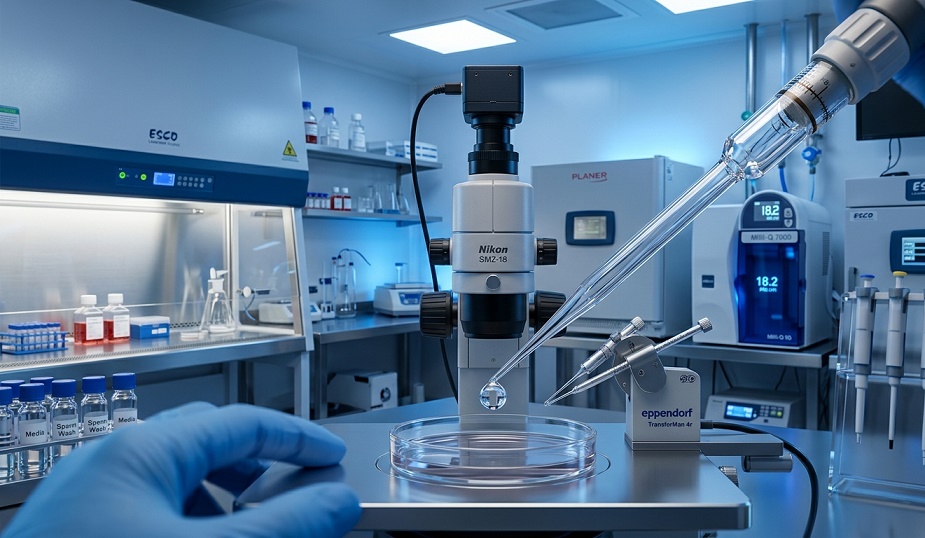
You might think your current Grade 1 system is enough because the resistivity meter reads 18.2 MΩ.cm; however, that number is a deceptive mask that hides the silent killers of human life.
If you ignore what is lurking behind that digital display, you are gambling with the future of every patient who walks through your doors; and the stakes could not be higher.
Why IVF Labs Demand Specialized Purity
Standard “Type 1” water is designed for general analytical chemistry. It is meant to protect sensitive machines, not delicate human life. In the world of assisted reproduction, the standard 18.2 MΩ.cm resistivity is merely the baseline; it is the entry fee, not the finish line.
Water is the primary component of culture media. It is the matrix for washing gametes and the foundation of every buffer you use.
When you are dealing with a single cell that lacks the detoxification mechanisms of an adult, even “trace” amounts of impurities become massive biological hurdles.
Beyond the Standard 18.2 MΩ.cm
Resistivity only measures ionic purity. It tells you that your water doesn’t have many dissolved salts. It tells you absolutely nothing about organic molecules, bacteria, or pyrogens.
In 2026, the industry standard has shifted. We are no longer just looking at ions; we are looking at Total Organic Carbon (TOC).
High-performance labs now mandate TOC levels below 2 parts per billion (ppb). If your system doesn’t have an integrated TOC monitor, you are essentially flying blind through a storm of invisible organics.
The Criticality of Ionic Stability in 2026
Recent updates from the European Society of Human Reproduction and Embryology (ESHRE) emphasize that even minor fluctuations in ionic concentration can cause osmotic stress.
This stress can trigger apoptosis in early-stage embryos. Your purification system must maintain a constant, unwavering output to prevent these micro-shifts during media preparation.
Most labs believe their filters catch everything, but there is a specific class of airborne invaders that can pass right through a standard cartridge.
The Danger of VOCs in Embryology
Volatile Organic Compounds (VOCs) are the ghost contaminants of the IVF lab. They can come from cleaning agents, floor waxes, or even the plastic tubing inside your lab equipment. Because they are non-ionic, they do not trigger your resistivity alarm.
These compounds are highly lipophilic. This means they easily pass through the protective lipid membranes of the oocyte and embryo. Once inside, they can disrupt mitochondrial function and alter gene expression. This isn’t just a theory; it is a documented cause of “unexplained” laboratory crashes.
How Organic Vapors Impact Development
VOCs like toluene, xylene, and various alkanes act as subtle toxins. They may not kill the embryo immediately. Instead, they slow down cleavage rates or lead to poor-quality blastocysts that fail to implant.
To combat this, your water system must utilize a dual-wavelength UV lamp (185/254 nm). The 185 nm wavelength generates hydroxyl radicals that break down these organic chains into carbon dioxide, which can then be removed by ion exchange resins. Without this specific step, your “pure” water is still a chemical soup.
But even if you strip away every chemical, a biological threat remains that can trigger an immune-like response in a cluster of cells.
Setting Strict Endotoxin Levels in IVF
Endotoxins, or lipopolysaccharides (LPS), are components of the cell walls of Gram-negative bacteria. Even if the bacteria are dead, their endotoxins remain. In any other medical field, a little endotoxin is manageable; in IVF, it is a dealbreaker.
The standard for Grade 1 water allows for endotoxin levels that are far too high for embryology. While general lab water might tolerate 0.25 EU/ml, a high-stakes IVF lab should aim for levels below 0.001 EU/ml. This is often referred to as “Ultrapure” or “Biopure” water.
Minimizing Biological Interference
Endotoxins bind to cell surface receptors and can trigger the release of cytokines. For a developing embryo, this is catastrophic. It creates an inflammatory environment that mimics a failed pregnancy before it even begins.
To achieve these near-zero levels, you must implement point-of-use (POU) ultrafiltration. These filters act as a mechanical barrier, catching the large LPS molecules just as the water leaves the tap. If your ultrafilter is located back at the central plant and not at the bench, you are risking re-contamination in the distribution loop.
| Parameter | Standard Grade 1 Water | IVF-Grade Ultrapure (2026) |
|---|---|---|
| Resistivity | 18.2 MΩ.cm | 18.2 MΩ.cm |
| TOC | < 50 ppb | < 2 ppb |
| Endotoxins | < 0.25 EU/ml | < 0.001 EU/ml |
| Bacteria | < 10 CFU/ml | < 0.1 CFU/ml |
| DNase/RNase | Not Specified | Nuclease-Free |
The question then becomes: do you upgrade your current system, or do you need an entirely different class of technology?
Grade 1 Water vs Ultra Pure Options
Choosing between “Grade 1” and “Ultra Pure” is often a matter of semantics in marketing, but in the lab, it is a matter of configuration. A standard Grade 1 system typically uses reverse osmosis (RO) followed by deionization (DI). While this is great for rinsing glassware, it lacks the polishing stages required for clinical work.
Understanding Lab Water Grades provides a breakdown of these classifications. For IVF, you are looking for what is often termed “Type 1+” or “Clinical Grade.”
Choosing the Right Polisher
Your polisher is the final stage of your purification chain. For IVF, this unit must include:
- A high-grade synthetic activated carbon for VOC removal.
- A nuclear-grade ion exchange resin for maximum resistivity.
- A 0.05-micron terminal filter to ensure sterility.
If you are currently using a centralized system for the entire building, you are likely losing quality in the pipes. Centralized vs Point-of-Use: Choosing Your Water Strategy explains why point-of-use systems are almost always superior for sensitive assays.
Once you have the right hardware, the real work begins; because a system is only as good as the person monitoring it.
Maintaining Sensitive Assay Water Quality
You cannot set and forget an IVF water system. Quality can degrade in hours if a cartridge expires or a UV lamp fails. Daily validation is the only way to ensure that your “pure” water hasn’t become a liability.
According to the International Organization for Standardization ISO 15189:2022 standards for medical laboratories, documentation and validation are mandatory. You need a rigorous SOP that goes beyond just checking the resistivity.
Daily Validation for Clinical Success
Every morning, your lab staff should verify:
- Resistivity: It must be exactly 18.2 MΩ.cm at 25°C.
- TOC Levels: Verify the internal monitor reads within your specified range.
- Dispensing Volume: Ensure no “dead legs” in the tubing where bacteria can grow.
For more on managing high-stakes water, consult The Ultimate Guide to Precision Water for Critical Applications. Furthermore, checking the CLSI guidelines for laboratory water will ensure you stay compliant with the latest 2026 clinical expectations.
The Hidden Risks of Plastic Leachable Contaminants
Even the best water can be ruined by the container it sits in. In 2026, research from the World Health Organization on microplastics and leachables has highlighted how plasticizers like BPA can migrate from storage tanks into ultra-pure water. Always use high-purity PEX or PVDF piping and virgin polypropylene storage containers to minimize this risk.
If you follow these steps, you will move beyond mere “lab water” and create a biological foundation that supports life; but ignore them, and you may find your success rates slipping through your fingers.
Leave a Reply
You must be logged in to post a comment.