
Calculating the ROI of cleanroom mats involves measuring yield loss prevention through particle sequestration, reduced labor costs in facility maintenance, and the mitigation of ESD related failures.
By deploying multi-layered adhesive or polymeric contamination control flooring, you effectively shut the door on 80% of external contaminants.
This shift from reactive cleaning to proactive prevention ensures your high stakes manufacturing environment remains profitable and compliant with 2026 ISO standards.
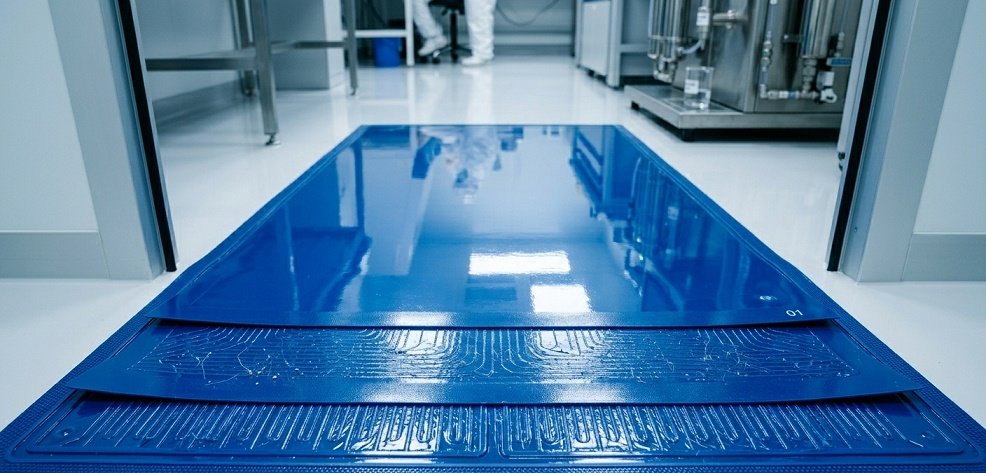
Most facility managers treat floor mats as a rounded-off expense in a supply budget. They view them as a “nice to have” accessory rather than a critical piece of industrial machinery. But that line of thinking is dangerously expensive.
If you don’t understand the math behind particle migration, you are essentially leaving your profit margins to chance.
Quantifying Yield Loss Prevention
In the world of electronics manufacturing, “small” does not exist. A 0.5 micron particle is a boulder when it lands on a semiconductor wafer. When these particles bypass your entry zones, they settle on sensitive components, causing “shorts” or “opens” that render the entire unit scrap.
How Dust Particles Destroy Semiconductors
The physics of 2026 micro circuitry means that traces are closer together than ever before. According to the International Roadmap for Devices and Systems IRDS, even a stray skin cell can bridge a gap and cause a catastrophic failure.
This isn’t just about “cleanliness”; it is about protecting the integrity of your product at the molecular level.
The Yield Math: 2026 Benchmarks
Let’s look at the numbers. If your facility processes 1,000 wafers a day and you have a 2 percent loss due to airborne or foot-borne contamination, you are losing 20 units daily. At a value of $500 per unit, that is $10,000 a day.
Implementing high quality mats that reduce that loss by even 0.5 percent pays for itself in less than 48 hours. You can find more on technical purity requirements at Purific.
The math is undeniable, yet most managers still ignore the invisible drain on their bottom line until it’s too late.
The Real Cost of Industrial Facility Maintenance
Every gram of dirt that walks into your facility has to be removed.
The question is…
Do you want to remove it from a controlled mat surface, or do you want to pay a specialized crew to scrub it off your sensitive cleanroom floors?
Labor vs. Effective Cleaning
Manual mopping in a cleanroom is a high cost activity. You aren’t just paying for water; you are paying for specialized chemicals, deionized water, and technicians who are trained to work in ISO 5 environments.
Data from the Institute of Environmental Sciences and Technology (IEST) suggests that it costs ten times more to remove dirt once it has spread throughout a facility than to catch it at the door.
Extending the Life of Your Flooring
Industrial floors are an asset. Constant scrubbing with harsh chemicals degrades the surface over time, leading to pitting and more particle traps. Cleanroom mats act as a sacrificial barrier. They take the beating so your expensive ESD flooring doesn’t have to.
You’re saving on chemicals and labor, but the real nightmare begins when you realize what the walking “static bombs” are doing to your hardware.
Integrating ESD Flooring with Decontamination Zones
Particle control is only half the battle. In modern electronics manufacturing, Electrostatic Discharge (ESD) is the silent killer.
If your matting isn’t integrated into your grounding plan, you are inviting disaster.
Static and Particle Control
An effective entryway system must be conductive or dissipative. When a worker steps onto the mat, the friction (tribocharging) can generate thousands of volts of static electricity.
If that worker then touches a sensitive component, the ROI of your cleanroom mats becomes a moot point because the product is already fried.
2026 Standards for ESD Control
The S20.20-2026 standard requires rigorous testing of floor systems. Your mats must maintain a resistance to ground within the 1.0 × 10^6 to 1.0 × 10^9 ohms range.
| Feature | Low-End Tacky Mat | High-Performance Polymeric Mat |
|---|---|---|
| Particle Retention Rate | 45% to 60% | 98% to 99% |
| ESD Integration | None | Full Dissipative Options |
| Lifecycle | 30 to 60 Layers | 3 to 5 Years (Washable) |
| Total Cost of Ownership | High (Constant Replacement) | Low (Long-term asset) |
If you want to know more about why your current setup might be failing, check out this guide on why your entryway is failing your lab.
This technical synergy between static and dirt is a masterclass in efficiency, but we haven’t even touched the specific dollar-for-dollar breakdown.
Achieving Particle Control ROI
Let’s get down to the brass tacks. To justify the expenditure to your CFO, you need to show the “cost per step.” This is the only way to see the true economic justification of your facility’s safety.
Breaking Down the Cost Per Step
A standard 30-layer tacky mat might seem cheap at $15 a pad. However, if you have 50 people entering five times a day, you are peeling those layers constantly. The labor to peel, the waste disposal of the plastic, and the downtime add up.
Contrast this with a high-performance polymeric mat. The initial investment is higher, but the maintenance is a quick wipe with a damp cloth. Over a three year period, the polymeric solution typically costs 40 percent less than the disposable equivalent.
Regulatory Compliance and Audits
Failing an FDA or ISO audit because of poor particle counts is a non-starter. The ROI here includes the “cost of not being shut down.” A single failed audit can cost hundreds of thousands in re-certification and lost production time.
You can cross-reference these purity standards with water quality benchmarks at Purific.
So, the question isn’t whether you can afford the best contamination control. The question is, can you afford the alternative?
Leave a Reply
You must be logged in to post a comment.